Homeowners are becoming increasingly aware of their impact on the environment. Traditional methods of lawn care now include new, more sustainable ways to care for a lawn. In a semi-arid climate like Denver, it’s critical to conserve resources and maintain a healthy lawn. Eco-friendly care includes minimizing the amount of water used, enhancing the health of the soil, and using grass varieties that naturally thrive in local conditions.
Eco-Friendly Lawn Care Denver Services are available to assist you with maintaining a beautiful lawn while minimizing the effects on our environment. By utilizing sustainable techniques such as using water-smart irrigation, choosing native grass, and practicing fertilization, Denver homeowners can preserve the health of local ecosystems and create lush outdoor spaces.
Importance of Eco-Friendly Lawn Care in Denver
The climate in Denver presents unique challenges to lawn maintenance. The combination of limited rainfall, high elevation, and extreme temperature fluctuations creates a need for efficient Water Use and Good Soil Health. Most traditional lawn care techniques rely heavily on the use of excessive amounts of water and chemical-based fertilizers, both of which put a strain on local Water Resources and degrade the Soil Biology.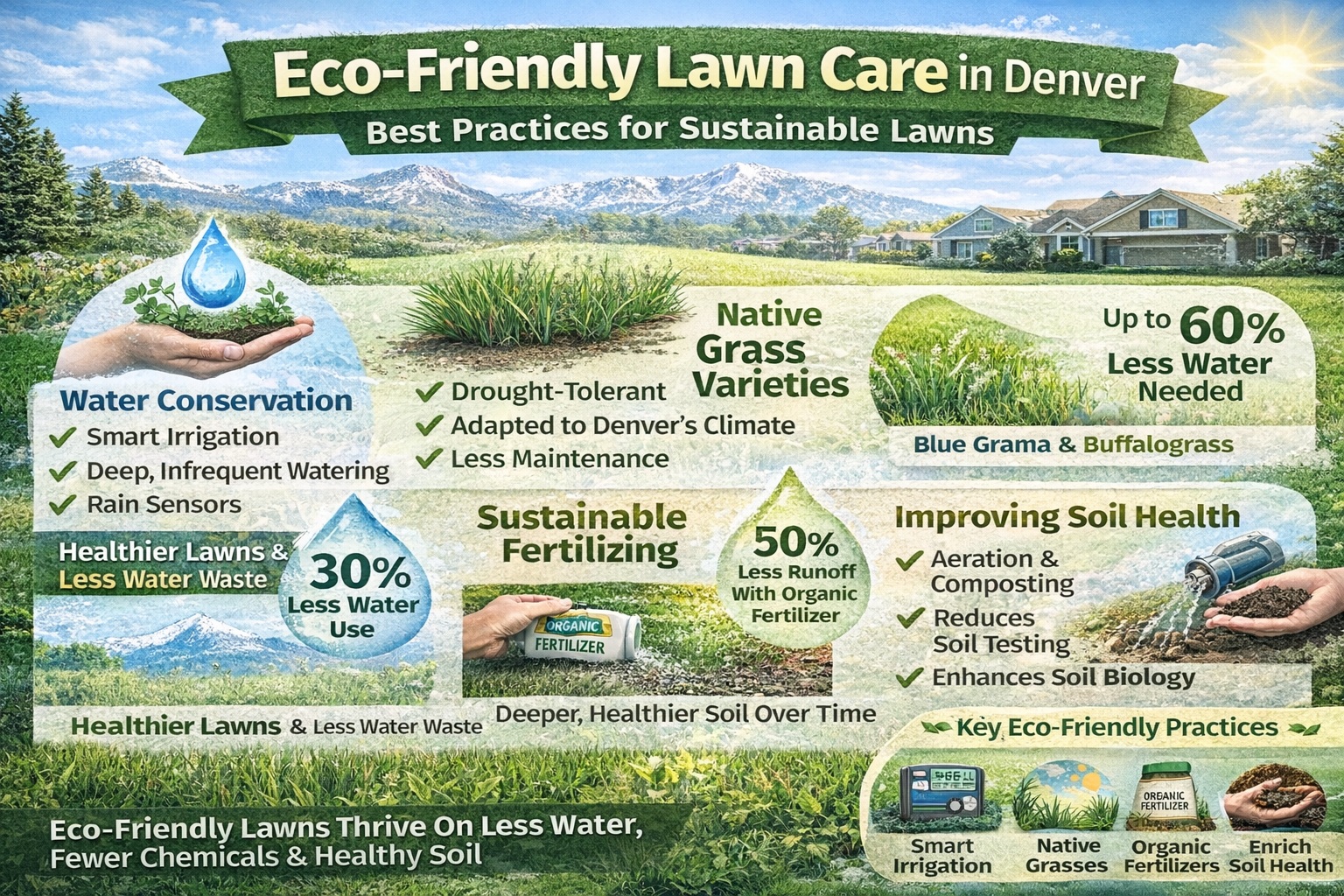
Sustainable Lawn Care Denver promotes working with nature to achieve results. Water-smart techniques reduce water runoff and save water, while promoting long-term lawn resilience and making them ideal for homeowners looking for an aesthetically pleasing and functional lawn.
Water Conservation: The Foundation of Sustainable Lawn Care
In Colorado, Water is one of the most valuable resources. Due to concerns with continued drought and the limitation of seasonal watering schedules, water conservation is no longer an option but rather the only means available to ensure continued healthy turf. Sustainable lawn care embraces water conservation techniques that have been accepted as the most efficient way to keep turf healthy while eliminating water waste.
Professional Lawn Care services provide their clients with irrigation plans tailored to local weather patterns, soil types, and the type of grass being grown.
Efficient Irrigation Practices
Watering at the earliest possible time of day is best because of reduced evaporation and increased moisture penetration within the soil. Watering deeply and infrequently will promote healthy root systems, making the turf more drought-resistant over a period of time.
Using smart controllers and rain sensors to adjust watering schedules based on real-time weather and soil conditions can save significant amounts of water by preventing overwatering.
Selecting Native / Climate Adapted Grasses
Native grasses are those species of grasses that have been growing in a given area before the introduction of exotic grass types. Native and properly adapted grasses require less water, are able to thrive using fewer fertilizers, and generally require less maintenance compared to traditional turf types.
Native and properly adapted grasses have deeper root systems, allowing them to survive longer dry periods and temperature fluctuations much better than traditional turf types.
Common examples of low water grasses used in Sustainable Lawn Care Denver are Buffalograss and Blue Grama. Buffalograss is one of the most recommended choices for use in Colorado's climate, as it is able to maintain a healthy appearance with significantly less water than a standard Bluegrass lawn.
Blended seed mixes contain two types of grasses (Buffalograss and Blue Grama), each providing durability and aesthetic appeal while helping to minimize environmental impacts.
Sustainably Fertilizing the Soil for Long-Term Soil Health
Traditional fertilizers are able to provide fast results; however, using chemical fertilizers over long periods can negatively impact soil health. The organic/slow-release fertilizer method allows for healthier lawns, requiring less input over time.
Organic / slow-release fertilizer naturally releases nutrients, allowing for less runoff and consistent growth. These products also improve soil structure, allowing for a naturally greater abundance of available nutrients through increased microbial activity within the soil.
Companies providing eco-friendly lawn care services in Denver select fertilizer blends according to the results of soil testing to ensure lawns get only what they need, no more than that.
How to Improve Soil Health Naturally
Soil Testing/Analysis
Healthy soil is the foundation of Sustainable Lawn Care. Soil testing allows for the identification of nutrient imbalance, pH issues, and compaction issues that impact the performance of a lawn.
With proper information derived from soil testing, lawn care specialists will be able to develop a custom treatment plan for a lawn that improves the condition of the soil without adding any additional chemical fertilizers.
Aeration / Soil Amendments
Core aeration is used to alleviate soil compaction as well as to improve water absorption, air movement, and root growth. Core aeration, combined with compost and/or other organic amendments, can also enhance the soil's fertility through natural means.
This process is an integral part of Sustainable Lawn Care Denver, enabling lawns to remain healthy and resilient year after year.
Mowing Practices to Support Eco-Friendly Lawns
Mowing the grass too closely to the ground places undue stress on the turf and increases its need for water. By maintaining the correct height of the grass with mower blades, the soil will be shaded, evaporation will be reduced, and the grass will grow deeper roots in the process, producing a much healthier and stronger root system.
In addition to providing soil shade, a higher mowing height promotes improved photosynthesis in longer blades of grass, translating into greater overall lawn health and requiring fewer inputs.
Benefits of Grasscycling
Grasscycling refers to the practice of leaving grass clippings on the lawn. Grasscycling returns nutrients to the soil naturally. Soil remains enriched with organic matter, lessening the need for additional fertilizers.
Grasscycling is a simple, eco-friendly practice that Lawn Care Experts in Denver endorse through their services.
Integrated Pest and Weed Management
Eco-Friendly Lawn Care practices involve lower pesticide and herbicide usage since they stress prevention over reaction. Healthy turf and soil resist pests and weeds.
When reactive measures are required, it is preferred to use targeted treatments rather than extensive applications of chemicals.
Encouragement of Natural Resistance
A holistic approach to disease and pest resistance of grass plants involves establishing stronger, more vigorous plants with better resistance qualities through appropriate watering, fertilization, and mowing practices.
Seasonal Care for Sustainable Lawns
Due to rapidly changing seasons in Denver, flexibility must remain a continuing focus in Sustainable Lawn Care so practices can adapt to seasonal weather conditions.
The ability to adjust schedules for watering, fertilization, and maintenance is invaluable for maintaining healthy lawns while also conserving resources.
Winter Preparation for Lawns
During fall, Eco-Friendly Lawn Care practices emphasize strengthening roots and improving soil health rather than encouraging excessive growth to prepare the lawn for dormancy and promote recovery and growth during spring.
Common Misconceptions of Eco-Friendly Lawn Care
The lawn looks less attractive / more effort to maintain.
The perception that eco-friendly lawns do not look as good as traditional lawns or require more effort to maintain is not true. Sustainable lawns maintain both durability and aesthetics better than traditional lawns over time.
Professional services provided by Lawn Care Denver ensure that environmentally friendly practices still result in lush, green, healthy lawns.
Frequently Asked Questions About Eco-Friendly Lawn Care
Will I use less water with eco-friendly lawn care?
Yes. By utilizing Water-Efficient Practices and Native Grasses, total Water Usage will be significantly less than with traditional methods.
Are Native Grasses Adaptable to Residential Lawns?
Native Grasses are an ideal choice in the Denver climate, as there is little to no difference in use or drought tolerance compared to non-native grasses.
Will I get the same results with eco-friendly fertilizing as with traditional fertilizing?
Yes. Sustainable fertilizers provide steady growth and promote long-term health without excessive chemical usage.
Is eco-friendly lawn care more costly?
In some instances, eco-friendly lawn care saves money by lowering Water, Fertilizer, and Lawn Repair costs.
How quickly can I see results from my eco-friendly lawn care?
There will be immediate improvements; however, the most significant results come from strengthening soil health and grass root systems over time.
Conclusion
The movement toward Eco-Friendly Lawn Care is more than a trend; it is a practical and productive method to create sustainable, healthy Landscapes within the challenging Climate of Denver. Through the application of Water Conservation, the Use of Native Grasses, and Sustainable Fertilization, homeowners can reduce environmental impact while achieving Strong and Vibrant Lawns.
Heroes Lawn Care is a premier provider of eco-friendly lawn care services throughout the Denver area. Our company specializes in sustainable lawn care solutions unique to the Colorado area. We focus on water-smart irrigation, soil health, responsible fertilization, and environmentally friendly maintenance practices for homeowners throughout the Denver Metro Area and surrounding areas.