
The Cedar Park, TX Landscaping Move That Makes Watering Days Irrelevant | by Heroes Lawn Care of Cedar Park
Cedar Park's outdoor watering schedule shapes a lot of homeowners' weekly routines: which days the sprinklers can run, what time of day irrigation is allowed, how the whole system gets planned around an address ending in an odd or even number. For most yards, that schedule is simply a fact of life to work around. For a smaller number of properties, it barely matters at all, because there's very little turf left that actually needs watering on any particular day.
This isn't a hypothetical scenario or a distant aspiration. It's an approach already visible across a growing number of Cedar Park, TX neighborhoods, where a side-by-side comparison between a traditional turf lawn and a reduced-footprint xeriscape property makes the practical difference immediately obvious, particularly during the driest stretches of a Central Texas summer.
That difference isn't luck. It's a specific landscaping approach that Cedar Park, TX homeowners are increasingly adopting, one that doesn't fight the city's water restrictions so much as sidestep most of what makes them relevant in the first place.
Heroes Lawn Care of Cedar Park sees this pattern clearly across the properties it works with: households that invested in reducing their turf footprint years ago now barely register when the city shifts between watering stages, while neighbors with traditional all-grass lawns feel every restriction directly.
The Landscaping Move That Actually Changes the Watering-Day Equation
The watering schedule imposed under the city's drought contingency plan primarily governs turf irrigation, since traditional grass lawns are by far the largest consumer of outdoor water on a typical residential property.
Understanding Cedar Park's Stage-Based Watering Framework
Cedar Park's drought contingency plan moves between stages depending on regional lake levels, with each stage tightening outdoor watering rules further. A homeowner's actual restrictions at any given time depend on which stage is currently active, which shifts periodically based on conditions at Lake Travis and Lake Buchanan, so checking the city's current status directly remains the most reliable way to know exactly what's permitted at any specific moment.
This stage-based structure means the specific rules a homeowner needs to follow can change more than once within a single year, tightening during dry stretches and easing somewhat after significant rainfall replenishes the region's water supply. A yard designed around heavy dependence on frequent watering has to adapt every time that structure shifts. A yard designed around minimal water dependence in the first place barely notices the change either way.
This adaptability advantage compounds over time in a way that's easy to underestimate at the outset. A homeowner who converted their yard years before a particularly severe drought stage took effect enters that stricter period already prepared, while neighbors scrambling to adjust a traditional turf lawn to sudden new restrictions face a much steeper, more stressful adjustment during exactly the season when their landscaping is under the most visible strain.
Stage 2 Water Ordinance Landscape Compliance: What the Rules Actually Require
Stage 2 water ordinance landscape compliance under Cedar Park's framework has historically centered on a twice-weekly watering schedule tied to address parity, along with time-of-day restrictions limiting irrigation to before 10 a.m. or after 7 p.m. on designated days. New landscape installations typically qualify for a limited establishment variance, allowing more frequent watering for a short window immediately after installation before the standard schedule applies. Understanding these specific mechanics matters less, though, for a property that simply doesn't have much turf left to water in the first place.
Homeowners navigating these rules for the first time sometimes assume compliance means accepting a stressed, patchy lawn as an unavoidable tradeoff. That assumption holds true for a property still relying primarily on traditional turf, but it doesn't apply nearly as directly to a property where turf has already been meaningfully reduced, since the areas most vulnerable to watering restrictions are no longer the dominant feature of the landscape.
Reframing the goal this way, reducing dependence rather than simply enduring restriction, changes how a homeowner approaches the entire planning conversation. Instead of asking how to keep a traditional lawn alive under tightening rules, the more useful question becomes how much of that traditional lawn actually needs to exist in the first place, given how much less vulnerable the alternative approach turns out to be.
Why Turf Reduction Is the Real Lever, Not Just Watering Less Often
The homeowners least affected by watering-day restrictions aren't the ones who've become especially disciplined about their sprinkler timers. They're the ones who've reduced how much thirsty turf their property actually contains.
Water-Wise Lawn Footprint Reduction Explained
Water-wise lawn footprint reduction means deliberately shrinking the area of traditional grass turf on a property, replacing sections with hardscape, native plantings, or a combination of both. A property that's reduced its turf footprint by half or more has correspondingly reduced how much of the yard actually depends on hitting a specific watering day, since the areas converted to hardscape or drought-tolerant planting require little to no supplemental irrigation once established.
This reduction doesn't need to happen all at once. Many homeowners approach turf reduction in phases, converting the sections of a property that see the least foot traffic or hold the least sentimental value first, then expanding the conversion over subsequent seasons as the initial changes prove successful and comfortable. This phased approach also spreads the planning and installation work across a more manageable timeline than attempting a full-property conversion in a single project.
A phased approach also gives a household time to genuinely evaluate how each converted section actually functions before committing to further changes elsewhere on the property. A side yard converted to decomposed granite and native planting in the first phase provides real, lived experience that informs decisions about which other areas make the most sense to convert next, rather than committing to an entire property redesign based purely on renderings and assumptions about how the finished space will actually feel.
Low-Maintenance Grass Turf Replacement Options
Low-maintenance grass turf replacement doesn't necessarily mean eliminating lawn entirely. Many homeowners retain a modest turf area for practical use, entertaining, pets, children, while converting the remaining footprint, side yards, strips along fence lines, areas that rarely see foot traffic, into xeriscape or hardscape zones that no longer factor into the watering-day equation at all.
This selective approach tends to produce results that feel more intentional than an all-or-nothing conversion. A property that retains a well-defined, appropriately sized turf area for active use, while converting everything else, reads as a deliberate design choice rather than either an unchanged traditional lawn or a stark, fully xeriscaped property with no green grass at all. Most homeowners land somewhere in this middle ground once they see how the specific tradeoffs play out on their own property.
Building the Hardscape Side of a Xeriscape Yard
Reduced turf footprint has to be replaced with something, and the hardscape elements chosen for that replacement do much of the visual and functional work in a successful xeriscape design.
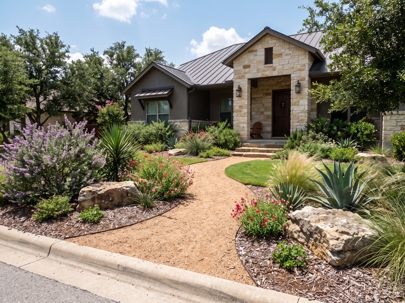
Decomposed Granite and River Rock Pathways
Decomposed granite and river rock pathways offer a natural, low-maintenance surface that requires no irrigation whatsoever, while still providing a defined, walkable connection between different areas of a property. These materials also drain well, an advantage during Central Texas's occasional heavy rain events, and they complement the native plant palette typically used alongside them far more naturally than a poured concrete path would.
The color and texture variation available within decomposed granite and river rock also gives a xeriscape design more visual interest than a single uniform gravel surface would provide. Blending different rock sizes, or transitioning between decomposed granite in a primary path and larger river rock in drainage-adjacent zones, produces a layered, intentional look rather than a flat, monotonous expanse that can sometimes give xeriscaping an undeserved reputation for feeling stark or unfinished.
Edging details matter here as well, whether that's a simple steel border keeping decomposed granite contained along a planting bed's edge, or a more decorative limestone edge that echoes the boulder placement elsewhere in the design. Thoughtful edging prevents loose material from migrating into adjacent turf or planting areas over time, while also reinforcing the sense that each material transition in the design was planned deliberately rather than simply poured in without much consideration for where one surface ends and another begins.
Austin Limestone Boulder Hardscaping as a Design Anchor
Austin limestone boulder hardscaping provides a strong visual anchor for a xeriscape design, breaking up what might otherwise read as a flat expanse of granite or rock with genuine dimension and texture. Strategically placed boulders also create microclimates within a planting bed, offering partial shade or wind protection that can help nearby drought-tolerant plants establish more successfully during their first challenging summer in the ground.
Limestone specifically ties a xeriscape design back to the broader Central Texas landscape in a way an imported material wouldn't, since the same stone appears naturally throughout much of the region's exposed terrain. This regional material connection gives a xeriscape yard a sense of belonging to its surroundings, rather than looking like an imported desert aesthetic transplanted awkwardly into a Central Texas neighborhood.
The Plant and Irrigation Side That Makes It Work
Hardscape alone doesn't make a xeriscape design feel complete. The plant selection and remaining irrigation infrastructure are what keep the space feeling genuinely alive rather than simply barren.
Native Texas Drought-Tolerant Plant Selection
Native Texas drought-tolerant plant selection focuses on species that evolved specifically to handle Central Texas's combination of intense heat, unpredictable rainfall, and expansive clay soil, requiring minimal supplemental water once their root systems are established. Low-water xeriscape landscape design built around these species can still offer significant seasonal color and textural variety, countering the common assumption that water-wise landscaping automatically means a sparse, all-gravel yard.
Flowering perennials, ornamental grasses, and structural shrubs native to the region can provide the same kind of layered visual interest homeowners associate with a traditional garden bed, just built around species that have spent generations adapting to exactly the conditions a Cedar Park, TX yard actually experiences. The result tends to surprise homeowners who assumed xeriscaping meant sacrificing color and texture in exchange for water savings.
Subsurface Drip Irrigation System Upgrades and Moisture-Retaining Organic Mulch Bedding
Subsurface drip irrigation system upgrades deliver water directly to plant root zones rather than spraying it across the surface, dramatically reducing evaporation loss compared to traditional overhead sprinklers. Moisture-retaining organic mulch bedding applied around remaining plantings further reduces water needs, insulating soil from surface evaporation and helping regulate soil temperature during Central Texas's most intense summer stretches. Texas heat-hardy hardscape installation, paired with this kind of targeted, efficient irrigation, produces a yard that needs meaningfully less water overall, regardless of which watering stage happens to be in effect at any given time.
Subsurface drip systems also tend to comply comfortably with time-of-day watering restrictions, since their efficient, targeted delivery means less total watering time is needed to achieve the same root-zone saturation an overhead sprinkler would require. A yard relying on this kind of irrigation infrastructure has considerably more flexibility working within whatever restricted watering windows happen to be in effect during a given drought stage.
Planning a Xeriscape Conversion in Cedar Park, TX
Converting an existing turf-heavy yard into a reduced-footprint xeriscape design is a planning process, not a single weekend project, and understanding the practical mechanics helps set realistic expectations from the start.
The 21-Day Establishment Variance and Other Practical Details
Homeowners planning a significant landscape conversion in Cedar Park, TX can typically request an establishment variance allowing more frequent watering during the initial weeks after installation, which matters considerably for helping new native plantings and any remaining turf sections take root successfully before transitioning to the standard watering schedule. Heroes Lawn Care of Cedar Park helps homeowners navigate this variance process directly, ensuring new xeriscape installations get the establishment period they genuinely need rather than being forced onto standard restrictions before plants have had a fair chance to root.
This establishment period is a detail many homeowners aren't aware exists until they've already begun a conversion project and started wondering how newly installed native plants are supposed to survive under the same watering restrictions applied to mature, already-established landscaping. Confirming variance eligibility before installation begins avoids this confusion entirely, ensuring the timeline for watering access is understood clearly from the very start of the project.
Heroes Lawn Care of Cedar Park designs xeriscape conversions around a property's specific sun exposure, existing drainage patterns, and how much turf a household actually wants to retain for practical use, rather than applying a single generic xeriscape template regardless of individual property conditions. Water-wise lawn footprint reduction planned this way produces a yard that still feels genuinely usable and visually appealing, not simply a minimal, low-effort response to watering restrictions.
Sun exposure in particular shapes which native species will actually thrive in a given planting bed, since a sun-loving species positioned in a shaded corner will struggle regardless of how well-suited it is to Central Texas conditions in general. Mapping actual light conditions across a property before finalizing plant selection is a detail that separates a xeriscape design built to genuinely succeed from one that simply follows a generic plant list without regard for the specific microclimates present on that particular lot.
Stage 2 water ordinance landscape compliance becomes almost a non-issue for a property built this way, since a yard with a significantly reduced turf footprint, efficient subsurface drip irrigation, and drought-tolerant plantings simply doesn't depend heavily on hitting a specific watering day to stay healthy. Texas heat-hardy hardscape installation combined with native planting means the yard continues looking intentional and well-maintained through summer heat waves and watering restrictions alike, rather than showing the stress that a traditional all-turf lawn often displays under the same conditions.
Conclusion
The Cedar Park, TX properties that seem unaffected by watering-day restrictions haven't found a loophole in the city's drought contingency plan. They've simply reduced how much of their yard actually depends on frequent irrigation in the first place, replacing thirsty turf with decomposed granite pathways, limestone boulder hardscaping, and native drought-tolerant plantings that need only a fraction of the water a traditional lawn requires.
This shift also positions a property more comfortably for whatever happens with future drought stages, since a yard already built around minimal water dependence doesn't face the same scramble to adapt each time regional conditions tighten restrictions further. Rather than reacting to each new stage as it arrives, a xeriscape-oriented property has effectively already adapted to the strictest reasonable scenario well in advance.
Heroes Lawn Care of Cedar Park designs landscaping conversions around this exact principle for Cedar Park, TX properties, reducing turf footprint deliberately rather than simply hoping lower water use follows naturally. Building a yard that barely notices which watering day it is remains the most reliable way to stay both genuinely water-wise and visually appealing, regardless of which drought stage the city happens to be operating under at any given time.