
Cedar Park, TX Landscaping Has a Calendar, and October Is Where It Starts | Heroes Lawn Care of Cedar Park
Most yards in Cedar Park, TX do not fail because of a bad plant or a bad design. They fail because the right work happened in the wrong order, or in the wrong month. Landscaping in Central Texas runs on a calendar that has very little in common with the one printed on the kitchen wall. The soil, the heat, the rain, and the roots all keep their own schedule, and October is the month when that schedule finally turns in a homeowner's favor.
After a summer of triple-digit afternoons, October brings cooler air while the ground is still warm. That combination is the whole secret of the Central Texas planting window. Roots keep growing in warm soil even when the leaves above are no longer under heat stress, which means anything planted now has months of quiet establishment before the next summer arrives. Heroes Lawn Care of Cedar Park builds its seasonal approach around that window, and the sequence below follows the same order of operations a crew follows on a real property: water first, structure second, permanent plants third, turf fourth, color fifth, mulch sixth, and light last.
Why October Is the Starting Line in Cedar Park, TX
Warm Soil, Cool Air, and the Root Advantage
A plant has two jobs in its first season: grow roots and survive. Spring planting asks it to do both while temperatures climb toward summer, so the plant spends its first months under mounting stress. Fall planting reverses the equation. Air temperatures drop, evaporation slows, and the soil still holds enough warmth to keep roots moving outward. By the time March arrives, a fall-planted shrub or perennial already has a working root system rather than a root ball sitting in a hole.
Central Texas adds its own complications. The clay beneath most Cedar Park neighborhoods swells when wet and cracks when dry, and in the western part of town the Hill Country limestone sits close to the surface. Roots that get an unhurried fall and winter to explore that soil tend to anchor deeper, which matters when the next July arrives.
Why Order Matters More Than Any Single Project
A homeowner can hire excellent work and still end up with a frustrating yard if the pieces arrive out of sequence. Mulch laid before a drainage correction gets washed into the street. Sod installed before the beds are shaped gets trampled by the crew that follows. Flowers planted before irrigation adjustments get watered by a system that was designed for last year's layout. The calendar and the sequence are really the same idea: each step prepares the ground for the next one.
Step One: Read the Water Before Anything Goes In the Ground
Every landscape in Cedar Park, TX answers to one question before any plant is chosen: where does the water go? Heavy rain events in Central Texas deliver a great deal of water in a short time, and clay soil cannot absorb it quickly. October is a good moment to deal with drainage because the dry stretch of early fall lets a crew see the ground as it actually is, and because corrections made now are settled before the wetter weeks of spring.
Natural Dry Creek Bed Drainage Swale Construction
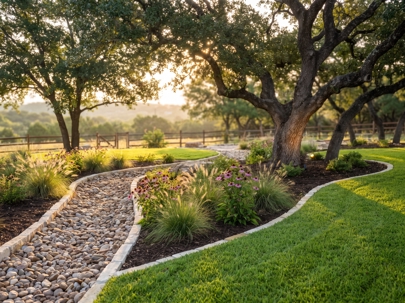
A dry creek bed is one of the oldest answers to a runoff problem, and in the Hill Country it also looks like it belongs there. Natural dry creek bed drainage swale construction starts with a shallow, gently sloped channel that follows the path water already wants to take. The channel is lined with graded stone, large at the edges and smaller in the center, so that flow slows down rather than scouring the soil. In dry weather the feature reads as a landscape accent. During a storm it carries water past the foundation, the patio, and the planting beds toward a safer discharge point.
A well-built swale is shaped, not simply dug. The grade needs to be steady enough to keep water moving and gentle enough to keep it from gathering speed. Planting along the banks with deep-rooted grasses and perennials holds the edges together, which is one more reason fall is the right time to build one: the plants that stabilize the banks can establish before the wettest part of the year.
Subsurface Catch Basin Landscape Drainage Solution
Some properties do not have the room or the slope for an open channel. A narrow side yard, a low corner beside a retaining wall, or a patio that sheds water toward the house all call for a different tool. A subsurface catch basin landscape drainage solution collects water at the low point through a grated inlet, then carries it away through buried pipe to a place where it can safely leave the property. Because most of the system sits underground, the surface can stay planted, paved, or covered in stone.
The two approaches are not rivals. A swale suits open space and gives the yard a visible feature, while a catch basin suits tight areas where a visible channel would get in the way. Many Cedar Park lots end up using both: a swale across the open back slope and a catch basin at the corner where downspouts and patio runoff meet. Settling that question early means every later step in the calendar is built on ground that drains.
Step Two: Rebuild the Bones of the Bed
Once water has a plan, the next job is defining the structure of the yard. Edges, stone, and bed lines are the permanent elements that decide how everything else will look and how well it will hold up.
Custom Mortared Limestone Flower Bed Curbing
Plastic edging and loose stone borders are common in newer neighborhoods, and they tend to shift, heave, and drift out of line as clay soil moves. Custom mortared limestone flower bed curbing solves that problem with a solid, set edge that does not move. Cut or stacked limestone is mortared into a continuous curb, which holds soil and mulch in place, keeps turf from creeping into the beds, and gives the property a finished line that reads as intentional from the street.
The material also fits the region. Limestone is the native stone of the Hill Country, so a curb built from it picks up the tones of the surrounding landscape instead of fighting them. Building curbing in October makes sense because the mortar cures in mild temperatures, and the beds are ready for planting while the weather is still favorable.
Quarry Limestone Rock Garden and Boulder Placement
A rock garden is more than a pile of stone with a few plants tucked between the pieces. A quarry limestone rock garden and boulder placement plan treats each stone as a structural decision. Larger boulders are partially buried so they look like part of the ground rather than something set on top of it. Smaller stone fills the transition between the boulder and the bed. Placement also solves practical problems: a boulder can mark the end of a swale, break up a long slope, or give a low planting area a backbone.
Stone is also one of the few elements in a landscape that never needs replacing from season to season. Setting it during the fall planting window gives the soil time to settle around each piece before spring rains arrive, so the placement stays where it was set.
Step Three: Plant the Permanent Layer
With drainage handled and the structure set, the planting begins. The first plants into the ground should be the ones that will stay for years.
Drought-Tolerant Texas Native Perennial Garden Planting
Drought-tolerant Texas native perennial garden planting is the backbone of a landscape that stays attractive through the heat of August. Native perennials such as salvias, coneflower, Gregg's mistflower, and native grasses are adapted to the same swings in rain and temperature that overwhelm many imported plants. They spend their first fall and winter building the root systems that carry them through the next summer, and once established they ask for far less supplemental water than a bed of typical nursery annuals.
Fall planting is especially well matched to this group. The cooler weather reduces transplant shock, the moderate rains of autumn and winter help roots settle, and the plants wake up in spring with a head start. A garden planted in October looks sparse for a few months, and then fills in by the following summer with growth that would not have been possible if planting had waited until spring.
Texas Hill Country Xeriscape Landscape Design
The planting itself works best when it follows a plan. Texas Hill Country xeriscape landscape design organizes a yard into zones: plants with similar water needs are grouped together, high-use turf areas are kept to a sensible size, and the rest of the property is given over to native planting, stone, and mulch. The approach is not a bare gravel yard. A well-designed xeriscape has layers of height, texture, and seasonal interest, with the structure of the stone and curbing providing definition through the winter months.
Cedar Park, TX also operates under a staged drought contingency plan, and new plantings have received a window of establishment time under those rules. A xeriscape plan that matches plants to water zones makes that period easier to manage, because the beds are designed around the amount of water the property will realistically receive.
Step Four: Sod Timing for Zoysia and Bermuda
Turf is where the calendar matters most, and where many homeowners guess wrong. Warm-season grasses such as Zoysia and Bermuda grow actively in the heat and then go dormant in winter, which means the timing of installation matters differently than it does for a shrub.
Zoysia and Bermuda Sod Delivery and Installation
Zoysia and Bermuda sod delivery and installation works best when the turf has time to knit into the soil before cold weather arrives. Early October still offers enough warmth for the sod to begin rooting, and that is why the first weeks of the month are the last comfortable stretch for new turf before the cool-down. Installation after that point is still possible, but the grass will not green or spread until spring, so the roots are doing their work quietly beneath a brown surface.
Preparation decides the result. The soil is graded so water drains away from the house, loosened where compaction has set in, and smoothed so that each piece of sod sits in firm contact with the ground. Sod is laid in staggered rows, rolled to remove air pockets, and watered right away. Fresh sod delivered and placed on the same day does much better than sod that sits on a pallet, which is why a coordinated crew and delivery schedule matter as much as the grass variety.
Choosing Between the Two Grasses
Bermuda is the more heat-loving and fast-recovering of the two. It thrives in full sun, spreads aggressively, and rebounds quickly from heavy use. Zoysia is denser and softer underfoot, tolerates some shade better than Bermuda, and grows more slowly. Neither grass does well in deep shade, so the shape of the yard, the position of mature trees, and the way the family uses the space all feed into the decision.
What About Winter Color on Dormant Turf?
Because both grasses fade to a straw color after the first frosts, some homeowners choose to overseed established turf with ryegrass for a green winter lawn. The practice suits established Bermuda or Zoysia lawns rather than fresh sod, and it comes with a transition in spring when the ryegrass fades and the warm-season grass wakes up. A lawn care service can help decide whether that trade-off suits the property, since the right answer depends on how much green the household wants in winter and how the spring transition will be handled.
Step Five: Seasonal Color Rotation Annual Flower Bed Planting
If native perennials are the backbone of the yard, annuals are the punctuation. Seasonal color rotation annual flower bed planting brings movement and brightness into the beds at the points where the permanent plants are quiet.
The October and November Cool-Season Set
Cool-season color goes in during October and November, once the nights begin to cool. Pansies, violas, dianthus, snapdragons, and ornamental kale all handle Central Texas winters well, and they bloom through the cooler months when little else in the yard is flowering. These plants prefer enriched, well-drained beds, so the soil is amended before planting and the bed is shaped so water does not collect around the roots. Placing color near entries, along walkways, and beside the limestone curbing puts the brightest part of the landscape where visitors and homeowners see it most.
The Spring and Summer Handoff
A true rotation means the beds are never left to sit empty or tired. As temperatures warm in spring, the cool-season annuals are removed while they still look good, and the beds are refreshed and replanted with heat-tolerant options such as vinca, lantana, zinnia, and angelonia. That handoff keeps the beds productive through the summer instead of letting them fade into bare soil. Planning the rotation from the start also helps the permanent plants, since the annual plantings are placed in the gaps between them rather than competing for the same space.
Step Six: Mulch After the Planting Is Done
Mulch goes in last among the bed tasks, and for a good reason. It sits on top of everything else, and any digging that happens after it is applied pulls it out of place.
Hardwood Double-Shredded Mulch Bed Application
Hardwood double-shredded mulch bed application gives beds a layer that knits together rather than blowing or floating away. The double-shredded texture interlocks, so it stays in place on slopes and through heavy rain far better than coarse chunks. It also breaks down slowly and feeds the soil as it decomposes, which matters in the thin, mineral-heavy ground found across much of Cedar Park, TX.
A layer of about two to three inches is the usual target. It insulates roots against the first hard freezes, slows evaporation, and suppresses weeds that would otherwise move into freshly planted beds. The mulch is kept a few inches away from tree trunks and the stems of shrubs, since a pile against the bark traps moisture and invites rot. October is a natural time for the application because the beds are freshly planted, and the mulch will protect them through the winter.
Step Seven: Light the Result
Landscape lighting is the last item in the sequence because it highlights everything that came before. Installing it earlier risks having fixtures moved or buried as other work proceeds.
Low-Voltage Architectural LED Landscape Lighting System
A low-voltage architectural LED landscape lighting system uses small, efficient fixtures powered through a transformer, which keeps the wiring safe and the installation flexible. Fixtures are placed with intent: uplights that wash light up a limestone wall or a mature oak, path lights that guide guests along the walkway, and downlights tucked into trees to create a soft moonlit effect across the lawn.
Shorter days arrive in October, and evenings outside become more pleasant as the heat breaks. Lighting turns the yard from a space that is used only until sunset into a space that is enjoyed after dark, and the stone, curbing, and plantings added earlier in the sequence become the features that the lights reveal. Because the system is low voltage, fixtures can be adjusted as the plants grow, which keeps the layout looking right year after year.
The Rest of the Cedar Park, TX Calendar
October starts the sequence, but the calendar continues all year. A yard that has been planted in the right order has different needs in each season.
Winter: Rest, Observe, and Adjust
Winter in Central Texas is mild enough that the landscape never stops entirely. Warm-season turf is dormant, so traffic should be kept light, and fresh sod needs a little attention during dry spells. Native perennials die back to the ground or slow their growth, and the stone, curbing, and evergreen structure carry the visual weight. Winter is also the best moment to watch how the yard handles rain. A swale or catch basin that works well in a winter storm is likely to work in a spring storm too, and any problem spots become obvious while there is still time to correct them.
Spring: Wake-Up and Handoff
Spring brings the biggest burst of activity. Turf wakes up as soil temperatures rise, perennials push new growth, and the cool-season annuals are replaced with warm-season color. Mulch beds are checked and topped off where needed. The irrigation system is tested and adjusted for the new plantings, so each zone delivers the right amount of water as the weather warms.
Summer: Let the Fall Work Pay Off
By the time summer arrives, the work done in October pays off. Established natives, deeper roots, and a thick layer of mulch let the landscape handle the heat with far less intervention than a yard planted in spring. The summer calendar is about protection rather than building: watering on the schedule the city allows, watching for stress, and resisting the urge to start major projects in the hottest weeks.
Late Summer: Plan the Next October
The last stretch of summer is the time to plan. Walking the property in August, noting what struggled and what thrived, and marking the areas that need drainage corrections, new beds, or turf replacement gives the next fall its to-do list. Starting the conversation with a landscaper in Cedar Park, TX before the planting window opens means the crew schedule and the material orders line up with the moment the ground is ready.
Choosing a Landscaper in Cedar Park, TX Who Works by the Calendar
Not every provider treats the calendar as a design tool. The questions below help sort out who understands how Central Texas actually works.
Questions Worth Asking
A good landscaper can explain the order of operations for a specific property and give reasons for each step. Useful questions include how drainage will be addressed before planting begins, how plants are chosen for the local soil and water conditions, what the plan is for each season after installation, and how irrigation will be adjusted for new plantings. Answers that mention the soil, the slope, and the timing show familiarity with local conditions. Answers that skip straight to plants and products often point to a template approach.
Integrated Work Matters
The sequence in this article includes drainage, stone, planting, turf, color, mulch, and lighting. Hiring separate providers for each piece can create gaps, because nobody owns the order of operations. A single team that handles the full sequence can coordinate delivery of sod with the finish of grading, schedule mulch after planting, and install lighting once everything has settled. Many landscapers in Cedar Park handle a few of these tasks, but few coordinate all of them under one plan, which is why Heroes Lawn Care of Cedar Park sequences drainage, hardscape, planting, and turf as one schedule rather than separate jobs.
Maintenance Continues the Plan
A landscape installed in October still needs follow-through. A lawn care service that understands the installation can adjust watering, feeding, and seasonal cleanup to match the plan instead of working against it. The same applies to bed maintenance, annual rotations, and irrigation checks. When Heroes Lawn Care of Cedar Park handles both the installation and the seasonal care that follows, the same team that built the beds knows how each one is meant to develop. Continuity between the installation crew and the ongoing care keeps the yard developing in the direction the design intended.
Putting the Calendar to Work
The pattern behind a great yard in Cedar Park, TX is easy to describe and harder to follow: understand the water, build the structure, plant the permanent layer, install the turf at the right moment, rotate the color, finish with mulch, and add light. Each step sets up the next one, and October is the month when the conditions line up to make the whole sequence work.
For homeowners who want that sequence handled as a single plan, Heroes Lawn Care of Cedar Park designs and builds seasonal landscaping for properties across Cedar Park, TX, from drainage and stone work to native planting, sod, color rotation, mulch, and lighting. Starting the conversation now means the ground is prepared while the planting window is open, and a yard that follows the calendar does not need to be rescued later.