
Where Does the Rain Go? Permeable Pavers Patio Installation in Georgetown, TX and the Upkeep Nobody Mentions | Heroes Lawn Care of Cedar Park
A patio is usually judged on a sunny afternoon, when the pattern is crisp, the color is even, and the surface is dry. The better test happens on a stormy one. When two inches of rain fall in an hour, where does the water go? On a conventional hard surface it runs across the patio, collects at the lowest edge, and heads toward the house, the lawn, or the neighbor's fence. On a permeable surface it drops through the joints, passes into a stone reservoir, and soaks away or drains slowly instead of racing off. That difference is why pavers patio installation in Georgetown, TX increasingly begins with a drainage question rather than a color sample.
Permeable systems come with a second conversation that rarely makes it into the brochure: how they are kept. A permeable patio is not a different kind of patio so much as a different kind of system, and systems have habits. Heroes Lawn Care of Cedar Park builds patios with the full life of the surface in mind, which means explaining the base, the stone, the edges, and the upkeep at the start rather than after the first white film appears on the surface.
Why Georgetown, TX Makes Drainage the Main Event
Two Soils, One City
Georgetown, TX straddles two very different pieces of ground. On the east side, the soil is dark, sticky clay that swells when wet and shrinks when dry. On the west side, the ground turns shallow and rocky, with limestone sitting close to the surface and sometimes breaking through the topsoil entirely. Both conditions affect how water behaves on a patio, but in opposite ways. Clay holds water and releases it slowly, so a base built on it can stay saturated. Limestone drains in fits and starts, sending water through fissures and along the rock surface rather than evenly through the soil.
A good installation reads the ground before choosing a system, because the same patio drawing can need very different construction depending on which side of town it sits on.
Heavy Rain in Short Bursts
Central Texas rain does not arrive gently. Long dry stretches are interrupted by intense storms that deliver a season's worth of water in an afternoon. A surface that cannot handle sudden volume sends runoff somewhere, and where it goes becomes a problem for the foundation, the planting beds, and the yard beyond. Permeable construction addresses that burst directly by giving the water a place to go during the storm and a path out afterward.
What Permeable Pavers Actually Do
Permeable Interlocking Concrete Pavers (PICP) for Stormwater Runoff
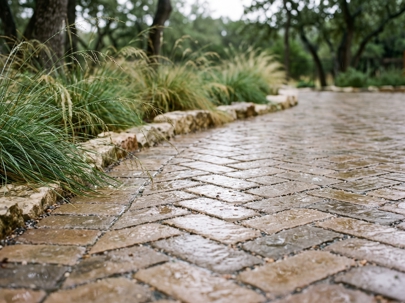
Permeable interlocking concrete pavers (PICP) for stormwater runoff look much like ordinary pavers from a few feet away. The difference is in the details. The units are shaped or spaced to leave open joints between them, and those joints are filled with small, clean, angular stone rather than sand. Water enters the joints, passes through a bedding layer of fine stone, and drops into a deeper reservoir of larger stone below.
That reservoir is the working part of the system. It holds water temporarily, sometimes for hours, and releases it into the ground at a pace the soil can accept or through a drain pipe that carries the overflow away. The surface of the patio stays usable during rain, standing water is rare, and the volume that leaves the property is reduced and slowed.
Why the Joint Stone Matters
The stone in the joints is the unsung hero of the system. It is not decoration. Clean, uniform, angular stone creates thousands of small channels for water to pass through. Sand, by contrast, packs tightly and seals the joints, which defeats the purpose of the design. When the joint stone stays clean and full, the patio drains. When it clogs with sediment or washes out, the drainage slows.
Building the Base: Where Permeability Is Won or Lost
Open-Graded Crushed Stone Aggregate Drainage Base (ASTM No. 57)
The reservoir under a permeable patio is made of open-graded crushed stone aggregate, and the specification matters. An open-graded crushed stone aggregate drainage base (ASTM No. 57) consists of washed, angular stone of a consistent size, with no fines to fill the voids. Those voids are where the water goes. A well-graded base with fines, the type used under conventional pavers, compacts tightly and holds very little water. An open-graded base stays loose, locks together through its angular shape, and offers space for storage.
The depth of the base depends on two things: the load the surface will carry and the volume of water it must hold. A patio for chairs and a grill needs less structure than one that will see vehicles or heavy equipment, but the stormwater function can call for extra depth even when the load is light. Compacting the stone in lifts, rather than in one thick layer, keeps it stable and prevents settling under the pavers.
Georgetown TX Expansive Clay Soil Excavation and Stabilization
On the clay side of town, the base cannot be treated as a simple stone tray. Georgetown TX expansive clay soil excavation and stabilization starts with removing enough of the surface soil to reach firm, uniform ground and then shaping the subgrade so that it slopes toward a controlled discharge point. Clay drains slowly, so a permeable base on clay often includes a perforated drain pipe set in the stone to carry excess water away rather than waiting for it to soak into the soil.
Stabilization is the other half of the work. Clay that stays wet loses strength, and a saturated subgrade can allow the base to move. Compacting the exposed clay at the right moisture level, sometimes treating it or adding a layer of structural stone, creates a platform that resists movement as the soil swells and shrinks. The goal is not to stop clay from moving, which is impossible, but to isolate the patio from as much of that movement as possible.
Subsurface Geotextile Stabilization Membrane Over Limestone Bedrock
On the western side of Georgetown, the challenge is different. When excavation reaches limestone, the rock itself becomes the subgrade. It is strong, but it is also uneven and full of cracks and voids. A subsurface geotextile stabilization membrane over limestone bedrock serves as a separator between the rock and the stone base. It keeps the clean aggregate from migrating down into the fissures, prevents fine soil from rising up into the voids of the base, and spreads loads more evenly across an irregular surface.
The fabric is chosen for strength and permeability, so water continues to pass through it. On bedrock sites, the base is often shallower, since there is only so much room to excavate, and the drainage path may rely on the rock surface or a pipe to carry water out. Portions of western Williamson County also sit over sensitive recharge ground, which is one more reason to manage runoff carefully and keep fines and contaminants out of the system.
Edges, Patterns, and Surfaces That Hold the System Together
Heavy-Duty Spiked PVC Paver Edge Restraint System
Pavers stay in place because of interlock, and interlock depends on the edges. A heavy-duty spiked PVC paver edge restraint system runs along the perimeter of the patio and is anchored into the base with long spikes. It keeps the outer pavers from drifting outward as people walk across the surface and as the base settles over the years.
For permeable construction the restraint matters even more. The joints are filled with stone, which does not bind the way polymeric sand does, so the system depends on the perimeter holding everything tight. The restraint also needs to sit on the stone base without blocking the flow of water at the edges, and the spikes must reach into compacted material rather than loose fill. Properly installed, the edge is invisible once the surrounding soil or landscape is graded up to meet it.
45-Degree Herringbone Pattern High-Load Paver Layout
Pattern is not only about appearance. A 45-degree herringbone pattern high-load paver layout is one of the strongest arrangements available because the interlocking rectangles distribute weight in multiple directions and resist the sliding and rotating forces that can loosen a surface. A patio that will host a heavy outdoor kitchen, a vehicle turnaround, or regular furniture movement benefits from the added stability.
When laid at 45 degrees to the edges, the pattern also directs the eye diagonally across the space and hides minor variations in the edge cuts. The trade-off is more cutting at the perimeter, which is why skilled layout and clean cuts show up in the finished edge. Permeable pavers come in shapes designed to work with herringbone, so the pattern and the drainage function can live together. The wider joints on these units also act as small drainage channels, which means the pattern is never in conflict with the performance of the surface beneath it.
Tumbled Antiqued Paver Stone Courtyard Installation
For a softer, older look, tumbled antiqued paver stone courtyard installation gives a new surface the character of something that has been in place for decades. Tumbling rounds the edges and varies the surface texture, so the pavers read as aged stone rather than crisp new concrete. The effect pairs naturally with limestone walls, wrought iron, and Hill Country landscaping, and it suits courtyards where the patio is a defined room rather than an open extension of the lawn.
The softened edges also help in permeable applications, where the joints are wider and more visible. A tumbled finish disguises small variations and keeps the surface looking natural as weather and use leave their mark.
Exterior Architectural Porcelain Paver Slab Installation
Porcelain offers a different look entirely. Exterior architectural porcelain paver slab installation produces a clean, modern surface with large format slabs and tight joints. Porcelain is dense, resists staining, and holds its color without sealing. It is also not permeable, which makes it a different tool from PICP.
In practice, the two often work together. A porcelain dining terrace can sit beside a permeable paver walkway or driveway apron, with the permeable section absorbing runoff from the solid surface. Porcelain slabs can also be set on a stone base or on pedestals, which preserves drainage beneath them. The decision comes down to the look the owner wants and the way water will move across the full site.
Sun City Backyards and the Expansion Question
Sun City Active-Adult Backyard Paver Patio Expansion
Many Georgetown homeowners are not building a patio from scratch. They are extending one. Sun City active-adult backyard paver patio expansion is a common project, where an existing slab or paver surface is widened to make room for a larger seating area, a grill station, or a path to a garden. Expansion raises its own questions. The new section must meet the old one at the same elevation, the drainage direction must remain consistent, and the pattern should flow naturally from one area to the next.
Accessibility also shapes the design. Smooth, firm, level surfaces with minimal lips make walking easier, and permeable pavers with tight bevels offer good footing while keeping the surface free of puddles. Slip-resistant textures, gentle slopes, and clear transitions help the space work for years. Community guidelines may also apply, so plans for materials, colors, and drainage are best reviewed before work begins.
The Upkeep Nobody Mentions
Keeping the Joints Open
A permeable patio drains only as well as its joints. Over time, windblown dust, leaf litter, mulch fragments, and soil washed in from adjacent beds collect in the openings. The surface may look fine while its drainage slowly declines. Regular sweeping or vacuuming of the joints removes the debris before it compacts, and topping up the joint stone as it settles keeps the surface full and stable.
Landscape design plays a part. Heroes Lawn Care of Cedar Park coordinates the patio with the surrounding landscape so that beds, edging, and grading work in favor of the drainage rather than against it. Keeping soil and mulch from washing onto the patio, grading beds so they drain away from the pavers, and using ground cover on bare slopes all reduce the amount of sediment that reaches the surface. The best maintenance is often prevention.
Hardscape Paver Efflorescence Cleaning and Matte Breathable Sealer
Sooner or later, many concrete pavers develop efflorescence. The white, powdery film is caused by natural salts moving through the concrete with moisture and depositing on the surface as the water evaporates. It is not a structural problem and often fades on its own over the first year or two, but it can be unsightly in the meantime.
Hardscape paver efflorescence cleaning uses a product made for the purpose, applied according to the paver manufacturer's instructions. Cleaning is best done after the surface has been allowed to dry and the new installation has had time to cure. Pairing hardscape paver efflorescence cleaning and matte breathable sealer application into one planned visit keeps the surface from being treated twice. Once the surface is clean, a matte breathable sealer can be applied to enhance the color and protect against stains. The word breathable matters. Trapped moisture is the root of most sealer complaints, including a hazy or milky look that appears weeks after application, so the vapor permeability of the product is worth confirming before it is applied to any paver surface. A sealer that traps moisture can cause cloudiness and push efflorescence back to the surface. On permeable pavers, the sealer must also leave the joints open, so only products approved for permeable surfaces should be used and the application should be tested in a small area first.
Seasonal Rhythm
Permeable surfaces reward consistency more than effort. A few minutes of attention at the right times of year prevents the slow buildup that eventually turns a draining surface into a sluggish one.
A simple annual routine goes a long way. In late winter, inspect the edge restraint, top up the joint stone, and clear any debris. After heavy storms, check that water drains within a reasonable time and that no areas hold puddles. In early fall, clear leaves and refresh the joints before the wet season. A lawn care service that understands the patio can coordinate lawn edging, mulching, and debris control so that the maintenance of the yard supports the maintenance of the hardscape.
Putting the Pieces in Order
Sequence of a Permeable Patio
The order of work matters. Excavation comes first, down to firm ground and to the depth the design requires. If the site is clay, stabilization and drain pipe follow. If it is bedrock, the geotextile goes in. The open-graded base is placed and compacted in lifts, the bedding layer is screeded, and the pavers are laid in the chosen pattern. Edge restraints are installed and spiked, the joints are filled with clean stone, and the surface is compacted. Finishing details such as cleaning and sealing are added at the right time rather than rushed.
Questions Worth Asking Before the Work Begins
A short list of questions separates a thoughtful plan from a generic one. What is the soil on this site, and how will it be handled? Where does the water go when the base fills? What stone is specified for the base, the bedding, and the joints? How are the edges restrained? What does the surface need in year one, year three, and year ten? Clear answers suggest an installer who has built these systems and watched them age. Heroes Lawn Care of Cedar Park walks through those answers on the site itself, with the soil, the slope, and the downspouts in view, since a drawing alone cannot show where a storm will send the water.
The Patio That Handles the Storm
A patio that looks good in dry weather is easy. A patio that handles a storm, drains in a reasonable time, stays level across years of clay movement or rocky ground, and keeps its color with simple upkeep is the one worth building. That result comes from decisions made below the surface and from care taken in the seasons that follow.
For homeowners across Georgetown, TX who want that kind of surface, Heroes Lawn Care of Cedar Park plans and builds pavers patio installation projects that account for the soil, the water, and the long-term care of the finished patio. Starting with how the rain will move across the site is the most reliable way to get a patio that performs as well as it looks.