
Cedar Park, TX Irrigation Installation Built Around the City's Watering Schedule, Not Against It | Heroes Lawn Care of Cedar Park
Every irrigation system in Cedar Park, TX operates inside a set of rules whether its owner has read them or not. The city publishes watering schedules, and those schedules tighten when drought conditions worsen. A system that was designed without that in mind tends to run into trouble in the worst possible season: the controller waters on the wrong day, a zone takes four hours to finish what the schedule allows two hours to do, and the lawn browns anyway because the rules and the equipment never agreed. The system is blamed, though the real problem was the design.
Good irrigation installation starts from the opposite direction. It treats the municipal schedule as a design constraint, like pipe size or water pressure, and builds the zones, nozzles, controller, and protective hardware around it. When a system is planned that way, restrictions stop being a crisis. The yard is watered thoroughly in the time and on the days that are allowed, and it stays healthy through the stage changes that come with a dry summer. Heroes Lawn Care of Cedar Park designs systems on that principle, and the sections below follow how it works from the permit to the controller.
Why the Schedule Is Part of the Design
Rules That Change With the Weather
For a household in Cedar Park, TX, the practical question is simple: can the system finish its work inside the allowed window, on the allowed days, without waste? Answering yes takes planning at the pipe-sizing stage, because a zone that needs ninety minutes to wet the soil properly cannot be squeezed into thirty by adjusting a dial later.
Cities across Central Texas manage water through staged drought plans. In normal conditions, outdoor watering follows a standard schedule. As supply tightens, the limits become stricter, reducing the number of allowed days or the hours of the day when sprinklers may run. The details change over time, and homeowners should confirm the current rules with the city.
What stays constant is the effect on the system. A schedule with fewer days means more water must be delivered on each of them, and a system that is slow, uneven, or poorly zoned cannot keep up. The design has to deliver enough water in the allowed window, and it must do so efficiently enough that none of it is wasted.
Where Most Systems Fall Short
Age compounds the problem. A system installed years ago for a different set of rules, a different landscape, or a younger tree canopy often continues to run unchanged while the yard evolves around it. Shade grows where sun once was, beds expand, and turf shrinks, yet the same zones water the same areas the same way. A fresh design recognizes that a landscape is a moving target and builds in the flexibility to follow it.
The common failures are familiar. Zones are too large for the available pressure and flow, so they take too long to run. Different kinds of sprinklers share the same zone, so some areas get flooded while others barely get wet. Shade and sun areas are watered on the same cycle. Controllers are set once and forgotten. When restrictions arrive, the owner has to choose between breaking the rules and losing the lawn. Systems designed with the schedule in mind avoid that choice.
Start With the Paperwork: Licensed Design and Permitting
City of Cedar Park TCEQ Licensed Irrigation Plan Design and Permitting
In Texas, irrigation design and installation are regulated, and the first step of any legitimate project is a plan. City of Cedar Park TCEQ licensed irrigation plan design and permitting means a state-licensed irrigator prepares a scaled drawing of the system, showing the zones, heads, pipe routes, valves, controller, and backflow protection. The plan is submitted for city review, approved, and followed through installation and final inspection.
The plan is more than a formality. It forces decisions about pressure, flow, and zone size to be made on paper, where they are easy to adjust. It documents what is buried and where, which makes later service far simpler. And it gives the city a basis for confirming that the system includes the protections required to keep irrigation water out of the drinking supply.
What a Good Plan Includes
Heroes Lawn Care of Cedar Park walks the property with the plan in hand before any pipe is cut, comparing the drawing against the rock, the slopes, the shade lines, and the planting beds so the paper design and the real yard agree.
A useful plan shows the layout of each zone and the type of equipment in it, the pipe sizes and routes, the location of the controller and valves, the backflow assembly, and any sensors. It lists the water source's pressure and flow, because every other choice depends on them. A plan that is specific about these items results in a system that matches its design. A vague plan leaves too much to improvisation in the field.
Building the Zones Around the Plants
Hydrozoned Circuit Layout Aligned With Cedar Park Municipal Watering Schedules
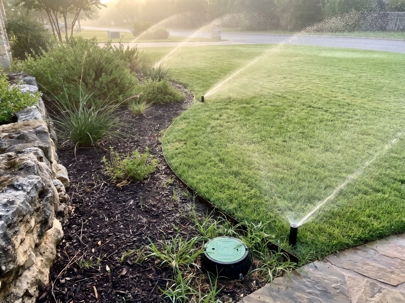
The most important design idea for living within the schedule is hydrozoning. Hydrozoned circuit layout aligned with Cedar Park municipal watering schedules groups plants by their water needs and gives each group its own circuit. Turf in full sun is one zone. Turf in shade is another. Shrub beds, native plantings, trees, and foundation areas each have their own.
The benefits are practical. Each zone can be scheduled for exactly the water its plants need, nothing more. When the city's rules shift, zones can be rescheduled individually, so the thirstiest areas are watered within the allowed days and the hardy ones are reduced. Zone size is limited to what the available flow can supply, which keeps run times short enough to fit the permitted hours. Instead of one large program trying to serve everything, the system becomes a set of small, well-matched circuits.
Matched Precipitation Rate (MPR) High-Efficiency Rotary Nozzle Calibration
Water has to land evenly, or the schedule will not work. Matched precipitation rate (MPR) high-efficiency rotary nozzle calibration ensures that every sprinkler in a zone applies water at the same rate, regardless of its arc or radius. A quarter-circle head and a full-circle head of ordinary design put out very different amounts of water per minute, which means a corner runs wet while a center strip runs dry. Matched-rate nozzles solve the problem by adjusting the flow to the arc.
Rotary nozzles deliver water in slow, thin streams, giving the soil time to absorb it. They apply less water per hour than conventional spray heads, so there is less runoff on clay and on slopes. Calibration includes setting the proper pressure at the head, checking that coverage overlaps correctly, and adjusting the arc and radius until the pattern is even. A well-calibrated zone uses less water to keep the grass equally green from one edge to the other.
Pressure-Regulating Spray Bodies (PRS-40) With Low-Head Drainage Check Valves
In spray zones, details inside the head matter. Pressure-regulating spray bodies (PRS-40) with low-head drainage check valves hold the pressure at the nozzle to a steady 40 psi, regardless of fluctuations in the supply. Too much pressure turns a spray into a fog that drifts away and evaporates. Consistent pressure keeps droplets large enough to land where they are aimed.
The check valve built into the body holds water in the line when the zone shuts off. Without it, water drains out of the lowest head after every cycle, creating a puddle at the bottom of a slope and a dry strip at the top. With it, the lines stay full, heads pop up with water ready, and the zone starts working the instant the valve opens. Over a season, the water saved by eliminating that drainage adds up, and the lawn at the foot of a slope stops suffering from the constant trickle.
Water Where Sprays Do Not Belong
Subsurface Pressure-Compensating (PC) Drip Tubing for Landscape Bed Hydrozones
Spray heads are a poor match for beds. Water lands on leaves, evaporates in the heat, and drifts onto walkways. Subsurface pressure-compensating (PC) drip tubing for landscape bed hydrozones delivers water directly to the root zone instead. Emitters are built into the tubing at regular intervals, and pressure compensation means each one releases the same amount of water regardless of its position on the line.
The tubing is placed just below the surface or under mulch, protected from sun and foot traffic. Beds with different plants can be given different emitter spacing and their own zones, so a thirsty perennial bed and a drought-tolerant native planting each receive what they need. Because drip applies water slowly and precisely, it works well within restricted schedules. Longer run times at low flow replace the short bursts of spray, and the water goes into the ground instead of into the air.
Dedicated Foundation Perimeter Drip Irrigation Loop for Slab Stabilization
The soil around a house in Cedar Park can be a quiet source of trouble. Clay shrinks as it dries and swells as it absorbs moisture, and the movement can stress a slab foundation. A dedicated foundation perimeter drip irrigation loop for slab stabilization helps keep the soil moisture around the foundation more consistent, which reduces the extremes that cause movement.
The loop is a ring of drip tubing set a short distance from the foundation, on its own zone, with its own schedule. The goal is steady moisture, not saturation. Because it is separate from the turf zones, it can be programmed to run on allowed days at a modest rate, regardless of what the lawn needs. Placement, depth, and distance from the foundation are chosen with care, and water is never directed against the slab itself.
Getting Pipe Into Limestone
Mechanical Heavy-Duty Rock Saw Trenching for Shallow Limestone Substrate
Burying irrigation lines in much of Cedar Park means dealing with rock. Limestone sits close to the surface in many neighborhoods, and ordinary trenchers stall against it. Mechanical heavy-duty rock saw trenching for shallow limestone substrate uses a powerful saw with a hardened blade to cut a narrow channel through the stone.
The trench is just wide enough for the pipe and wire, which keeps disturbance to the yard minimal. Lines can be placed at the right depth, protected from aerators, foot traffic, and temperature swings, and routed along the planned path instead of detouring around obstacles. After the pipe is laid, the trench is backfilled with fine material that cushions the line, and the surface is restored. A trench cut this way heals quickly, and a few weeks later the yard shows little sign of the work.
Protecting the Water Supply
Reduced Pressure Zone (RPZ) and Double Check Backflow Preventer Assembly
Irrigation systems connect directly to the household water supply, and backflow protection stops irrigation water from flowing backward into it. A reduced pressure zone (RPZ) and double check backflow preventer assembly are the two main types of device used. A double check assembly uses two spring-loaded valves in series. An RPZ adds a relief valve between them that discharges water if pressure conditions change, offering a higher level of protection.
Which device is appropriate depends on the system and the local requirements. The assembly is installed in an accessible location with proper clearances and tested annually by a certified tester, with results reported to the city. Keeping the assembly serviceable matters for compliance, and it matters for protecting the neighborhood's drinking water. The backflow device is the quiet guardian of the whole system.
Letting the System Think
Smart Wi-Fi Evapotranspiration (ET) Controller With Local Weather Station Sync
A fixed schedule waters the same way in a cool, cloudy week and a hot, windy one. Smart Wi-Fi evapotranspiration (ET) controller with local weather station sync adjusts to the real conditions. The controller pulls data from a nearby weather station, calculates how much water the plants lose through evaporation and transpiration, and waters only to replace it.
Zone settings tell the controller about soil, slope, sun exposure, plant type, and sprinkler rate, so it knows how long each zone needs to run. Rain delays, freeze protection, and seasonal changes happen automatically. Programming can also include the city's allowed days and times, so the system stays within the rules without anyone checking the calendar. The owner can view and adjust settings from a phone, and alerts arrive if something looks wrong.
Mainline Master Valve and Ultrasonic Flow Meter for Automated Burst Shut-Off
A broken pipe or stuck valve can waste an enormous amount of water before anyone notices. Mainline master valve and ultrasonic flow meter for automated burst shut-off watches for exactly that. The master valve is an electric valve at the start of the mainline, normally open only when the system is running. The ultrasonic flow meter measures how much water is moving through the line without any moving parts.
If the flow is higher than expected for the active zone, because a pipe has broken or a head has been sheared off, the controller closes the master valve and stops the water. It also logs usage over time, which helps detect slow leaks and verifies that each zone is running as designed. For a household that travels or a property with a long mainline, it is a significant safeguard.
Keeping the System Honest
Seasonal Checks
Watering habits deserve attention too. Deep, infrequent cycles encourage roots to grow downward, which makes turf and shrubs more resilient when restrictions tighten. Cycle-and-soak programming, in which a zone runs for a short period, pauses, and runs again, helps clay and sloped areas absorb water without runoff. The controller can handle that pattern automatically once it has been set up for each zone.
Even a well-designed system needs a look a few times a year. In spring, each zone is run and observed for broken heads, clogged nozzles, and misaligned coverage. In summer, the controller is reviewed against the weather and the current city schedule. In fall, settings are adjusted for cooler temperatures. Before the first freeze, exposed components are protected. A lawn care service that knows the layout can spot problems during regular visits and report them before they grow.
When Repairs Come Up
Every system needs repairs eventually. Heads get hit, nozzles clog, and valves wear out. Prompt sprinkler repair keeps small problems from wasting water or damaging turf, and irrigation system repair is much simpler when an accurate as-built plan shows what lies underground. Heroes Lawn Care of Cedar Park keeps the plan on file for each installation so that service starts with information instead of guesswork.
Questions Worth Asking Before Installation
A handful of questions reveals how a system will be designed. Will a licensed irrigator prepare and submit a scaled plan? How will zones be organized by plant type and sun exposure? Are nozzles matched for precipitation rate? How will trenching be handled in rock? What backflow assembly will be used and where? How does the controller adjust to weather and to the city's schedule? What protects against leaks? Clear answers point to a system built around conditions in Cedar Park, TX and not a generic template.
A System That Follows the Rules and Keeps the Lawn
Living within a watering schedule does not mean living with a struggling yard. A system designed for the schedule delivers water efficiently, evenly, and on the days allowed, protects the water supply, and responds to the weather. It keeps lawns green and beds healthy through the stages of a dry summer.
For homeowners across Cedar Park, TX ready to build that kind of system, Heroes Lawn Care of Cedar Park provides irrigation installation that begins with the city's schedule and the plants on the property and ends with a controller that does the thinking. The best first step is a walk around the yard to map the zones, check the soil and rock, and plan the system to fit.