
The Hardscape Construction Detail That Determines Whether Your Retaining Wall Lasts — or Fails
A retaining wall can look flawless on the day it's finished and still be counting down toward failure, all because of a detail that's completely invisible once the last stone is set. Hardscape construction projects rarely fail because of the visible materials chosen — the stone, the pavers, the block system. They fail because of what happens to water once it's no longer able to move through the ground the way it did before construction began.
This single factor, drainage, is the detail that separates a retaining wall, patio, or driveway that holds up for decades from one that starts showing cracks, bulges, or settling within just a few seasons. Understanding why it matters so much, and what proper drainage actually involves, is essential for any Round Rock, TX homeowner planning a hardscape project.
It's also one of the easiest details to overlook when evaluating a proposal, since drainage provisions are largely invisible in a finished project. A beautifully finished retaining wall or patio surface gives no visual indication of whether proper drainage exists underneath or behind it, which means homeowners are often left judging a project's quality based on the one aspect that has the least bearing on its long-term structural performance.
This creates a genuine information gap between what a homeowner can evaluate by looking at a finished project and what actually determines whether that project holds up over time. Two contractors can both produce visually similar, attractive results at the moment of completion, while one has quietly built in the drainage infrastructure needed for long-term stability and the other has skipped it entirely to save time or materials. That gap only becomes visible once weather and time have had a chance to test the structure, by which point the responsible party has often long since moved on to other projects.
The One Detail Every Hardscape Construction Project Shares — Whether It's a Wall, a Patio, or a Driveway
Retaining walls, patios, driveways, and fire pits all look like fundamentally different projects on the surface, but they share a structural vulnerability that most homeowners don't realize until something goes wrong.
This shared vulnerability is precisely why a homeowner who understands drainage well enough to ask informed questions about one type of hardscape project is generally equipped to evaluate any hardscape project on the same property. The specific engineering details differ between a retaining wall and a paver patio, but the underlying question — where does water go once this structure interrupts its natural path — remains the same regardless of which hardscape feature is being discussed.
Why Water Management Determines Structural Lifespan
Every hardscape element sits on top of soil that naturally absorbs, holds, and releases water depending on rainfall and season. Once a hard, non-permeable surface or structure is introduced, that natural water movement gets interrupted, and where that interrupted water goes next determines whether the structure above it holds steady or eventually fails. Retaining wall construction services that don't account for this reality are building on borrowed time, regardless of how well-constructed the visible wall face appears to be.
This is precisely why two retaining walls that look nearly identical on installation day can have dramatically different outcomes a few years later. The visible stone, block, or concrete facing says nothing about what's happening behind it, and a wall with excellent surface craftsmanship but inadequate drainage is often more deceptive than one that looks rougher but was engineered correctly from the start.
The same principle extends to how homeowners judge hardscape work more generally. A finished project photographed on completion day captures none of the engineering decisions that will determine its performance over the following years, which is exactly why relying on visual impression alone, however well-photographed, leaves out the single most consequential factor in the entire project.
Hydrostatic Pressure: The Invisible Force Behind Most Wall Failures
Hydrostatic pressure is the force water exerts when it accumulates behind a retaining wall without anywhere to go. Unlike soil weight, which is a relatively constant and predictable load, hydrostatic pressure builds dynamically after rain events and can exert significantly more force against a wall than the soil itself ever would. A wall engineered to handle normal soil load without accounting for this additional water-driven pressure is vulnerable to bulging, leaning, or outright collapse, often well before the wall's expected structural lifespan.
Heroes Lawn Care calculates expected hydrostatic load as a standard part of every retaining wall design, factoring in wall height, soil type, and typical rainfall intensity for the specific property, rather than applying a generic drainage specification regardless of these site-specific variables.
How Drainage Failure Shows Up Differently Across Hardscape Types
The same underlying problem, water with nowhere to go, produces different visible symptoms depending on what type of hardscape element is involved.
Retaining Walls: Bulging, Leaning, and Cracking
A retaining wall under hydrostatic pressure typically shows warning signs gradually: a slight forward lean, horizontal cracking along mortar joints, or a visible bulge partway up the wall face where pressure has concentrated. By the time these signs are visible, the wall has often already sustained internal stress that compromises its long-term stability, even if it hasn't yet failed outright.
These warning signs also tend to worsen at an accelerating rate rather than a steady, predictable pace. A wall showing a slight lean after several years of inadequate drainage can progress to a much more serious structural issue within a single particularly wet season, since each additional saturation cycle adds further stress to a structure already compromised by prior pressure buildup. Catching these early signs and addressing the underlying drainage issue promptly is far less disruptive than waiting until the wall requires a full rebuild.
Patios and Walkways: Heaving, Settling, and Erosion
Outdoor stonework installation that doesn't account for proper drainage tends to show different symptoms than a retaining wall, since patios and walkways don't hold back soil the same way. Instead, poor drainage beneath a patio or walkway typically shows up as uneven settling, heaving during freeze-thaw cycles, or erosion at the edges where water concentrates and washes out base material over time. Patio and walkway installation built on a properly graded and drained base avoids this gradual, creeping deterioration that otherwise becomes increasingly visible each rainy season.
Standing water on a patio surface after rain is often dismissed as a minor cosmetic inconvenience, but it's frequently an early indicator of a deeper drainage problem beneath the surface. Water that isn't shedding properly off a patio isn't just pooling on top — it's often also failing to drain adequately through the base layer, which means the same water accumulation contributing to that visible puddle is likely also undermining the base material supporting the pavers themselves.
Why Round Rock, TX Clay Soil Makes Drainage Non-Negotiable
Central Texas soil conditions add another layer of urgency to proper drainage planning, beyond what would be necessary in regions with more forgiving soil types.
How Expansive Soil Compounds Water Pressure Problems
Round Rock, TX sits on expansive clay soil that swells significantly when saturated and contracts as it dries, creating a constantly shifting foundation beneath any hardscape structure. This soil behavior compounds the hydrostatic pressure problem, since clay soil holds water longer than sandy or well-draining soil, extending the period during which a retaining wall or patio base is under elevated pressure after any significant rain event. Concrete and masonry services that don't specifically account for this regional soil behavior are applying a drainage standard calibrated for a different, less demanding set of conditions.
Heroes Lawn Care evaluates soil composition at the specific location of any proposed hardscape structure, since clay content and drainage characteristics can vary meaningfully even across a single Round Rock, TX property. A drainage plan calibrated to the actual conditions at the build site performs far more reliably than one based on general regional assumptions alone.
What Proper Drainage Actually Involves
Understanding why drainage matters is only useful if it translates into knowing what an actual, properly engineered drainage system looks like for different types of hardscape construction.
Backfill, Drainage Pipe, and Weep Holes for Retaining Walls
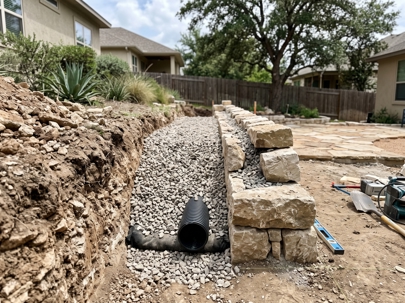
A properly drained retaining wall typically includes a gravel backfill zone directly behind the wall, a perforated drainage pipe positioned to carry accumulated water away from the structure, and in many designs, weep holes through the wall face itself to relieve any pressure that does build up. Custom hardscape design and build that incorporates all three of these elements gives water a clear path out of the system rather than trapping it against the wall where pressure inevitably accumulates.
Each of these three components plays a distinct role. The gravel backfill allows water to move freely rather than becoming trapped in dense, compacted soil directly behind the wall. The drainage pipe collects that water and channels it to a safe exit point, typically daylighting somewhere lower on the property rather than simply dispersing into the surrounding soil. Weep holes serve as a secondary release mechanism, providing an outlet even if the primary drainage pipe becomes partially obstructed over time. Omitting any one of these three components weakens the overall system, even if the other two are executed correctly.
Base Preparation and Grading for Patios and Driveways
Paver driveway installation and patio construction rely on a different but related drainage approach: a properly compacted base layer that allows water to pass through rather than pool, combined with a slight grade directing surface water away from structures rather than toward them. Deck and patio building services that skip proper base depth or grading in favor of a faster installation often produce a surface that looks acceptable initially but develops drainage-related problems within the first few significant rain events.
Grade is particularly easy to get wrong without careful measurement, since a slope too subtle to notice visually can still be enough to direct water toward a home's foundation rather than away from it over time. A grade that's slightly too aggressive, on the other hand, can create its own erosion problems at the low point where water concentrates. Getting this balance right requires precise measurement during installation rather than a visual estimate, which is part of why base preparation deserves the same level of attention typically reserved for the visible surface material chosen.
Building Hardscape Elements as a Connected System, Not Isolated Projects
Many properties end up with a retaining wall, a patio, and perhaps a fire pit or outdoor kitchen installed at different times, sometimes by different contractors, each treated as an independent project rather than parts of a single connected drainage system.
How a Retaining Wall, Patio, and Fire Pit Share the Same Drainage Plan
Landscape structural elements installation planned as a cohesive system accounts for how water moves across the entire property, not just within the footprint of a single feature. A retaining wall installed without considering how it will interact with a patio drainage plan added later, for example, can inadvertently redirect water toward the patio's base rather than away from it, undermining a structure that was otherwise properly built. Fire pit and outdoor kitchen construction added into this kind of connected system benefits from the same water-management planning already established for the surrounding hardscape, rather than introducing a new, disconnected drainage consideration into an already-complicated property.
Outdoor living space construction planned holistically from the start, even if installed in phases over time, tends to hold up far better than a collection of individually sound but disconnected hardscape features competing with each other for how water moves across the yard.
This phased approach doesn't require installing everything at once. A property owner can build a retaining wall in one season and add a patio, fire pit, or outdoor kitchen in a later phase, as long as the original drainage plan accounted for those future additions from the beginning. The problem arises specifically when each phase is planned in isolation, without any reference to how water was already being managed by earlier hardscape work on the same property.
What This Means for Hiring in Round Rock, TX
Given how much of a hardscape project's long-term performance depends on drainage planning that isn't visible in the finished result, the way a contractor discusses drainage during the planning stage reveals a great deal about how the finished project will actually perform.
Questions That Reveal Whether Drainage Was Actually Planned For
Asking specifically how a proposed retaining wall will handle hydrostatic pressure, what drainage provisions are included in a patio or driveway base, and how multiple hardscape features on the same property will interact with each other's drainage tends to separate contractors who've genuinely engineered for local conditions from those who haven't given the question much thought. A vague answer, or one that treats drainage as an optional upgrade rather than a structural necessity, is a meaningful signal worth taking seriously before signing a contract.
A useful follow-up question is asking a contractor to walk through, specifically, where water will go once it leaves a proposed hardscape structure. A contractor with a genuine drainage plan can typically answer this immediately and specifically, describing an actual exit point or drainage path. A contractor without a real plan tends to answer more generally, describing drainage in vague terms without being able to point to where the water actually ends up once it leaves the property's hardscape features.
Heroes Lawn Care builds drainage planning into every hardscape construction project in Round Rock, TX from the earliest design conversation, rather than treating it as an afterthought addressed only if a homeowner specifically asks. Every retaining wall includes properly engineered backfill and drainage provisions, and every patio, walkway, or driveway is graded and based with the region's clay soil and rainfall patterns accounted for from the start.
Conclusion
The detail that ultimately determines whether a retaining wall, patio, or driveway lasts for decades or starts failing within a few seasons isn't the material chosen or even the visible craftsmanship of the finished surface. It's what happens to water once that surface or structure interrupts its natural path through the ground, and whether the project was engineered to give that water somewhere useful to go.
This is, in many ways, good news for homeowners evaluating hardscape proposals. It means the single most important factor in a project's long-term success isn't a matter of taste, budget tier, or material preference — it's a specific, verifiable engineering question that any contractor should be able to answer clearly and specifically. Asking about it directly, before signing anything, is a straightforward way to separate a project built to last from one that simply looks finished on installation day.
Heroes Lawn Care treats drainage as the foundation of every hardscape construction project in Round Rock, TX, not an optional add-on considered only after the visible design has already been finalized. Getting this invisible detail right from the very beginning is still the most reliable way to end up with hardscape features that perform as well in ten years as they did on the day they were completed.