
Approved Plans, Septic Fields, and Culverts: The Liberty Hill, TX Landscaping Contractor Checklist Most Owners Discover Late | Heroes Lawn Care of Cedar Park
Owners of land around Liberty Hill, TX tend to picture the finished result first: a clean lawn rolling toward a tree line, a driveway lined with stone, wildflowers in spring, a house that looks settled into the property. The checklist that gets there is far less romantic. It includes a committee approval, a septic system that dictates where plants can go, a ditch that has to survive the next storm, and a layer of rock beneath the topsoil that refuses to cooperate. These items surface late for many owners, usually after a first outline of the work has already been mapped out, and they reshape the project when they do.
A capable landscaping contractor in this part of Williamson County knows the checklist before the first machine arrives. The work is part construction, part land management, and part design, and the order in which things happen decides whether the finished property looks intentional or improvised. Heroes Lawn Care of Cedar Park organizes acreage projects around that checklist, so the items that usually appear late are handled first.
Why Liberty Hill, TX Projects Come With a Checklist
Land That Is Still Becoming a Yard
Many properties around Liberty Hill began as ranch or pasture and are in the process of becoming residential. That means the lot may include a dense stand of cedar, a skin of topsoil over caliche, a driveway that meets a county road with a culvert beneath it, and a septic system placed where the builder found room. A suburban lot arrives mostly finished. A Liberty Hill acreage lot arrives as raw material.
Why the Order of Work Matters
Heroes Lawn Care of Cedar Park starts each Liberty Hill project with a site walk that marks the cedar stands, the rock outcrops, the drainage paths, the septic components, and the road frontage on a single drawing. That drawing becomes the checklist, and the checklist becomes the schedule.
Each item on the checklist affects the next. Clearing determines what grading can reach. Grading determines where water goes. Water determines where the culvert and swale sit. The septic system determines where planting can happen. And the neighborhood's approval process determines what any of this is allowed to look like. Doing these in the wrong order means redoing work, and on acreage, redoing work is a big job.
Item One: Approvals Before Anything Else
Subdivision Architectural Review Committee (ARC) Landscape Approval
Many newer communities around Liberty Hill have an Architectural Review Committee, and landscape changes are often within its scope. Subdivision Architectural Review Committee (ARC) landscape approval typically requires a submittal that shows what is planned: the layout, the plant list, the hardscape materials, the grading changes, and sometimes the lighting and fencing. The committee reviews it against the community's guidelines and issues an approval, a request for changes, or a denial.
The practical lesson is to seek approval before work begins. Starting construction first and asking afterward can lead to orders to remove or alter finished work. A contractor familiar with the process prepares the submittal in the format the committee expects, anticipates the common questions, and keeps a record of the approved plan so the finished project matches it. Timelines for review vary, so building that time into the schedule from the beginning prevents delays at the point when crews are ready to start.
Turnkey Design-Build Residential Landscape Project Management
Approvals are easier to manage when one party is responsible for the whole project. Turnkey design-build residential landscape project management puts design, submittals, scheduling, earthwork, planting, and finishing under a single plan. Instead of coordinating a designer, a grading company, a hardscape crew, and a planting crew independently, the owner has one point of accountability.
The advantage is most visible when something changes. If a committee asks for a different plant palette, or if rock turns up where a bed was planned, the design, the schedule, and the crews adjust together. Because the same team that drew the plan builds it, the intent behind each decision carries through to the finished property.
Item Two: The Land Itself
Acreage Lot Cedar Clearing and Forestry Mulching Services
Ashe juniper, locally called cedar, spreads across Hill Country land and can take over a lot in a few decades. Dense stands crowd out native grasses, drink heavily from the soil, and create a serious fire load. Acreage lot cedar clearing and forestry mulching services remove the unwanted growth by grinding it in place with a tracked machine that shreds trees and brush into mulch, which is left on the ground as a protective layer.
The method has advantages over traditional clearing. There are no brush piles to haul or burn, the mulch layer protects the soil from erosion, and the machine can work around trees that are meant to stay. Selecting which trees to keep is the most important step. Mature oaks, healthy elms, and well-formed specimen trees give a property its character, and clearing around them with care preserves the best of what was already there.
Mechanical Rock Grinding and Caliche Subsoil Excavation
Once the cedar is gone, the ground comes into view, and in this area it is often caliche or limestone close to the surface. Caliche is a hardened layer of calcium carbonate that behaves almost like weak rock. It resists digging, drains poorly, and blocks roots. Mechanical rock grinding and caliche subsoil excavation uses heavy equipment to break up and remove the hard layer where planting beds, trenches, or foundations need to be installed.
Grinding is more controlled than blasting or heavy ripping. A grinder mills the rock down in place, producing material that can be reused as fill or base. In planting areas, the hardpan is broken up and replaced with amended soil so roots can penetrate and water can drain. Skipping this step is a common reason new trees stall or die in the first two years, even when everything else was done correctly.
Heavy-Duty Skid Steer Earthmoving and Site Preparation
Once the land is clear and the rock is dealt with, there is a great deal of material to move. Heavy-duty skid steer earthmoving and site preparation covers the compact machines that spread soil, haul rock, build berms, dig small trenches, and shape the ground in places larger equipment cannot reach. A skid steer can maneuver between trees, along the edge of a septic field, and around a house without damaging what is already there.
Precision matters at this stage. The shape given to the ground in preparation determines how water moves for years afterward. A contractor with good equipment control can build gentle swales, raised planting areas, and level pads without overworking the soil.
Item Three: Water, Grade, and the Road
Laser-Guided Rough and Final Yard Grading Contractor
Grading is the quiet backbone of any landscape project. A laser-guided rough and final yard grading contractor uses laser or GPS-controlled equipment to hit exact elevations, which allows water to be directed with confidence. Rough grading establishes the general shape of the land, moving soil to create positive drainage away from the house and toward designed discharge points. Final grading refines the surface to a smooth, uniform finish ready for topsoil and seed or sod.
On acreage, small errors accumulate. A degree of slope off across a long distance can turn into a low spot where water stands or a ridge that sheds water onto a neighbor. Laser guidance removes the guesswork and creates a surface that drains in the way the plan intended. The difference is easy to see after the first heavy rain.
Rural Driveway Culvert Stonework and Roadside Swale Stabilization
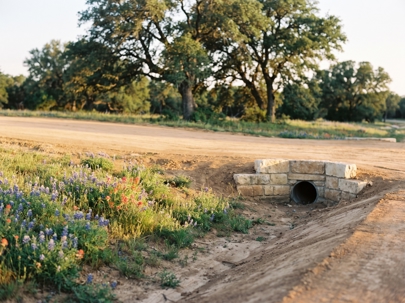
Where a rural driveway meets the road, water has to cross it. Rural driveway culvert stonework and roadside swale stabilization handles that crossing. A culvert pipe carries water beneath the driveway, and stonework at each end, usually limestone headwalls or rock aprons, holds the soil in place and prevents the water from undercutting the pipe. The roadside swale that feeds it is shaped and lined so flow moves steadily without eroding the banks.
This is one of the places where a failure causes damage quickly. A culvert set too shallow gets crushed. A swale that is too steep scours itself into a gully. A headwall without proper footing can wash out. Done correctly, the entrance looks neat, the water moves where it should, and the driveway edge stays intact through heavy rain. Requirements for work near county or city roads vary, so the right approvals are part of the checklist as well. The entrance is also the first thing visitors see, so stonework chosen to match the house and the local limestone turns a purely functional crossing into a gateway, and plantings of native grasses along the swale banks soften the edges while holding the soil in place.
Bulk Topsoil Delivery and Automated Tractor Box Blade Leveling
After grading comes the surface that plants and grass will actually grow in. Bulk topsoil delivery and automated tractor box blade leveling spreads a layer of quality soil across the prepared ground and levels it to a uniform depth. The box blade, pulled by a tractor, carries soil and drops it where the surface is low, scraping where it is high, until the area is smooth and consistent. Automated controls help it follow the target grade accurately.
Topsoil matters because the native soil in many Liberty Hill lots is thin and rocky. A blend with the right proportion of organic matter and mineral content gives roots a place to establish and holds moisture longer between rains. Depth is a key decision. Too thin and the layer dries out, too thick and it can slide on a slope. Delivering the soil in bulk, close to where it will be spread, keeps machine travel across finished ground to a minimum, and testing a sample for texture and organic content before it is placed avoids problems that only show up a year later as patchy growth.
Item Four: Septic Systems and the Planting That Respects Them
Aerobic Septic Spray Field Landscape Buffer Planting
Many rural homes use aerobic septic systems, which treat wastewater and then spray the treated water across a designated area of the yard. Aerobic septic spray field landscape buffer planting works within that constraint. The spray area must remain open and covered with grass, and its heads need to stay clear of obstruction. At the same time, a buffer of appropriate plantings around the field can screen it from view, soften the edge, and help manage the surrounding ground.
Plant selection is critical. Deep-rooted trees and large shrubs should stay away from the field and its lines, since roots can invade and damage buried components. Low-growing grasses and shallow-rooted perennials are better suited near the edges. Edible gardens do not belong on a spray field. Access for servicing the system must remain open, and covers, risers, and spray heads should be easy to find. The local rules and the system's design govern what is allowed, so the plan should be checked against the specifics of the installation.
Item Five: Establishing the Ground Cover
Commercial Hydroseeding and Native Acreage Wildflower Establishment
Seeding large areas by hand or with a broadcast spreader works on small lots, but acreage calls for a different method. Commercial hydroseeding and native acreage wildflower establishment applies a slurry of seed, mulch, and tackifier from a tank, covering large areas quickly and evenly. The mulch holds moisture against the seed and protects the soil from erosion while germination takes place.
Hydroseeding suits slopes, roadside swales, and large turf areas, since the tackifier helps seed stay put. For wildflowers, the mix is chosen for native species adapted to Central Texas, such as bluebonnets, Indian blanket, coreopsis, and Mexican hat. Timing is important. Fall seeding gives wildflowers a head start to bloom in spring, and following the rainfall pattern of the region improves results. Native meadows take a season or two to reach their full display, but they require far less water and attention than conventional lawn once they are established.
Putting the Checklist in Order
A Practical Sequence
On a Liberty Hill, TX acreage lot, weather adds its own constraints to the sequence. Heavy equipment works best on dry ground, so earthmoving is planned for drier stretches, while seeding is timed to the moisture and temperatures of the planting window. Building that rhythm into the schedule is part of what separates a project that flows from one that stalls after every storm.
The sequence tends to follow a consistent logic. First comes the site walk and the plan, along with the approvals the community requires. Next is clearing and grinding, followed by earthmoving and rough grading. The culvert, swale, and drainage work go in, then topsoil and final grading. Septic buffer plantings, trees, and beds follow. Last come hydroseeding or sod, mulch, and finishing details. Following this order prevents machines from damaging finished work and keeps the schedule moving.
Questions Worth Asking Before Hiring
Acreage work also rewards a contractor who can explain tradeoffs plainly. Leaving a stand of mature trees changes where the grading can run, a preserved drainage channel changes where the driveway crosses, and a wildflower meadow changes how the edges of the property are maintained. None of these choices is wrong, but each one has consequences that are easier to weigh at the drawing stage than on the ground.
A few questions reveal how well a contractor understands acreage work. Has the contractor handled ARC submittals in the community? How will cedar be cleared, and which trees will be preserved? What equipment handles the caliche? How is grading controlled? What is the plan for the culvert and the swale? How will the septic field be protected? What seed mix and timing suit the property? Specific answers show experience with land like this, and vague ones suggest a contractor accustomed to smaller, simpler lots.
Care After the Work Is Done
The First Two Seasons
Newly graded and seeded ground is vulnerable until vegetation fills in. After heavy rain, drainage paths and swales should be checked, any erosion repaired, and bare spots reseeded. New trees and shrubs need regular watering through their first seasons. A lawn care service familiar with the project can handle turf establishment, weed control, and seasonal cleanup without disturbing the new surfaces. Heroes Lawn Care of Cedar Park provides a care plan with each project so the property continues to develop in the direction the design intended.
Keeping the Land in Shape
Seasonal rhythm helps. Late winter is a good time to inspect culverts, headwalls, and swales before spring storms. Early fall is the time to seed or refresh wildflower areas and to clear any cedar seedlings that have sprouted. A short walk across the property in each season, with the original plan as a guide, catches small problems while they are still easy to fix.
On acreage, cedar and brush return if they are ignored. Periodic follow-up to remove seedlings, maintain the meadow, and keep the swales clear preserves the work done in the first phase. The reward is a property that stays open, healthy, and manageable instead of slipping back to the condition it began in.
Starting With the Checklist
The finished property is the easy part to imagine. The checklist is what produces it. Approvals secured, cedar cleared, rock handled, grade set, culverts built, septic respected, and ground cover established add up to land that looks planned because it was.
For owners across Liberty Hill, TX with raw acreage and a picture in mind, Heroes Lawn Care of Cedar Park serves as the landscaping contractor that works through the checklist in order, from committee approval and cedar clearing to grading, drainage, and wildflower meadows. The right place to begin is a walk across the land with the plan, the community guidelines, and the questions above in hand.