
Stop Settling for a Boring Backyard: How a Concrete Patio Turns Cedar Park Homes Into Outdoor Living Spaces
Most backyards in Cedar Park aren't broken. They're just boring. A stretch of grass, a wooden fence, maybe a patch of pavement near the back door — functional, but never actually used for much beyond mowing and the occasional trip to the trash cans. A well-designed Concrete Patio is what changes that equation. Rather than another underused corner of the yard, it becomes the anchor point for a space people actually want to spend time in — morning coffee outside instead of at the kitchen counter, dinner on the patio instead of the dining room, weekends spent outdoors instead of scrolling past photos of someone else's backyard.
This article looks at why so many backyards in this market never get past the 'grass and a fence' stage, what separates a patio that actually gets used from one that quietly becomes storage space for patio furniture no one sits in, and how the right design and installation approach turns a flat slab into a full outdoor living space.
It's worth pointing out that this isn't a matter of square footage. Some of the most underused backyards in Cedar Park are actually quite large — plenty of room, no real reason to be outside. The size of a yard has very little to do with whether it gets used. What matters is whether there's a defined, comfortable space within it that gives people a reason to walk out the back door in the first place.
Why So Many Cedar Park Backyards Are Going to Waste
It's a familiar pattern. A homeowner moves into a new build or an established Cedar Park property, the backyard comes with basic sod and a fence line, and beyond a grill and a couple of folding chairs, nothing else ever gets added. Years pass. The space technically exists, but it never becomes part of daily life the way the inside of the home does.
The 'Grass and a Fence' Backyard: A Familiar Story
There's nothing wrong with a simple lawn — but a yard with no defined purpose tends to stay exactly that: undefined. Without a stable, level surface to anchor furniture, a grill, or a seating area, most outdoor plans stall before they start. Folding chairs sink into soft grass. Rugs get ruined by sprinklers. A wooden picnic table warps within a season or two. The lack of a proper foundation is often the single biggest reason a backyard never evolves past its builder-grade starting point.
What Homeowners Actually Want From Their Backyard
When homeowners describe what they actually want, it rarely starts with a specific material or structure — it starts with a feeling. A place to eat dinner outside on a Tuesday. Somewhere friends can gather without dragging chairs across wet grass. A quiet spot for morning coffee that doesn't involve stepping onto damp turf. These everyday moments are what a well-planned outdoor living space installation is designed around, and none of them are possible without a stable, usable surface to build on first.
Why DIY Fixes and Furniture Alone Don't Solve the Problem
It's tempting to treat the problem as a furniture problem — buy a nice outdoor sectional, add some string lights, call it done. But furniture placed directly on grass or gravel rarely stays level, cushions and rugs trap moisture underneath, and the whole setup tends to look temporary because, structurally, it is. Real backyard patio construction starts below the surface, not above it. Without a properly built slab underneath, even the best outdoor furniture ends up fighting an uneven, shifting foundation.
There's also a compounding effect to consider. Furniture bought for a temporary setup rarely gets reused once a proper patio finally goes in, since the dimensions, layout, and even the style no longer fit the finished space. Homeowners who commit to a well-planned surface from the start tend to avoid the cycle of furnishing and re-furnishing an unfinished space multiple times while waiting to settle on a permanent solution.
The Trade-Off of Waiting: A Missed Backyard Is a Missed Season
Central Texas offers a long stretch of the year where outdoor space is genuinely comfortable to use — spring evenings, early summer mornings, and mild fall weekends that stretch well into the season. A backyard that sits unused through those months isn't just an aesthetic miss; it's lost time that can't really be recovered once the calendar moves on. Homeowners who put off a backyard upgrade year after year often aren't avoiding the project itself so much as they're unsure where to start, which is usually where a professional consultation ends up saving more time than a season of DIY trial and error.
How a Concrete Patio Becomes the Foundation for a Real Outdoor Living Space
The shift from an unused backyard to one that gets daily use almost always starts with a stable, well-designed surface. A concrete slab patio installation gives every other element — furniture, shade structures, lighting, cooking areas — something solid and level to work with, which is a large part of why it remains the most common starting point for full backyard transformations.
Design Principles That Turn a Slab Into a Destination
A patio that actually gets used is rarely just a rectangle poured in the middle of the yard. Thoughtful layout accounts for how the space connects to the house, where shade naturally falls throughout the day, and how people will actually move through the space — from the back door to the grill, from the dining area to a lounge zone. These layout decisions are made before a single yard of concrete is poured, which is why professional planning tends to produce a noticeably more livable result than an ad hoc pour.
Zoning: Separating Dining, Lounging, and Cooking Areas
One of the more reliable ways to make a backyard feel like a true extension of the home is to treat it the way an interior floor plan would be treated — with distinct zones for distinct purposes. A dining area near the kitchen door for easy serving, a separate lounge area angled toward a fire feature or a view of the yard, and a cooking zone positioned with airflow and counter space in mind all give a single patio multiple practical uses instead of one generic slab that tries to do everything at once and does none of it particularly well.
Sizing the Patio to Match How the Yard Will Be Used
A patio that's undersized for its intended use ends up feeling cramped no matter how nicely it's finished, while one that's oversized for a small household can feel empty and impersonal. Matching the footprint to actual usage patterns — regular family meals versus occasional larger gatherings, for instance — is one of the planning steps that's easy to overlook but has an outsized effect on how comfortable the finished space feels day to day.
Finishes That Match Cedar Park's Mix of Modern and Traditional Homes
Cedar Park's housing stock spans a wide range of styles, from traditional stone-and-brick exteriors to newer, more contemporary builds. A residential concrete patio contractor with local design experience typically matches the finish to the home rather than defaulting to a single standard look across every project.
Stamped, Stained, and Custom Decorative Options
Stamped concrete patio services can replicate the texture of natural flagstone or hand-laid brick, which tends to suit a more traditional exterior. For a cleaner, more contemporary aesthetic, a stained or lightly textured finish in a cooler gray or warm charcoal tone often reads as more modern and architectural. Decorative concrete patio designs can also incorporate borders, contrasting bands, or geometric scoring patterns to add visual interest without relying on a stamped texture at all — giving homeowners a wide design range from a single base material.
Concrete Patio vs. Wood Decking, Pavers, and Artificial Turf
Wood decking has a warm, natural look but requires ongoing sealing and refinishing to hold up against Central Texas sun. Pavers offer good design flexibility but are made up of many individual units that can shift out of alignment over time. Artificial turf solves the maintenance question but doesn't provide the flat, stable base needed for furniture, outdoor kitchens, or fire features. A modern patio design and build approach using poured concrete tends to offer the best balance of durability, design flexibility, and long-term ease of upkeep among these options.
This comparison isn't about declaring one material universally superior — different yards and different priorities call for different solutions. But for homeowners specifically looking for a foundation that can support a full range of outdoor living features without ongoing structural maintenance, a properly engineered concrete slab consistently comes out ahead of the alternatives on that particular measure.
Building Out the Full Outdoor Living Space
Once the patio itself is in place, the backyard transformation is really just getting started. The features layered on top of that foundation are what turn a slab of concrete into a space people actually plan their evenings and weekends around.
Shade, Shelter, and Extending the Usable Season
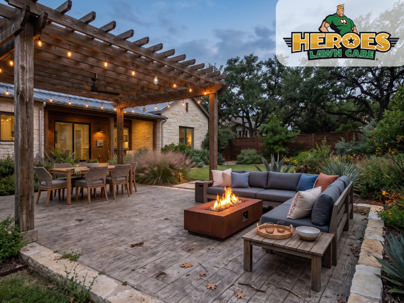
A patio with no shade tends to sit empty during the hottest part of a Texas afternoon, no matter how well it's built. A pergola positioned over a portion of the space provides relief from direct sun while still allowing airflow, and a partially covered structure can extend comfortable use of the patio into more hours of the day and more months of the year than an exposed slab ever could on its own.
Orientation matters here as much as the structure itself. A shade element positioned without regard for how the sun moves across a specific lot can end up providing far less relief than expected, while one planned around the actual path of the sun through the afternoon can keep a seating or dining area comfortable well past the point an unshaded patio would become unusable. This is one of the details a professional design process accounts for that's easy to miss when planning a backyard without guidance.
Lighting and Fire Features That Change How a Backyard Feels at Night
Layered lighting — a mix of ambient string or path lighting, task lighting near a cooking area, and accent lighting around plantings or architectural features — turns a patio that goes dark and unused after sunset into a space that functions well into the evening. A fire pit or fire feature adds both warmth and a natural gathering point, which is often what separates a patio that's occasionally used from one that becomes the default spot for evenings at home.
Privacy and Comfort: Making the Space Feel Like a Retreat
Not every backyard update is about entertaining. A growing number of homeowners are treating their patio as a quiet retreat rather than a gathering spot — a place to decompress after work rather than host a crowd. Simple additions like a privacy screen, layered plantings along a fence line, or a lounge area angled away from neighboring windows can make a patio feel sheltered and calm rather than exposed. That sense of privacy tends to matter just as much to how often a space gets used as any furniture or finish choice.
Low-Maintenance by Design: Why Concrete Holds Up Long Term
Part of what makes a concrete foundation appealing for a full outdoor living space is how little ongoing effort it demands compared to the alternatives. There's no annual staining or sealing required the way there is with wood, no individual units to reveal the way there can be with pavers, and no synthetic material to replace every several years the way artificial surfaces eventually need. For an older slab that's showing wear, patio replacement and resurfacing offers a practical way to restore both the surface and the look of the space without a full teardown — which is often a more efficient path than starting the entire project over.
Why Cedar Park Homeowners Choose Heroes Lawn Care
Heroes Lawn Care approaches backyard transformations as a complete design-and-build process rather than a single isolated pour. That distinction matters, because a patio that's planned in coordination with lighting, plantings, drainage, and shade structures tends to function far better as a finished space than one installed on its own and built around afterward.
A Design-Build Team That Plans the Whole Backyard, Not Just the Slab
Because Heroes Lawn Care operates as a full-service landscaping and hardscape company, a patio project can be planned alongside the rest of the yard — grading, plant beds, walkways, and lighting — instead of existing as a disconnected feature in the middle of an otherwise unplanned space. This kind of professional concrete patio service tends to produce a backyard that reads as one cohesive design rather than a series of separate projects added over time.
What to Expect From Consultation to Completion
A typical project starts with a conversation about how the space will actually be used — daily family time, regular entertaining, a quiet retreat, or some combination of all three. From there, Heroes Lawn Care walks through layout options, finish choices, and any additional features like shade structures or fire elements before any custom concrete patio installation work begins. The result is a Cedar Park backyard that's been planned around how a family actually lives, rather than assembled piece by piece after the fact.
A Reputation Built on Cedar Park Backyards
Because Heroes Lawn Care works consistently throughout the Cedar Park area, the team has a working familiarity with local lot sizes, HOA expectations, and the kinds of layouts that tend to suit this market's mix of home styles. That local track record tends to matter more than it might seem — a backyard plan built with the neighborhood's actual conditions in mind is far more likely to hold up and look intentional than one adapted from a generic template.
Conclusion
A backyard doesn't stay boring because homeowners don't care about it — it usually stays boring because it was never given a real foundation to build on. Once a stable, well-designed Concrete Patio is in place, everything else — shade, seating, lighting, a fire feature, an outdoor dining setup — has something solid to anchor to, and the space starts getting used the way it was always meant to be. For homeowners throughout Cedar Park who are ready to stop settling for a yard that just sits there, Heroes Lawn Care builds that foundation with the finished outdoor living space already in mind, not as an afterthought.
Whether the goal is a full backyard renovation or simply replacing a patio that's already showing its age, the same principle applies: the space works when it's designed with everyday life in mind, not just poured and left to figure itself out. That's the difference between a backyard that gets photographed once and forgotten, and one that becomes part of how a Cedar Park family actually spends its time at home. The backyard that's currently sitting quiet doesn't have to stay that way — the only real difference between it and one that gets used every week is a foundation built with that outcome in mind from the start.