
The View vs. the Wind: What Volente, TX Pergola Construction Actually Has to Solve | Heroes Lawn Care of Cedar Park
A lakeside pergola faces two design pressures pulling in opposite directions at once. The whole point of the structure is preserving an unobstructed view of Lake Travis, which pushes toward open framing, minimal posts, and a light structural footprint. At the same time, that same open, exposed lakefront position means the structure faces meaningfully more wind force than a comparable pergola built on a typical inland suburban lot, which pushes toward heavier bracing, more substantial footings, and a genuinely robust structural system. Reconciling those two competing demands is the actual engineering problem behind every well-built lakeside pergola.
This tension doesn't resolve itself simply by picking a midpoint between the two extremes. A structure built to a generic, averaged specification risks being simultaneously too heavy-looking for the view it was meant to frame and still inadequately engineered for the specific wind conditions the site actually experiences. Genuinely solving the problem requires addressing each pressure deliberately, rather than assuming a compromise automatically satisfies both.
Pergola construction in Volente, TX has to solve for both pressures simultaneously, not treat one as the primary design driver and the other as an afterthought addressed with whatever standard specification happens to be on hand.
Heroes Lawn Care of Cedar Park, working as a landscaper across the broader Lake Travis corridor, treats this dual challenge as the defining design question for every lakeside pergola project, since a structure that solves only one half of the equation, an open view with inadequate wind resistance, or a wind-resistant structure that blocks the water view, ultimately fails at the actual purpose a lakeside outdoor living space is meant to serve.
The Two Competing Pressures Behind Every Volente, TX Pergola Construction Project
Understanding why these two pressures exist in the first place, and why they pull against each other, is the starting point for any lakeside pergola design that actually works.
Why Lakefront Wind Exposure Isn't the Same as Suburban Wind Exposure
Wind exposure categories classify the terrain surrounding a structure, with open, unobstructed terrain producing meaningfully higher wind pressure at the same wind speed compared to a typical suburban lot surrounded by buildings, trees, and other obstructions that naturally break up airflow. A property positioned directly along open water, as many Volente, TX lots along Lake Travis are, commonly falls into a higher exposure category than an inland suburban property just a short distance away, which means the actual wind force a lakeside pergola needs to resist can run substantially higher than a generic, one-size-fits-all specification would assume.
This distinction is easy to overlook precisely because two properties separated by only a mile or two can face genuinely different wind conditions, one nestled among mature trees and neighboring structures, the other sitting exposed along open water with nothing breaking the wind before it reaches the property. A pergola design and specification appropriate for the first property can be meaningfully under-built for the second, even though both fall within the same general Central Texas region and might otherwise seem to share similar climate conditions.
Full Afternoon Sun and No Natural Shade Buffer
Many Lake Travis-facing properties orient toward the west or southwest, positioned to capture the lake view directly, which also means these properties receive full, unfiltered afternoon sun with no natural tree line or structure to break it up. This combination, direct afternoon sun exposure paired with the open wind exposure already discussed, shapes several of the material and design decisions that follow, since a structure built for this specific combination of conditions needs to perform differently than one built for a shaded, wind-protected inland lot.
Solving for the View: Cantilever Design and Open Framing
The view-preservation half of the equation points toward design choices that minimize visual obstruction, even where that runs somewhat against the instinct to simply build a heavier, more conservative structure.
Cantilevered Patio Shade Pergola Construction
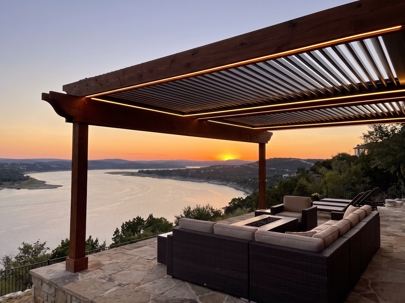
Cantilevered patio shade pergola construction supports the roof structure from offset posts rather than a traditional four-corner post arrangement, eliminating the support columns that would otherwise sit directly in a homeowner's sightline toward the water. This floating, post-free profile genuinely does open up the floor plan and preserve views in a way a conventional four-post design simply can't match, though it requires more sophisticated structural engineering to achieve safely, since the cantilevered portion of the structure needs to resist both gravity load and wind uplift without the direct support a corner post would normally provide.
The engineering challenge here compounds directly with the elevated wind exposure already discussed. A cantilevered structure asks more of its remaining support points precisely because it has fewer of them, which means the connection hardware and footings supporting a cantilever design on an already high-wind-exposure lakefront lot need to be specified even more conservatively than a comparable cantilever built on a more sheltered inland property. Achieving the open, post-free profile a lakeside view demands, on a site that also happens to face elevated wind exposure, requires structural calculations calibrated specifically to that combination rather than a generic cantilever specification borrowed from a lower-exposure setting.
Freestanding Double-Beam Pergola Design
Freestanding double-beam pergola design offers an alternative approach to view preservation, using paired structural beams to distribute load across a wider span than a single beam could safely manage, allowing for fewer total support points across the overall structure. This design approach doesn't achieve quite the same fully post-free profile a true cantilever offers, but it does reduce the total number of posts needed compared to a conventional design built purely around minimum span requirements, offering a meaningful middle-ground option for properties where a full cantilever design isn't the right fit.
Solving for the Wind: Bracing, Brackets, and Footings Built for Open Exposure
The wind-resistance half of the equation requires hardware and foundation work specifically calibrated to the higher exposure category a lakefront property actually experiences.
Heavy-Duty Powder-Coated Steel Bracket Assembly
Heavy-duty powder-coated steel bracket assembly hardware provides the connection strength a lakeside pergola's structural joints need to resist the elevated wind loads open-water exposure produces, while the powder-coated finish resists the corrosion that comes with sustained proximity to water and humidity. Standard residential bracket hardware, adequate for a suburban lot's more moderate exposure category, often falls short of what a genuinely open lakefront position demands, which makes hardware specification a detail worth confirming specifically rather than assuming a general residential standard applies.
Corrosion resistance deserves particular attention on a lakefront property, since the combination of humidity, occasional splash exposure, and sustained sun creates conditions that accelerate hardware degradation compared to a typical inland installation. Powder coating provides meaningfully more durable protection against this environment than a standard painted or untreated finish, extending the hardware's effective service life in exactly the conditions most likely to compromise a less robust finish over time.
Hill Country Limestone Footing Anchor Setting
Hill Country limestone footing anchor setting addresses both the elevated wind load and the often irregular, terraced terrain common across Lake Travis properties, where grade changes and existing limestone bedrock frequently require custom footing engineering rather than a standard, uniform foundation approach. Properties positioned on terraced lakefront lots often need footing plans specifically adapted to each individual post location's actual grade and subsurface conditions, since a single generic footing depth rarely suits every post position across a sloped, irregular lakeside lot.
Limestone bedrock, common throughout the Lake Travis area, presents its own specific installation considerations compared to deeper, softer soil conditions found elsewhere in Central Texas. Anchoring into limestone can actually provide excellent load-bearing stability once properly engineered for, though reaching and preparing that bedrock consistently across an entire pergola footprint requires site-specific assessment rather than an assumption that subsurface conditions will be uniform across every post location.
The Roof Decision: Adjustable Shade for a Sun-Exposed Lake Elevation
Given the full afternoon sun exposure common to lake-facing properties, roof type becomes a genuinely consequential decision rather than a purely aesthetic one.
Motorized Louvered Roof Pergola System
Motorized louvered roof pergola system installations allow homeowners to adjust shade coverage throughout the day, closing the louvers during peak afternoon sun exposure and opening them during milder morning or evening hours, addressing the lack of natural shade buffer that many west and southwest-facing lake properties experience. This adjustability offers a genuine advantage over a fixed roof design specifically because lakefront exposure tends to be more consistently intense than a shaded inland property, where natural tree cover already provides some of the variable shade a louvered system creates mechanically.
This adjustability also allows a homeowner to fully open the roof during milder conditions, maximizing both natural light and an even more unobstructed view of the sky and surrounding Hill Country landscape beyond the immediate lake view, then close it again as needed for shade or light rain protection. A fixed roof design forces a single, unchanging compromise between shade and openness, while a motorized system lets that balance shift throughout the day and across seasons according to actual conditions rather than a single fixed decision made at installation.
High-Wind Resistant Lakeside Timber Pergola Framing
High-wind resistant lakeside timber pergola framing needs to account for the increased solid-surface wind load a louvered roof system presents compared to a fully open trellis design, since even in its open position, a louvered roof system's individual blades and mounting hardware still create more wind resistance than bare open framing would. This means the underlying timber framing supporting a motorized louvered system needs to be specified with both the elevated lakefront wind exposure category and the roof system's own wind resistance characteristics factored into the same structural calculation, rather than treated as two separate considerations addressed independently.
Making the Space Genuinely Usable: Kitchen, Lighting, and Traditional Options
Beyond the core structural tension between view and wind, a genuinely successful lakeside pergola also needs to function well as an actual entertaining space.
Integrated Outdoor Kitchen Pergola Overhang and Embedded LED Strip Lighting Pergola Installation
Integrated outdoor kitchen pergola overhang design positions cooking and serving areas to take advantage of the shade structure above while maintaining clear sightlines toward the water from the primary gathering areas, a coordination that requires thinking through kitchen placement and view preservation together rather than treating them as separate design decisions. Embedded LED strip lighting pergola installation extends a lakeside pergola's usability into the evening hours, when Lake Travis properties often see their most valued use, watching sunset colors reflect across the water without losing structural coverage or ambient lighting once natural light fades.
Kitchen placement in particular benefits from careful consideration of sightlines specific to a lakeside property, since a poorly positioned cooking area can inadvertently place whoever is preparing food with their back to the water view for the majority of an evening's entertaining. Positioning the kitchen along one edge of the structure, rather than centered in a way that blocks the clearest view corridor, tends to preserve both functional cooking space and the view priority that likely drove the entire project in the first place.
Custom Cedar Arbor and Trellis Shade Structure for Properties That Don't Need the Full System
Custom cedar arbor and trellis shade structure options remain a genuinely appropriate choice for Volente, TX properties that don't require the full motorized, cantilevered system, particularly on lots with more moderate sun exposure or existing natural shade that reduces the need for adjustable coverage. Lake Travis lakeside deck pergola installation doesn't automatically mean the most elaborate available system; matching the actual structure to a specific property's exposure, view priorities, and existing outdoor living setup remains the more genuinely useful design principle than defaulting to the most feature-rich option regardless of whether a given property actually needs it.
A property positioned with some natural tree cover, or oriented in a direction that doesn't face the same full afternoon sun exposure as a directly west-facing lot, may genuinely be better served by a simpler cedar structure than by the full motorized and cantilevered approach appropriate for a more exposed neighboring property. Recommending the simpler option when it genuinely fits, rather than defaulting to the most elaborate system regardless of actual site conditions, reflects the same honest, condition-specific assessment that should drive every decision throughout the design process.
Heroes Lawn Care of Cedar Park designs every Volente, TX pergola project around this specific balance between view preservation and wind resistance, starting with an honest assessment of a property's actual exposure category and sun orientation before any structural or roofing decisions get finalized. Cantilevered patio shade pergola construction and freestanding double-beam alternatives both get evaluated against a property's real conditions, rather than one design approach being applied by default regardless of what a specific lakefront lot actually requires.
This assessment-first approach also helps homeowners avoid the disappointing outcome of investing in a fully cantilevered, view-optimized design, only to discover partway through the engineering process that the specific site's wind exposure and grade conditions genuinely call for a more conservative structural approach. Understanding these tradeoffs clearly during initial planning, rather than after a design has already been emotionally committed to, produces a far smoother path from concept to finished structure.
Heroes Lawn Care of Cedar Park also specifies bracket hardware and footing plans calibrated to Lake Travis's genuinely elevated wind exposure category, recognizing that standard residential specifications developed for suburban lots don't automatically transfer to an open lakefront position without meaningful adjustment. As the landscaping and lawn care company based in Cedar Park, TX serving the broader Lake Travis corridor, Heroes Lawn Care of Cedar Park brings this same attention to site-specific conditions across the full range of landscaping and outdoor living work it handles for Volente, TX homeowners, not just pergola construction in isolation.
Conclusion
A lakeside pergola in Volente, TX succeeds only when it resolves the genuine tension between two competing priorities: keeping the structure open enough to preserve the lake view that made the property valuable in the first place, while building it strong enough to withstand wind exposure meaningfully more severe than what a typical inland pergola ever has to face. Neither priority can be treated as secondary to the other without compromising the finished result.
This dual solving is ultimately what separates a genuinely successful lakeside pergola from one that quietly disappoints in one direction or the other, a structure that looks stunning in photos but sways uncomfortably during a strong lake wind, or a bulletproof structure so heavily braced that it blocks the exact view it was meant to frame. Getting both halves of this equation right simultaneously requires treating them as one connected design problem from the very first planning conversation, rather than addressing structural adequacy and view preservation as separate, sequential concerns.
Heroes Lawn Care of Cedar Park builds every pergola construction project in Volente, TX around this exact balance, matching structural approach, roofing system, and footing design to each property's specific view priorities and actual wind exposure conditions. Solving for both the view and the wind simultaneously, rather than favoring one at the expense of the other, remains the most reliable way to end up with a lakeside pergola that performs as well structurally as it does as a place to actually watch the sun go down over the water.