The Silent Tree Killer Spreading Through Round Rock, TX Neighborhoods (And What Your Landscaping Needs to Do About It) | Heroes Lawn Care of Cedar Park
Landscaping in Round Rock, TX is often discussed in terms of grass health, irrigation, curb appeal, and seasonal maintenance, but the mature trees above the lawn can be far more valuable and much harder to replace. That is why oak wilt deserves special attention. This vascular disease affects oak trees by interfering with their ability to move water through their tissues, and in Central Texas it can move between susceptible trees both through insect-assisted infection of fresh wounds and through interconnected root systems. The difficult part is that an affected landscape may look normal until canopy symptoms become noticeable, which is why prevention matters long before a homeowner sees a tree in obvious decline.
Good Landscaping therefore has to account for what happens both above and below the turf. A mower striking an exposed oak root, construction equipment cutting through the root zone, unnecessary pruning at a high-risk time, or excavation performed too close to established trees can create problems that have little to do with conventional lawn care. Texas A&M Forest Service recommends avoiding unnecessary oak pruning or wounding from February through June and immediately painting fresh oak wounds whenever they occur. For a property with established live oaks, tree protection should influence how beds, drainage work, turf renovation, and construction activities are planned.
The connection between oak health and Landscaping is particularly important in neighborhoods where several mature oaks grow close together. Live oaks can share interconnected roots, giving oak wilt a pathway to move underground after an infection center becomes established. Heroes Lawn Care of Cedar Park approaches this kind of landscape planning with the understanding that preserving an established tree canopy requires more than reacting to visible symptoms. Maintenance schedules, soil disturbance, irrigation, planting design, and renovation work all need to respect the tree’s root zone and the possibility of disease transmission.
Oak Wilt Is Different from an Ordinary Lawn or Tree Problem
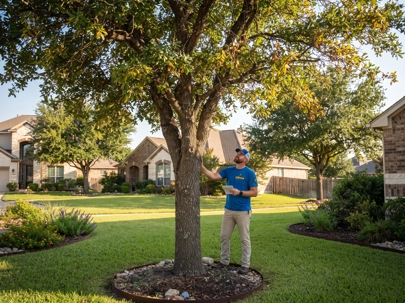
Oak wilt should not be confused with general heat stress, drought damage, nutrient deficiency, insect injury, or a typical turf disease. The pathogen affects the vascular system of susceptible oak trees, restricting water movement and causing canopy decline. In live oaks, one recognized symptom is veinal necrosis, in which portions of the leaf veins develop yellow or brown discoloration. Red oaks can decline much more rapidly. Symptoms alone, however, are not sufficient reason for a homeowner to assume oak wilt is present, because several other environmental and biological problems can produce similar-looking stress.
That distinction is important because a routine lawn disease and fungus treatment application is not a substitute for diagnosing oak wilt. Turf fungicides are formulated for lawn diseases and should not be treated as a tree-level solution simply because both problems involve fungi. When an oak begins declining unexpectedly, especially when nearby oaks show similar symptoms, professional tree-health assessment becomes more appropriate than experimenting with generalized landscape treatments. The objective should be to determine whether the problem is oak wilt, root injury, drought stress, construction damage, another disease, or a combination of factors before deciding what should happen next.
Round Rock itself maintains an Urban Forestry Division and tree-care standards that acknowledge oak wilt as a significant tree-health concern. That local context matters because tree care is not an isolated gardening issue. Mature canopy influences property shade, soil temperature, water demand, habitat, and the overall character of established neighborhoods. Losing one substantial oak can change the growing environment beneath it almost immediately.
Prevention Starts with What Happens Around the Trunk and Roots
Many homeowners naturally focus on branches when thinking about tree health, but the root zone can be equally important. Grade changes, trenching, compacted soil, repeated equipment traffic, and aggressive excavation can damage roots even when the tree canopy looks untouched. Landscaping projects near mature oaks should therefore begin by identifying where major roots are likely to extend and minimizing unnecessary soil disturbance within that area.
Oak wilt prevention and pruning care should be incorporated into routine property planning rather than treated as an emergency response. Pruning schedules need to account for disease-risk periods, and accidental wounds from mowers, string trimmers, construction, or storms should receive appropriate attention. Work crews also need to recognize that an oak trunk is not the only vulnerable part of the tree. Surface roots can be wounded during edging, grading, excavation, and attempts to reshape lawn areas.
Soil management matters as well. Blackland prairie soil amendment and conditioning may be appropriate on properties with heavy, clay-dominant soils, but it should never mean indiscriminately digging through established tree roots. Round Rock and the surrounding Williamson County area include differing soil environments, so soil improvement should begin with the actual conditions on the property rather than a generic regional assumption. Aeration, organic matter, drainage improvement, and surface amendments should be selected with existing roots in mind.
Landscaping Around Mature Oaks Without Creating New Problems
Landscape renovations beneath mature trees require restraint. Installing new beds, borders, decorative rock, or irrigation may improve the property visually, but changing soil depth or cutting extensively through roots can create stress. Decorative river rock weed barrier installation, for example, should be designed so it does not bury the root flare, trap excessive heat against the trunk, or require damaging excavation around important roots.
The same applies to custom steel flower bed edging installation. A clean steel border can sharpen the appearance of beds and simplify maintenance, but aggressive trenching through major oak roots defeats the purpose of improving the landscape. Installation depth and routing should respond to existing roots rather than forcing a predetermined geometric line through them.
This is one reason successful tree-centered Landscaping sometimes looks less rigid than a new landscape built on an empty lot. Established trees already define part of the design. Beds, walkways, turf transitions, and drainage routes should adapt to the biological infrastructure that is already present instead of treating every root as an obstacle to remove.
Rebuilding the Landscape When a Tree Is Lost or Declining
When a mature tree declines severely or must eventually be removed after proper diagnosis, the surrounding landscape changes in ways that extend far beyond the missing trunk. Areas that were heavily shaded may suddenly receive hours of direct sunlight. Turf species that tolerated the old shade may behave differently. Irrigation zones may deliver more water than the newly exposed soil needs, and understory plants accustomed to protection from afternoon heat may begin to struggle.
Texas native shade tree installation can be part of the long-term recovery strategy, but replacement should not be treated as a one-for-one cosmetic substitution. Species diversity deserves serious consideration, especially in neighborhoods dominated by one tree type. Diversifying the canopy can reduce the extent to which a single pest or disease threatens the character of an entire property. Placement should also account for mature size, utility lines, structures, irrigation, soil volume, and long-term root development.
Homeowners should also reconsider what happens at ground level. An evergreen privacy hedge screening installation may replace some visual screening lost after canopy removal, while redesigned planting beds can create structure during the years a younger shade tree needs to mature. The goal is not to hide the loss, but to rebuild the landscape so it remains attractive and functional while the next generation of trees establishes.
Lawn restoration may also be necessary. Spring lawn overseeding and topdressing can be appropriate in certain turf situations, but it should not become an automatic prescription for every warm-season lawn. Turf variety, season, sunlight, and the degree of soil disturbance should determine whether overseeding, sod replacement, topdressing, or another renovation method is more appropriate.
Drainage, Grading, and HOA Appearance Still Matter
Tree protection does not eliminate the need to address drainage and neighborhood appearance. In fact, drainage problems can place additional stress on trees by creating chronically saturated or excessively dry areas around roots. Yard slope re-grading for storm runoff may be necessary where water repeatedly crosses lawns, collects near structures, or erodes planting beds, but grading plans near established trees should minimize root-zone disturbance. Solving a runoff problem by severely cutting important roots can exchange one landscape problem for another.
Homeowners also need to distinguish city requirements from private neighborhood rules. What might casually be called a Round Rock HOA landscape compliance standard is not one universal citywide HOA specification. Individual homeowners associations can have their own requirements for tree removal, replacement planting, visible dead vegetation, edging, front-yard modifications, and approved landscape materials. Before removing a prominent tree or redesigning a highly visible front yard, homeowners should check both applicable municipal requirements and their own association documents.
This becomes particularly important after tree loss. A property may need temporary landscape adjustments while replacement trees establish, and the homeowner may want to use river rock, alternative planting, edging, or lawn renovation to restore curb appeal. Coordinating those changes early can prevent a rushed design that solves the visual problem but creates new irrigation, drainage, or maintenance difficulties.
Build a Landscape That Is Less Vulnerable to the Next Problem
The larger lesson from oak wilt is that resilient landscapes should not depend too heavily on one species, one irrigation pattern, or one maintenance assumption. Tree diversity, appropriate plant selection, healthy soil, deliberate drainage, and careful construction practices make the entire property more adaptable. They also help homeowners distinguish normal seasonal changes from warning signs that deserve professional attention.
A resilient landscape may combine native or adapted trees with well-planned turf, evergreen screening, defined beds, and drainage improvements. Decorative features should be placed where they can be maintained without repeatedly damaging roots. Irrigation should support trees and turf without creating prolonged saturation, while lawn treatments should target diagnosed problems rather than being applied simply because vegetation looks stressed.
Heroes Lawn Care of Cedar Park can play a broader Landscaping role by coordinating lawn, soil, drainage, and landscape work around the needs of established trees, while suspected oak wilt itself should be evaluated through appropriate tree-health expertise. Knowing when a landscape problem has crossed into specialized arboricultural territory is part of responsible property management.
The Most Important Landscaping Decision May Be What You Choose Not to Disturb
Preventive Landscaping around mature oaks often depends on restraint. Not every exposed root needs to disappear beneath new soil. Not every irregular bed edge needs a trench cut through it. Not every canopy needs aggressive thinning, and not every struggling patch of lawn needs excavation beside an established tree. Sometimes protecting the long-term value of the property means adjusting the design around the tree instead of forcing the tree to accommodate the design.
That approach becomes especially important when several oaks occupy the same property or neighborhood. Landscaping decisions involving trenching, re-grading, bed construction, irrigation modifications, or replacement planting should consider how roots, water, soil, and mature canopy interact. A visually polished project can still be a poor landscape investment if the construction process unnecessarily damages the trees providing much of the property’s shade and character.
Conclusions
Oak wilt is a serious Central Texas tree disease, but effective Landscaping begins by avoiding panic and focusing on prevention, diagnosis, and careful site management. Round Rock homeowners should pay attention to unusual oak decline, avoid unnecessary oak wounding during higher-risk periods, protect root zones during construction, and seek qualified tree-health guidance when multiple oaks begin showing suspicious symptoms. Lawn fungicides or cosmetic maintenance should never be assumed to solve a vascular tree disease.
The larger Landscaping lesson is that tree health cannot be separated from the rest of the property. Drainage, soil work, lawn renovation, edging, planting, grading, and irrigation can either support mature trees or place additional stress on them. By treating the canopy, root zone, lawn, and built landscape as one connected system, Round Rock homeowners can protect existing trees while creating a property that is better prepared for disease, drought, storms, and future landscape change.