
The Deck Patio Builder Round Rock, TX Homeowners Wish They'd Called First
There's a familiar pattern in outdoor renovation projects across Central Texas: a homeowner hires the first contractor who returns a phone call, the project moves forward, and within a year or two something starts going wrong — boards that cup and warp, railings that wobble, a surface that never quite drains the way it should after a storm. A second call gets made, this time to a more experienced deck patio builder, and the homeowner ends up paying twice for a project that should have only needed doing once.
This pattern shows up often enough in Round Rock, TX that it's worth examining closely. The goal here isn't to point fingers at any specific company, but to lay out exactly what separates a first call that gets it right from a first call that quietly sets a homeowner up for a second one.
None of this is unique to any one contractor or any one part of Central Texas. It's a pattern rooted in how outdoor construction decisions tend to get made — quickly, based on speed and availability, without always asking the questions that would reveal how a project is actually going to hold up once real Texas weather has a chance to test it.
Why So Many Round Rock, TX Homeowners End Up Calling a Second Deck Patio Builder
The decision to hire a deck patio builder is usually made under a mix of excitement and time pressure. A backyard vision is finally within reach, multiple estimates need comparing, and the fastest, most affordable option can look appealing in the moment. What often gets overlooked is that a deck is a structural project, not a purely cosmetic one, and cutting corners on the structural side rarely shows up until well after the invoice has been paid.
The Pattern Behind the Regret
Homeowners rarely regret hiring a builder because the finished deck looked bad on day one. The regret tends to surface later, once the visible signs of poor workmanship start appearing — usually somewhere between twelve and twenty-four months in, right around the point when the first full cycle of Central Texas heat, humidity, and rain has had a chance to expose whatever wasn't done correctly the first time.
By the time those signs appear, the original contractor has often moved on to other projects, and getting a warranty claim honored, if a meaningful warranty even exists, can turn into its own frustrating process. That's part of why the decision made in the first phone call carries more weight than it might initially seem to. A slightly longer conversation upfront, one that covers materials, structure, and process in real detail, is a small time investment compared to the disruption of tearing out and rebuilding a deck a year or two after it was supposedly finished.
What Usually Goes Wrong the First Time Around
A handful of issues come up again and again in these stories. Framing that wasn't spaced or fastened to code standards begins to flex or bounce underfoot. Ledger boards attached without proper flashing let moisture into the structure, leading to rot in places that aren't visible until a board is pulled up. Footings poured too shallowly as the soil beneath them moved through the seasons, throwing the entire deck slightly out of level. None of these problems are visible in a walkthrough on completion day, which is exactly why they're so easy for an inexperienced or corner-cutting contractor to leave unaddressed.
The Hidden Cost of a Rushed Estimate
A fast, low estimate can feel like a win in the moment, but it often means shortcuts were built into the number before the first board was ever ordered. A rushed estimate rarely includes time for a proper soil or site assessment, a detailed materials conversation, or a structural plan tailored to the specific property. Heroes Lawn Care treats the estimate stage itself as part of the quality process, walking the property and discussing structural specifics before putting a number in front of a homeowner, rather than generating a generic quote sight unseen.
The Questions Most Homeowners Forget to Ask Before Hiring
A more informed first call tends to start with better questions, not just a lower estimate. Homeowners who ask about materials, structure, and process upfront are in a much stronger position to evaluate whether a builder is offering custom deck patio builder services built around their specific yard, or a generic, one-size-fits-all package.
These conversations don't need to feel adversarial or overly technical to be effective. A homeowner doesn't need a construction background to ask what materials are being used and why, how the structure will be built, and what happens if something needs adjusting after the fact. The willingness of a builder to answer those questions patiently and specifically, without brushing past them, says a great deal about what the rest of the project is likely to look like.
Material Questions That Reveal How a Builder Actually Works
Asking what material options are available, and why a builder recommends one over another for a specific property, tends to reveal a lot about how much attention a project will actually receive. A builder who offers only one material regardless of the homeowner's goals is signaling a limited process. A builder who asks about maintenance preferences, budget priorities, and how the space will be used before recommending wood and composite deck installation options is signaling something closer to a genuine consultation.
Wood vs. Composite: What a Good Builder Should Explain Clearly
Cedar and pressure-treated pine offer a natural look and feel but require periodic sanding, staining, or sealing to hold up against Central Texas sun and humidity, typically every couple of years. Composite decking, made from wood fiber and polymer blends, resists warping, splintering, and fading far better over time, though it generally comes with a different set of installation considerations around expansion and contraction in extreme heat. A builder who explains these tradeoffs clearly, rather than simply pushing whichever material is easiest to source, is demonstrating the kind of professional deck installation approach that tends to hold up over the long run.
Neither material is universally better. Cedar offers a warmth and character that composite can't fully replicate, while composite offers a level of low-maintenance durability that many busy households value more than the natural wood look. A builder offering genuine wood and composite deck installation expertise should be able to walk through both options honestly, including the maintenance commitment each one requires, rather than steering every homeowner toward the same default choice regardless of their actual priorities.
The Structural Details That Separate a Lasting Deck from a Short-Lived One
Materials get most of the attention in a typical sales conversation, but the structural elements underneath the surface are what actually determine whether a deck lasts one Texas summer or twenty.
Framing, Footings, and Fasteners: Why the Unseen Work Matters Most
Proper joist spacing, correctly sized beams, and code-compliant footing depth are not optional details to be adjusted based on budget. They are the foundation of backyard deck construction that will actually hold up to real use — furniture, foot traffic, and the seasonal expansion and contraction of both the wood and the ground beneath it. Corrosion-resistant fasteners matter more in a humid Central Texas climate than they might in a drier region, since standard hardware can begin to weaken years before the visible decking shows any sign of wear.
These details rarely come up unprompted in a sales conversation, largely because they're not visually impressive the way a finished railing or a stain color sample is. A homeowner who asks directly about joist spacing, footing depth, and fastener type is far more likely to get a straightforward answer than one who assumes those details are simply handled correctly by default. In practice, they aren't always handled correctly by default, which is precisely how so many of the structural regrets described earlier end up happening in the first place.
How Texas Heat and Humidity Test a Deck's Build Quality Over Time
A deck that looks solid in October, when temperatures are mild and humidity is manageable, faces a very different test in July and August. Intense sun exposure causes wood to dry, contract, and sometimes crack if it wasn't properly cured or sealed before installation. Humidity swings between seasons put stress on joints and fasteners that weren't rated for the movement. Residential deck contractors familiar with Central Texas conditions plan for that seasonal stress from the beginning, rather than building to a standard that assumes a milder, more consistent climate.
This is also where composite materials tend to draw the most attention, since manufacturers design many composite products specifically to resist the kind of thermal expansion that causes problems for wood in extreme heat. Even so, composite decking still needs to be installed with the correct gapping and fastening technique to perform as advertised — a product's heat resistance on paper doesn't automatically translate into a durable result if the installation itself cuts corners.
What Maintenance and Warranty Conversations Reveal About a Builder
The way a contractor talks about what happens after installation is often just as telling as how they talk about the installation itself.
Why a Vague Maintenance Plan Is a Warning Sign
A builder who can't clearly explain what upkeep a deck will need — how often wood surfaces should be resealed, how composite boards should be cleaned, what warning signs to watch for as the seasons change — is often a builder who hasn't thought much past the day the final board is installed. A detailed, specific maintenance conversation, by contrast, suggests a contractor who is thinking about how the project will perform years down the road, not just how quickly it can be finished and invoiced.
What a Meaningful Warranty Actually Covers
Warranty language can vary significantly between contractors, and a vague, one-line warranty promise is far less useful than a builder who can explain specifically what's covered — structural framing, fasteners, workmanship — and for how long. A builder confident in the quality of their backyard deck construction is generally willing to put that confidence in writing with specific, plain-language terms, rather than a broad statement that sounds reassuring but doesn't actually commit to much. Heroes Lawn Care provides written warranty terms that spell out exactly what's covered on both structural and workmanship elements, so homeowners aren't left interpreting vague language after the fact.
Design That Matches How a Family Actually Lives Outdoors
A deck that's structurally sound but poorly designed for how a family actually spends time outside is still a disappointing result, even if it holds up physically for years.
Custom Layouts vs. Cookie-Cutter Kits
A prefabricated layout might be faster and cheaper to install, but it rarely accounts for how a specific yard slopes, where the sun sits at different times of day, or how a family actually plans to use the space — weekend cookouts, quiet mornings with coffee, or a dedicated play area for kids. Outdoor living space builders who take the time to understand those details before drawing up a design tend to produce a deck design and build services outcome that fits naturally into daily life, rather than one that looks good in photos but goes unused because the layout doesn't match how the household actually functions.
Multi-Level Layouts and Integrated Outdoor Features
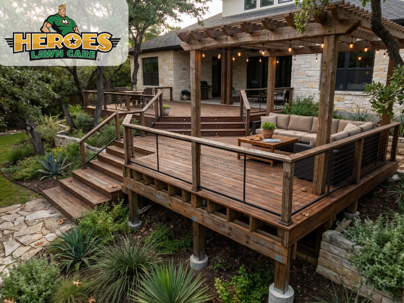
Yards with elevation changes or an existing patio nearby often benefit from a multi-level design that ties the different outdoor areas together rather than treating the deck as a disconnected addition. A builder experienced in patio and deck construction as a combined project tends to design with those transitions in mind from the start — where steps make sense, how railings should be positioned for both safety and sightlines, and how the finished space will actually flow from the back door to the yard beyond it.
Lighting, shade structures, and built-in seating are often far simpler to plan into a design from the outset than to add later as separate projects. A builder thinking beyond the deck boards themselves, toward how the entire outdoor space will function together, tends to produce a result that feels intentional rather than assembled piecemeal over several unrelated projects spread across different seasons.
What a Trustworthy First Call Actually Looks Like
Everything covered so far points toward one practical conclusion: the difference between a homeowner's first call being the only call, or the first of two, usually comes down to a handful of specific signals that are visible before a single board is ever installed.
Signs a Deck Builder Is Being Straightforward From the Start
A builder willing to walk a property in person, explain material tradeoffs honestly, and describe the structural specifics of framing and footings without being asked twice is generally operating with more transparency than one who rushes toward a signed estimate. The same is true of a builder who treats patio and deck patio construction as connected parts of a broader outdoor living plan rather than isolated, disconnected projects. Heroes Lawn Care approaches every consultation in Round Rock, TX with that same level of detail, walking homeowners through material options, structural specifics, and design considerations before any work begins, rather than after a problem has already surfaced.
Homeowners further out, including those in Jonestown, TX, tend to ask the same core questions, even though yard conditions and sun exposure can vary somewhat across the wider Central Texas region. The fundamentals of a properly built deck — sound framing, code-compliant footings, corrosion-resistant fasteners, and materials chosen for the local climate — don't change based on zip code, even if the specific challenges of a given property do.
Conclusion
The homeowners who end up satisfied with their first deck patio builders tend to share a few things in common: they asked pointed questions about materials and structure before signing anything, they chose a builder willing to explain tradeoffs honestly rather than rushing toward the sale, and they treated the project as the structural investment it actually is rather than a purely cosmetic upgrade.
None of the details covered here require special expertise to ask about. Material tradeoffs, structural specifics, maintenance expectations, and warranty terms are all reasonable questions for any homeowner to raise during a first consultation, and a contractor's willingness — or reluctance — to answer them clearly tends to say more about the eventual outcome than the estimated number ever could. A rushed, vague answer to a direct question is rarely a good sign, even when everything else about the pitch sounds polished.
Heroes Lawn Care works with homeowners across Round Rock, TX, and out toward communities like Jonestown, TX, offering custom backyard deck solutions built around the realities of Central Texas soil, heat, and humidity from the very first conversation. That first conversation typically includes a walkthrough of the property, an honest discussion of wood and composite deck installation options, and a clear explanation of how the structural plan accounts for local weather before a single estimated number is ever discussed. Getting the right deck patio builder on the phone the first time is still the simplest way to avoid the second call, the redo, and the frustration of a deck replacement and renovation project that never should have been necessary in the first place.