
Why Leander's Clay Soil Is Quietly Destroying Your Backyard — And How a Concrete Patio Fixes It for Good
Homeowners across Leander are noticing something strange happening to their backyards — hairline cracks spreading across patios, low spots forming after every rainstorm, and once-flat walkways that now dip and tilt. Most people blame poor construction or old age. In reality, the real culprit is usually underground and invisible: expansive clay soil. This soil expands when it absorbs moisture and contracts sharply when it dries out, and in Central Texas, where wet springs are followed by scorching, bone-dry summers, that cycle repeats constantly. A properly engineered Concrete Patio is one of the few backyard surfaces built to withstand this kind of soil movement, which is exactly why it has become the go-to solution for homeowners who are tired of watching their outdoor space crack, sink, or shift year after year.
This article breaks down why Leander's soil behaves the way it does, what happens to backyards that aren't built to handle it, and how a correctly engineered, professionally installed patio system solves the problem permanently rather than temporarily.
It's worth noting that this isn't a problem unique to older homes or neglected yards. Newer builds throughout Leander are just as susceptible, since the underlying soil composition doesn't change based on the age of the house sitting on top of it. Understanding what's actually happening below the surface is the first step toward choosing a backyard solution that won't need to be redone in a few years.
The Hidden Problem Beneath Every Leander Backyard
Leander sits in a region of Texas where the topsoil is heavily influenced by expansive clay — a naturally occurring soil type that changes volume dramatically depending on moisture content. Unlike sandy or loamy soil, clay doesn't drain evenly, and it doesn't stay the same size. During wet months, it swells. During the long Texas summer, it shrinks and pulls away from anything sitting on top of it. That constant push-and-pull is what quietly damages backyard surfaces that were never engineered to move with the ground beneath them.
What Expansive Clay Soil Actually Does to Your Yard
When clay soil shifts, it doesn't move evenly across a property. One section of a yard may swell more than another depending on drainage, tree roots, or sun exposure, which means a flat surface can develop uneven pressure points within a single season. Over time, this uneven movement is what causes poured surfaces without proper reinforcement to crack, walkways to separate at the joints, and outdoor structures to settle unevenly. It's a slow, cumulative process — which is exactly why so many homeowners don't notice the damage until it's already significant.
Tree placement can make this even more unpredictable. Large trees positioned close to a patio or walkway draw moisture from the soil beneath and around their root systems, which means the ground closer to a mature tree may dry out and contract faster than soil just a few feet away. That difference in moisture content across a relatively small area is often what causes a crack to form in one specific spot rather than spreading evenly across an entire surface.
Signs Your Backyard Is Already Being Affected
Several warning signs tend to show up before a backyard problem becomes serious. Hairline cracks that appear after the first hot summer, standing water that pools in the same spot after every rain, a walkway or slab that feels slightly uneven underfoot, and gaps forming between an existing patio and the foundation of the house are all early indicators of soil movement. None of these issues resolve on their own, and left unaddressed, they tend to accelerate rather than stabilize.
Doors or gates that used to swing freely but now stick at certain times of year can also point to soil movement affecting the ground near a home's foundation, even if the connection isn't obvious at first. Taken together, these signs are rarely random — they're usually a pattern that reflects how the soil beneath a property is expanding and contracting throughout the year.
How Leander's Weather Patterns Intensify the Problem
Central Texas doesn't just deliver heat — it delivers extremes in both directions within a single year. A wet spring can saturate clay soil for weeks at a time, followed almost immediately by a summer stretch with little to no rainfall. That rapid swing from saturation to drought is what makes Leander's ground move more aggressively than soil in regions with steadier, more moderate rainfall patterns. Occasional winter freezes add another layer of stress, since any moisture trapped near the surface can expand as it freezes and contract again as it thaws. Each cycle, on its own, seems minor. Repeated year after year, it's enough to compromise a surface that wasn't designed to move along with it.
Why Standard Backyard Surfaces Fail in Leander's Soil
Gravel, loose stone, and thin, unreinforced slabs are especially vulnerable because they rely on the soil beneath them to stay consistent. In a region with expansive clay, that consistency simply doesn't exist. Wood decking fares slightly better structurally but is exposed to Central Texas humidity and UV intensity, which shortens its lifespan considerably. This is why residential concrete patio contractors in this region increasingly recommend a fully engineered slab system rather than a surface-level fix — the solution has to address what's happening below ground, not just what's visible above it.
It's also common for homeowners to try patching or leveling an existing surface as a short-term fix, only to find the same cracks or low spots reappear within a season or two. This happens because patching addresses the visible symptom without correcting the underlying cause. Until the base preparation, reinforcement, and drainage are handled correctly, any surface poured on top of untreated expansive soil is working against the same forces that damaged the one before it.
How a Properly Installed Concrete Patio Solves the Problem
The difference between a backyard surface that fails within a few years and one that holds up for decades almost always comes down to what happens before the first layer of concrete is ever poured. A correctly engineered concrete slab patio installation accounts for soil movement from the very beginning, rather than treating it as an afterthought.
Engineering a Foundation Built for Central Texas Soil
A durable patio starts with proper grading, so water flows away from the structure instead of pooling beneath it. The subgrade is then compacted to reduce the air pockets that allow soil to shift unevenly, and a reinforced base — typically steel rebar or wire mesh embedded within the slab — helps the concrete move as a single, stable unit rather than cracking at its weakest point. This kind of custom concrete patio installation is noticeably more resistant to the seasonal expansion and contraction that damages unreinforced surfaces.
The Role of Reinforcement, Base Prep, and Drainage
Drainage in particular is often underestimated. A patio that's poured without proper slope or a drainage plan will hold water directly against the slab edges, which accelerates the very soil movement it needs to resist. Combining thorough base preparation, reinforcement, and intentional drainage design is what separates a long-lasting patio from one that needs repair within a few short years.
Sealing plays a supporting role in this same system. A quality sealant limits how much moisture the concrete itself absorbs, which matters in a climate where humidity and sudden downpours are both common. This isn't a one-time step — periodic resealing keeps the slab's surface protected long after installation, working alongside the reinforced base to extend the life of the patio well beyond what an unsealed, unreinforced surface could achieve.
Design Options That Fit Every Leander Backyard
Durability doesn't have to come at the expense of style. Modern patio design and build options range from a clean broom-finished slab to fully decorative surfaces that mimic natural stone, brick, or hardwood — all while maintaining the strength that Central Texas soil demands.
Stamped, Decorative, and Custom Finishes
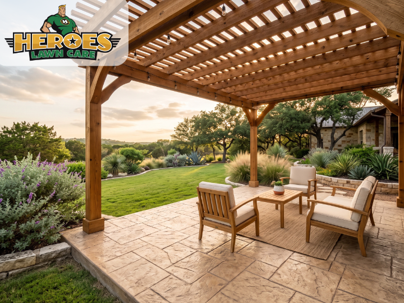
Stamped concrete patio services have grown especially popular because they allow homeowners to achieve the look of flagstone, slate, or travertine at a fraction of the long-term maintenance. Warm tans, soft charcoals, and desert-inspired earth tones tend to complement the Hill Country landscape particularly well, and decorative concrete patio designs can be tailored to match a home's existing exterior rather than standing apart from it. Because the finish is applied to an engineered slab, homeowners get the visual upgrade without sacrificing the structural benefits underneath.
Matching Finishes to Different Backyard Styles
Homes throughout Leander range from traditional Hill Country exteriors to more contemporary builds, and finish selection typically follows that same range. A textured, earth-toned stamped pattern tends to suit a traditional exterior, while a smooth, monochromatic finish in a cooler gray tone often complements a more modern layout. Because the base engineering stays consistent regardless of finish, homeowners aren't forced to choose between a look that fits their home and a structure that holds up over time.
Concrete Patio vs. Pavers, Wood Decks, and Loose Stone
Pavers offer flexibility but rely on individual units staying aligned over shifting soil, which often means periodic releveling. Wood decking requires ongoing sealing and is more vulnerable to Central Texas sun and humidity. Loose stone and gravel surfaces shift underfoot and rarely stay level for long. A single, reinforced concrete slab avoids most of these maintenance cycles by moving as one connected structure rather than dozens of independent pieces.
This doesn't mean pavers or decking are without merit — both can work well in the right setting. But when expansive clay soil is the primary concern, a monolithic reinforced slab has a structural advantage that segmented materials simply can't match, since there are no individual joints or units for the shifting ground to work apart over time.
Turning Your Patio Into a Complete Outdoor Living Space
A backyard patio construction project rarely stops at a single slab of concrete anymore. Increasingly, homeowners are treating the patio as the foundation for a broader outdoor living space installation — one that includes shaded seating, a fire feature, or a dedicated space for outdoor cooking and entertaining.
Pairing Your Patio With Pergolas, Fire Pits, and Seating Areas
A pergola positioned over a portion of the patio provides relief from direct summer sun while still allowing airflow, making the space usable for more hours of the day. A fire pit extends that usability into cooler evenings, and a defined seating area gives the whole space a sense of purpose rather than functioning as empty poured ground. Because the underlying slab is engineered to handle soil movement, these additional features can be incorporated without worrying that shifting ground will compromise them later.
How an Outdoor Living Space Increases Everyday Use of a Backyard
A backyard that's difficult to use in the peak of summer heat or after a rainstorm tends to go unused for much of the year. Once a stable, level surface is in place, that changes considerably. Shade from a pergola, a defined dining or lounging area, and a slab that doesn't retain standing water all contribute to a space that's usable more often — not just for special occasions, but for everyday routines like morning coffee, evening dinners, or weekend downtime. The initial outdoor living space installation tends to pay off less in a single dramatic transformation and more in the accumulated value of a backyard that's actually used week after week.
Protecting Your Investment: Sealing, Resurfacing, and Long-Term Care
Even a well-engineered patio benefits from routine maintenance. Sealing helps protect against moisture intrusion and staining, particularly important given how much rain Central Texas can receive in short bursts. For older surfaces that are already showing wear, patio replacement and resurfacing can restore both the appearance and structural integrity of a slab without a full teardown, which is often a more practical option than starting from scratch. Professional concrete patio services typically include an assessment of whether resurfacing or full replacement makes more sense for a given property.
Why Leander Homeowners Trust Heroes Lawn Care
Heroes Lawn Care approaches every patio project with an understanding that Central Texas soil doesn't behave like soil anywhere else in the country. That local knowledge shapes everything from the initial site evaluation to the final finish, ensuring the patio installed today is still performing the way it should years down the road.
Local Expertise Across Leander, Round Rock, and Cedar Park
Because Heroes Lawn Care works throughout Leander and the surrounding communities, the team brings first-hand familiarity with how local soil, drainage patterns, and seasonal weather shifts affect outdoor construction. That regional experience means fewer surprises during installation and a patio that's built specifically for the conditions it will actually face, rather than a generic approach borrowed from a different climate entirely.
What to Expect From a Concrete Patio Consultation
A typical consultation begins with an evaluation of soil conditions, drainage patterns, and how the space will be used — whether that's quiet family evenings, larger gatherings, or a low-maintenance upgrade to an existing slab. From there, Heroes Lawn Care outlines design options, reinforcement needs, and finish choices so homeowners can make an informed decision before any work begins. The goal throughout is a finished space that looks intentional, fits the home, and is built to handle exactly what Leander's ground conditions will throw at it.
A Full-Service Approach to Backyard Improvement
Because Heroes Lawn Care operates as a full landscaping and hardscape company rather than a single-trade operator, patio projects can be considered alongside broader backyard elements — grading, drainage improvements, plantings, and lighting — instead of being treated as an isolated slab in the middle of an otherwise unplanned space. That broader perspective is part of what distinguishes professional concrete patio services from a narrower, one-off installation, and it's part of why homeowners throughout the area continue to return to the same team for follow-up projects once the first one is complete.
Conclusion
Backyard damage in Leander is rarely random. In most cases, it's the predictable result of expansive clay soil moving beneath a surface that was never engineered to handle it. Recognizing the early warning signs — cracking, pooling water, uneven ground — gives homeowners the chance to address the problem before it becomes a larger, more expensive repair. A professionally engineered Concrete Patio solves that problem at its source, combining proper base preparation, reinforcement, and drainage with a design that fits the home. Heroes Lawn Care has built its approach around exactly these local soil conditions, giving homeowners throughout Leander a backyard surface that's designed to last rather than one that simply looks good on installation day.
Whether the goal is replacing a damaged surface, starting a backyard project from scratch, or building out a fuller outdoor living space around an existing slab, the underlying principle stays the same: a durable outdoor surface has to be engineered for the ground it sits on, not just the space it fills. For homeowners in Leander, that means planning around clay soil from day one — and working with a team that already understands exactly how this region's ground behaves.