
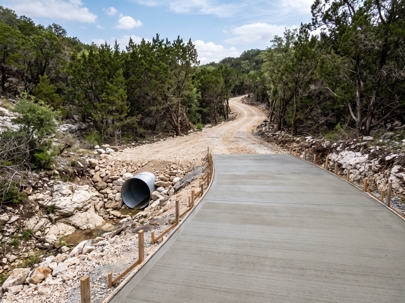
Why Liberty Hill, TX Homeowners Converting Gravel to a Concrete Driveway Skip the One Step That Matters Most | by Heroes Lawn Care of Cedar Park
A gravel driveway that washes out after a heavy rain is frustrating, but it's also forgiving. A homeowner can regrade it, add fresh material, and correct whatever drainage issue caused the washout in the first place. Pour concrete over that exact same unresolved drainage problem, and the forgiveness disappears entirely. Whatever grading or water flow issue existed underneath the gravel is now locked permanently beneath a rigid slab that isn't going anywhere.
This trade-off is rarely discussed openly during the sales conversation for a conversion project, even though it's arguably the single most important factor in whether the finished driveway holds up over the following decades. A homeowner focused on eliminating annual regrading chores understandably wants to move quickly toward a permanent surface, without necessarily recognizing that permanence cuts both ways: it locks in whatever was working just as thoroughly as it locks in whatever wasn't.
This is the step most homeowners converting a long rural gravel driveway to a concrete driveway in Liberty Hill, TX skip entirely: a genuine drainage and grading assessment performed before the pour, not after problems start showing up.
Heroes Lawn Care of Cedar Park sees this pattern repeatedly across Liberty Hill's rural and acreage properties: a homeowner tired of regrading gravel every year or two decides concrete is the lower-maintenance answer, without realizing that concrete only removes the maintenance burden if the underlying drainage problem gets solved first, not paved over.
The Step Most Gravel-to-Concrete Driveway Conversions Skip in Liberty Hill, TX
Gravel-to-concrete driveway conversion projects tend to focus heavily on the visible, exciting parts of the decision: which finish, how wide, how the transition from the county road will look. The drainage assessment that should come before any of those decisions is easy to skip past, since it doesn't produce anything visually compelling to plan around.
Why Gravel Forgives Drainage Problems and Concrete Doesn't
A gravel surface, even one with a drainage problem, can be reworked relatively easily. Regrading the surface, adjusting the crown, adding a culvert where one is needed, all remain straightforward corrections on a gravel driveway, since the surface material itself isn't a fixed, permanent structure. Rural access driveway construction using concrete removes that flexibility entirely. Once poured, correcting an underlying grading or drainage issue means breaking out and removing sections of a rigid slab, a dramatically more involved and disruptive undertaking than simply regrading loose material ever was.
This forgiveness gap is easy to underestimate precisely because gravel's flexibility often masks how significant an underlying drainage issue actually is. A homeowner who's regraded the same low spot every year or two for a decade may not fully register that the same volume of water is going to keep finding that same low spot indefinitely, regardless of what surface sits on top of it, unless the actual drainage path is corrected rather than simply resurfaced.
What “Grade and Drainage First” Actually Means
This principle, common among contractors who specialize in Hill Country driveway and access road work, means walking the entire length of a proposed driveway corridor before any conversion decision gets finalized, assessing current grade, identifying low points where water naturally collects, and locating any spot where the driveway crosses a natural drainage path. Texas Hill Country terrain driveway paving that skips this walk-through and assessment is making a permanent decision based on incomplete information about how water actually moves across that specific property.
Heroes Lawn Care of Cedar Park treats this walk-through as a mandatory first step for every Liberty Hill, TX conversion project, regardless of how straightforward a driveway might initially appear, since even a seemingly simple corridor can hide a low point or drainage issue that isn't obvious without deliberately walking and assessing the full length in person.
How Long Rural Driveways Change the Drainage Math
A long driveway, common across Liberty Hill's more rural and acreage properties, faces drainage challenges that a short suburban driveway simply doesn't encounter in the same way.
Cross-Drainage at Intervals, Not Just at the Ends
Long-distance concrete slab durability depends heavily on how water is managed along the driveway's entire length, not just at its beginning and end. A driveway stretching several hundred feet or more collects water across that entire distance, which means drainage needs to be addressed at multiple points along the way rather than assuming water will simply find its way off the surface at the far end. Surface run-off erosion mitigation planned only at a driveway's endpoints, without cross-drainage at appropriate intervals in between, tends to concentrate water flow in ways that erode the shoulder or undermine the base at whatever low point the water eventually accumulates.
This distributed drainage approach requires a fundamentally different way of thinking about the driveway compared to a short residential run. A hundred-foot suburban driveway can often manage with a single point of drainage focus, but a driveway several times that length behaves more like a private road, accumulating volume and momentum as water travels its length, which is precisely why cross-drainage spaced at reasonable intervals matters so much more here than it would on a shorter, simpler installation.
Culvert Installation and Ditch Grading Where the Driveway Crosses a Natural Drainage Path
Culvert installation and ditch grading become necessary wherever a driveway crosses a natural low point or seasonal drainage path, allowing water to pass beneath the driveway surface rather than pooling against it or cutting around it during a heavy rain event. A driveway built without a properly sized culvert at these crossing points forces water to find its own way past the obstruction, which usually means eroding the surrounding soil or, in the case of a concrete slab, undermining the base material supporting the concrete from below.
Culvert sizing itself is a genuine engineering question, not a one-size-fits-all detail. A culvert sized too small for the volume of water a given crossing actually needs to handle during a significant storm event will back up and overflow regardless of how well the rest of the driveway was built, while a culvert sized appropriately for that specific crossing's watershed handles the same storm event without incident. Getting this sizing right depends on genuinely understanding how much water a given low point actually receives, which is exactly the kind of detail a proper site walk-through is meant to uncover.
Watershed size, upstream terrain, and how much of the surrounding land drains toward a specific crossing point all factor into an appropriate culvert size, which means the correct specification for one property's driveway may not translate directly to a neighboring property even under broadly similar conditions. Treating culvert sizing as a fixed, standard detail rather than a property-specific calculation is one of the more common shortcuts that leads to an undersized culvert failing during exactly the kind of intense storm event it was supposed to handle.
Building a Concrete Driveway That Can Actually Handle Hill Country Terrain
Once drainage has been properly assessed and addressed, the actual construction of the concrete driveway itself needs to account for the specific demands of Hill Country terrain and rural use.
Subgrade Aggregate Base Preparation Before the Pour
Subgrade aggregate base preparation establishes a compacted, stable layer beneath the concrete slab, providing consistent support across the driveway's full length regardless of variations in the native soil or rock beneath it. This base layer matters even more on a long rural driveway than on a short residential one, since any inconsistency in base preparation has more distance across which to produce uneven settling or cracking over the driveway's lifespan.
Hill Country terrain often presents genuinely variable subsurface conditions across even a single driveway's length, transitioning between exposed limestone, thin topsoil, and pockets of clay within a relatively short distance. A base preparation approach that treats the entire corridor uniformly, without accounting for this variability, risks under-preparing sections where the native ground actually needs more attention than a generic specification would call for.
Identifying these transitions requires the same kind of deliberate, full-length assessment already emphasized for drainage planning. A driveway corridor that shifts from solid limestone to loose, sandy fill within the span of a hundred feet needs a base preparation approach that responds to that shift, rather than a single uniform depth and compaction standard applied without regard to what's actually underneath each section.
Following the Land's Natural Contour Instead of Fighting It
A properly built Hill Country driveway generally follows the natural contour of the land rather than forcing a perfectly straight, aggressively graded path that ignores existing terrain. Driveways built to fight the land's natural slope, rather than work with it, tend to concentrate water flow unnaturally and require more extensive retaining or drainage structures than a design that follows the terrain's existing shape. This approach also tends to reduce the amount of cut and fill required during construction, which limits how much the surrounding natural drainage patterns get disrupted in the first place.
This contour-following approach sometimes means a driveway takes a gentler, slightly longer path rather than the shortest straight-line distance between the road and the house. That tradeoff is almost always worthwhile on sloped Hill Country terrain, since a driveway that respects the land's natural grade tends to require meaningfully less ongoing drainage correction than one built along an artificially straight path that ignores how the surrounding land naturally directs water.
Engineering for What Actually Drives on a Rural Driveway
A driveway serving a rural or acreage property often needs to support significantly different vehicle loads than a standard suburban driveway built primarily for passenger cars.
High-PSI Load-Bearing Concrete and Thickened Edge Slabs for Heavy Vehicles
High-PSI load-bearing concrete pour specifications become relevant for driveways that regularly see trucks, trailers, or heavy equipment, since a standard residential concrete mix designed around passenger vehicle loads isn't engineered to handle that additional weight without a higher risk of premature cracking or surface failure. Thickened edge slab reinforcement, adding extra concrete depth specifically along a slab's outer edges, addresses a related vulnerability, since edges bear disproportionate stress under heavy loads and are more prone to cracking or spalling than the reinforced interior of the slab.
Identifying the actual vehicles and equipment that will regularly use a driveway is a necessary conversation before finalizing a concrete specification, since a mix and thickness appropriate for occasional passenger car use won't hold up the same way under regular truck or trailer traffic. This conversation is easy to skip when the primary focus is on finish and appearance, but it directly determines whether the driveway performs reliably under its actual expected use or begins showing stress cracking within the first few years of regular heavy traffic.
Heavy Vehicle Turnaround Paving Considerations
Heavy vehicle turnaround paving requires additional planning beyond the driveway's main run, since a turnaround area needs to support the tighter turning radius and concentrated weight of a larger vehicle maneuvering in a confined space. A turnaround designed without this consideration in mind, using the same specifications as the rest of the driveway, often becomes the first section to show cracking or surface wear, precisely because it experiences a different, more concentrated stress pattern than a straight run of driveway does.
Turning movements place torsional stress on a concrete surface that straight-line travel simply doesn't produce, since a vehicle's tires scrub against the surface during a turn rather than rolling straight across it. This additional stress is part of why a turnaround area often benefits from the same thickened edge treatment and higher-strength mix used for heavy load-bearing sections, even if the rest of a given driveway's specification is somewhat lighter for standard passenger vehicle use.
What to Ask Before Converting Gravel to Concrete
Bringing drainage assessment, base preparation, and load engineering together into a single planning conversation gives a homeowner a much clearer picture of what a genuine, durable conversion actually requires.
Questions About Drainage Assessment Before Getting a Quote
Asking directly whether a contractor plans to walk the full driveway corridor and assess drainage before providing a final quote, rather than basing an estimate purely on total length and width, reveals a great deal about how seriously that contractor treats the underlying grading and water management work. Rural access driveway construction handled by a contractor who skips this assessment is building on an assumption rather than verified information about how water actually behaves on that specific property.
Heroes Lawn Care of Cedar Park walks every proposed Liberty Hill, TX driveway corridor in full before finalizing a gravel-to-concrete conversion plan, identifying low points, existing culvert conditions, and natural drainage paths well before any concrete gets ordered. This assessment shapes decisions about culvert placement, cross-drainage spacing, and subgrade preparation long before the visual questions, finish and width, ever enter the conversation.
Texas Hill Country terrain driveway paving planned this way avoids the frustrating pattern of a beautiful new concrete driveway that starts showing drainage-related problems within its first year or two, problems that trace directly back to a grading or drainage issue that was already present under the original gravel surface and simply never got addressed before the conversion. High-PSI load-bearing concrete pour specifications and thickened edge slab reinforcement matter considerably less if the underlying drainage and grading work was never done correctly in the first place, since even a well-engineered slab still depends on stable, properly drained ground beneath it to perform as designed.
Long-distance concrete slab durability, in the end, comes down less to the concrete mix itself and more to whether the ground beneath the entire length of the driveway was properly assessed, graded, and drained before that concrete was ever poured. Surface run-off erosion mitigation addressed early in the planning process protects that investment for decades, while the same issue left unaddressed until after the pour becomes a far more involved and disruptive problem to correct.
Conclusion
Converting a long gravel driveway to concrete is, for many Liberty Hill, TX homeowners, a genuine upgrade in comfort and low-maintenance appeal. The mistake isn't the decision to convert. It's skipping the drainage and grading assessment that gravel's flexibility had been quietly compensating for all along, an assessment that becomes essential precisely because concrete removes the ability to simply regrade the problem away later.
This distinction is worth carrying into any conversation with a prospective contractor. A quote that arrives quickly, based purely on driveway length and a standard specification, without any mention of walking the corridor or assessing drainage, is very likely skipping the exact step that determines whether the finished driveway performs well for decades or starts showing problems within the first few rainy seasons.
Heroes Lawn Care of Cedar Park treats this drainage assessment as the non-negotiable first step in every concrete driveway conversion in Liberty Hill, TX, addressing grading, culvert placement, and subgrade preparation before any concrete decisions get finalized. Getting this step right from the beginning remains the most reliable way to end up with a driveway that performs well for decades rather than one that locks an old problem permanently beneath a brand-new surface.