
Your Leander, TX Concrete Driveway Is Supposed to Crack — Here's How to Tell Good Cracks From Bad Ones | by Heroes Lawn Care of Cedar Park
A hairline crack running straight across a driveway at a neat, regular interval usually isn't a problem. A jagged crack veering diagonally across a slab, widening unevenly toward one edge, usually is. Most homeowners react to both the same way — with alarm — because concrete cracking gets treated as a single, uniformly bad category of problem, when in practice it's two very different phenomena that happen to look superficially similar.
Heroes Lawn Care of Cedar Park fields this exact question regularly from Leander, TX homeowners inspecting their own driveways: is this crack something to worry about, or is it simply the concrete doing what it was designed to do. The answer depends entirely on a handful of specific, visual details most homeowners have never been taught to look for.
A properly built concrete driveway in Leander, TX is designed to crack in specific, predictable places. Understanding the difference between that planned cracking and the uncontrolled kind is the single most useful piece of knowledge a homeowner can have when evaluating their own driveway, or a contractor's proposed installation plan.
That knowledge is useful in both directions: it prevents unnecessary worry over completely normal joint cracking, and it sharpens attention toward the specific signs that actually warrant a closer look. Most homeowners have neither piece of this puzzle by default, since driveway maintenance rarely comes with the kind of practical education that would let someone confidently tell the difference on sight.
The Crack Myth That Confuses Every Leander, TX Concrete Driveway Owner
Concrete shrinks slightly as it cures, a physical reality no mix design or installation technique can fully eliminate. That shrinkage has to go somewhere, and where it goes is determined either deliberately, by the contractor, or randomly, by whatever weak point in the slab happens to give way first.
Why “Cracking” Isn't a Single Category of Problem
Central Texas flatwork contractors who understand this distinction design cracking into a driveway from the very beginning, rather than hoping the slab simply won't crack at all, an outcome that isn't realistic for concrete regardless of installation quality. The goal was never a crack-free driveway; it was always a driveway where cracking happens exactly where it's supposed to, in a controlled, unobtrusive way that doesn't compromise the slab's structural integrity or appearance.
This framing tends to surprise homeowners the first time they hear it, since most marketing language around concrete driveways implies a flawless, crack-free surface is the realistic expectation. Setting that expectation accurately from the outset, rather than letting a homeowner discover years later that some cracking was inevitable all along, avoids a lot of unnecessary alarm when the first hairline joint crack eventually appears.
Planned Cracking vs. Uncontrolled Cracking: The Real Distinction
Planned cracking occurs along intentionally placed weak points, straight, neat lines that guide the concrete's natural shrinkage into locations chosen specifically because a crack there won't affect structural performance or visible appearance in any meaningful way. Uncontrolled cracking occurs randomly, wherever the slab happens to be weakest, often as a direct result of inadequate sub-base preparation or reinforcement rather than the concrete's normal curing shrinkage. The first kind is evidence the driveway was built correctly. The second kind is evidence something underneath the surface wasn't.
What Control Joints Are Actually For
The mechanism that makes planned cracking possible is the control joint, a shallow groove cut or formed into the concrete surface at regular intervals.
Expansion Control Joint Placement and Spacing
Expansion control joint placement creates an intentional weak point running the full depth of a reasonable portion of the slab, deep enough that when shrinkage stress builds up, the concrete cracks along that groove rather than at some unpredictable point elsewhere in the surface. Joints are typically spaced at consistent intervals across a driveway's length and width, calculated based on slab thickness, since a joint spacing that's too wide leaves too much unsupported distance between weak points, giving the concrete room to crack randomly before the stress ever reaches the intended joint.
Timing matters as much as spacing. Joints cut too late, after the concrete has already begun developing internal stress from curing shrinkage, may not intercept a crack that's already begun forming elsewhere in the slab. Joints cut promptly, typically within the first day after finishing, are far more likely to successfully guide that shrinkage stress to the intended location before it has a chance to find a different, unplanned weak point on its own.
Why a Crack Along a Joint Line Is a Sign the System Worked
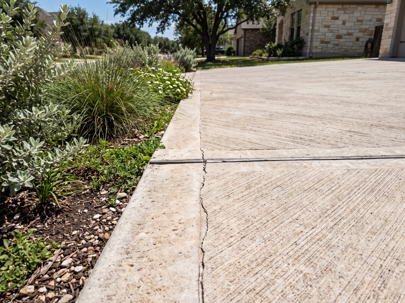
A hairline crack that appears precisely along a control joint, rather than veering off into the surrounding slab, is direct visual confirmation that the joint did exactly what it was designed to do. This is worth emphasizing because it runs counter to most homeowners' instinct: a crack at a joint line isn't a defect to report or worry about. It's the intended outcome of a properly engineered driveway working as designed.
This reframing matters practically, not just conceptually. A homeowner who understands this distinction is far less likely to spend time and money pursuing an unnecessary repair for cosmetic joint cracking, and far more likely to recognize genuinely concerning cracking when it actually appears, since they're no longer treating every visible line in the concrete as equally alarming.
What Uncontrolled Cracking Actually Looks Like — and Why It Happens
Uncontrolled cracking has its own distinct visual signature, and understanding that signature helps separate a genuine problem from ordinary, expected joint cracking.
Expansive Clay Soil Sub-Base Compaction: The Root Cause Behind Most Random Cracks
Leander, TX sits on expansive clay soil that swells significantly when saturated and contracts as it dries, creating a shifting foundation beneath any concrete slab poured on top of it. Expansive clay soil sub-base compaction that isn't performed to an adequate standard leaves voids and inconsistent density beneath the slab, which means sections of the driveway lose even support at different times as the clay beneath them swells and shrinks unevenly through the seasons. That uneven support is what produces the jagged, unpredictable cracking pattern that signals a genuine structural problem rather than ordinary curing shrinkage.
This uneven support tends to produce cracking that migrates or worsens over successive seasons, unlike planned joint cracking that typically appears once and then remains stable. A crack that seems to be lengthening, widening, or spawning new branches over the course of a year or two is showing behavior consistent with ongoing soil movement beneath the slab, rather than the one-time, stable shrinkage that produces normal joint cracking.
Steel Rebar Grid Reinforcement and What Happens Without It
Steel rebar grid reinforcement, or wire mesh depending on slab thickness, helps hold a cracked section of concrete together even after a crack forms, distributing load across the reinforcement rather than allowing a crack to widen unchecked over time. A driveway poured without adequate reinforcement, or with reinforcement that wasn't positioned correctly within the slab during the pour, loses this safety net entirely, which means any crack that does form, whether planned or not, has a much greater tendency to widen, shift, and eventually create a genuine trip hazard or structural weak point.
Reinforcement positioning matters as much as its presence. Rebar or mesh placed too close to the bottom of the slab, rather than centered within its depth, provides meaningfully less crack-control benefit than correctly positioned reinforcement, since its effectiveness depends on being properly embedded within the concrete mass rather than sitting near one surface. This is a detail that's completely invisible once the slab is poured and finished, which is exactly why verifying correct placement during construction matters more than trying to diagnose it after the fact.
Chairs or spacers, small support devices that hold reinforcement at the correct height during the pour, are the practical tool that makes proper positioning achievable. Skipping these spacers, or using an insufficient number of them across a large slab, allows the reinforcement to settle toward the bottom of the form under the weight of the wet concrete, undermining its effectiveness before the pour is even finished.
Reading the Difference: A Practical Homeowner Checklist
Bringing these distinctions together into something a homeowner can actually use requires a handful of practical, visual criteria for evaluating any specific crack.
Crack Location, Direction, and Width as Diagnostic Clues
A crack running in a straight line, aligned with a visible or expected joint location, staying consistently narrow along its entire length, is almost always planned cracking working as intended. A crack running diagonally across the slab, widening noticeably at one end, or accompanied by any visible height difference between the two sides of the crack, points toward uncontrolled cracking driven by an underlying base or reinforcement issue rather than ordinary shrinkage. Concrete slab driveway replacement becomes a genuine consideration specifically when this second pattern shows up extensively across a driveway, rather than for the isolated, narrow joint cracking that's a normal part of any concrete driveway's expected lifespan.
A simple physical test can add further confirmation: running a hand or a coin along both sides of a crack checks for any noticeable height difference between the two edges. Planned joint cracking typically shows no meaningful elevation change, since the concrete on either side of the joint is still resting on the same stable base. A height difference, even a small one, generally indicates the soil beneath one side of the crack has settled or shifted relative to the other, which points toward the kind of uncontrolled movement worth having evaluated further.
Building (or Fixing) a Driveway That Cracks the Right Way
Understanding the difference between planned and uncontrolled cracking is useful for evaluating an existing driveway, but it's even more valuable applied at the planning stage of a new installation.
Cracking Prevention Soil Stabilization and Grading for Drainage
Cracking prevention soil stabilization addresses the clay soil issue directly, treating or reinforcing the subgrade before concrete is ever poured so the slab above it has a genuinely stable foundation to rest on rather than raw, untreated expansive clay. Driveway grading and drainage control works alongside soil stabilization, directing water away from the slab's edges and away from the surrounding soil that would otherwise absorb it and swell unevenly beneath one section of the driveway more than another.
These two elements work together rather than independently. Soil stabilization addresses the clay's inherent tendency to swell and shrink, while drainage control limits how much moisture ever reaches that soil in the first place. A driveway with excellent soil stabilization but poor drainage still faces ongoing moisture-driven stress, just at a somewhat reduced level, while a driveway with excellent drainage but no soil stabilization still contends with whatever swelling occurs from ambient moisture and seasonal rainfall the drainage system can't fully redirect.
Heroes Lawn Care of Cedar Park evaluates soil conditions and existing drainage patterns before finalizing any Leander, TX concrete driveway design, since these two factors together determine far more about a driveway's long-term crack pattern than the concrete mix or surface finish selected afterward. A driveway built on a properly stabilized, well-drained subgrade develops predictable, planned cracking at its control joints and little else, even decades into its service life.
Sealant, Finish, and Long-Term Maintenance
Penetrating concrete driveway sealant helps protect the slab's surface from moisture intrusion and staining without changing its appearance, extending the interval between resurfacing or repair needs across the driveway's lifespan. Broom finish slip-resistant concrete remains the most common surface choice for its practical traction benefits, though decorative stamped concrete driveway options offer homeowners a more customized visual result while still relying on the same underlying soil preparation and reinforcement principles that determine whether any driveway, decorative or plain, ages gracefully or develops problematic cracking.
Decorative surface treatments deserve particular attention on this point, since a stamped or textured finish can sometimes make cracking harder to spot early, simply because the pattern itself already includes visual lines and texture that can mask a developing crack until it's more advanced than it would have been on a plain broom finish. This doesn't argue against decorative options, only that a driveway with a more elaborate surface treatment benefits from more deliberate periodic inspection than a plain finish would require.
Heroes Lawn Care of Cedar Park applies penetrating sealant as a standard recommendation for every finished Leander, TX driveway, since this relatively simple maintenance step meaningfully extends the interval before a homeowner needs to consider more significant repair or replacement work. Central Texas flatwork contractors who build with expansive clay soil conditions specifically in mind, from initial soil stabilization through final sealant application, produce driveways where any cracking that eventually appears stays confined to the planned, unobtrusive joint locations engineered into the design from day one.
Homeowners evaluating an existing driveway showing signs of uncontrolled cracking don't necessarily need to jump straight to full replacement. In some cases, addressing the underlying soil and drainage issue, combined with targeted repair of the affected section, can resolve the problem without requiring the entire slab to be removed and repoured. A thorough diagnostic assessment, distinguishing genuinely structural cracking from cosmetic joint cracking, is the necessary first step before deciding which approach actually makes sense for a specific driveway's condition.
This diagnostic step matters because the two potential responses, targeted repair versus full replacement, carry very different scopes and timelines. Correctly identifying which category a given driveway's cracking actually falls into prevents both unnecessary full replacement of a driveway that could have been addressed with a more modest repair, and equally, prevents an inadequate targeted repair applied to a driveway whose underlying soil problem genuinely requires a more comprehensive solution.
Conclusion
Not all cracks in a concrete driveway signal the same thing, and treating every crack as evidence of failure leads homeowners to either panic unnecessarily over normal joint cracking or, just as often, dismiss genuine warning signs because “concrete always cracks anyway.” Learning to distinguish planned, joint-aligned cracking from the jagged, unpredictable kind driven by soil movement and inadequate reinforcement is the practical skill that actually matters.
That distinction is worth revisiting periodically, not just at the moment a new crack first appears. A driveway's crack pattern can evolve over several years as seasonal soil movement continues, which means an initial assessment showing only planned joint cracking doesn't guarantee that it remains true indefinitely. Checking back on existing cracks every so often, watching for any new width, length, or elevation changes, is a simple habit that catches emerging uncontrolled cracking early, while it's still a straightforward, targeted repair rather than a full slab replacement.
Heroes Lawn Care of Cedar Park builds every concrete driveway in Leander, TX around the region's expansive clay soil from the very first planning conversation, engineering control joints, reinforcement, and drainage so that any cracking that eventually appears stays exactly where it's supposed to. Understanding this distinction, and building or repairing accordingly, remains the most reliable way to end up with a driveway that performs well for decades rather than one that quietly develops problems nobody caught in time.