
The Compaction Mistake Behind Uneven Paver Patios in Cedar Park, TX | Heroes Lawn Care
A single patio, a few years after installation, sometimes shows two problems that seem to contradict each other: one section has visibly sunk below the surrounding surface, while another section nearby has pushed upward, creating an uneven ridge where two areas of pavers no longer sit flush. Homeowners often assume these are two separate issues. In most cases, they trace back to the exact same root cause: how the base beneath the patio was compacted, not simply how deep it was.
This distinction, between base depth and base compaction technique, is one of the most consistently overlooked details in paver patio installation across Cedar Park, TX, and it's responsible for both the heaving and the settling that so often show up in the same patio within just a few years of completion.
Most installation estimates and proposals focus heavily on base depth, since it's an easy, quantifiable number to specify and compare between contractors. Compaction technique, by contrast, rarely gets the same attention, even though it's arguably the more consequential variable in determining whether that specified depth actually translates into a stable, load-bearing foundation once the patio is finished.
The Compaction Shortcut Hiding Behind Most Uneven Paver Patio Installation Projects
A base layer can technically meet the correct total depth requirement and still fail to provide a stable foundation, because depth alone doesn't guarantee density. Achieving real, load-bearing density requires compacting that base material in stages, not all at once.
Compacting in One Pass vs. Compacting in Lifts
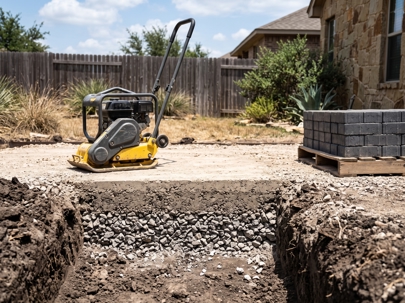
Professional paver patio base preparation compacts crushed stone in shallow layers, known as lifts, typically no more than a few inches deep each, with a plate compactor run over each layer before the next is added. A shortcut version of this process pours the entire base depth at once and compacts only the surface, leaving the material underneath significantly less dense than it appears. Proper paver base preparation treats each lift as its own compaction step, since skipping this staged process is one of the most common ways a base ends up under-compacted despite technically containing the correct total volume of material.
Heroes Lawn Care documents lift depth and compactor pass count for every base installed, treating this staged process as a verifiable step rather than an assumed detail left to individual crew judgment on a given day.
Why a Single Thick Layer Can't Achieve Real Density
A plate compactor's energy only penetrates a limited depth into loose material, regardless of how long it runs across the surface. When an entire base is poured at full depth before any compaction begins, the compactor can only meaningfully densify the top few inches, leaving material lower in the layer loose and full of small air voids. Those voids don't announce themselves at installation, since the surface layer compacts normally and the patio looks structurally sound on the day it's finished. The problem is buried, quite literally, beneath a surface that gives no visual indication of what's actually happening underneath.
This is precisely why base depth alone is such an unreliable indicator of quality. Two patios can specify the exact same total base depth on paper, yet perform completely differently over time depending entirely on whether that depth was achieved through proper staged compaction or through a single rushed pass that only densified the uppermost portion. A homeowner comparing quotes by base depth alone is comparing a number that, on its own, says very little about how the base will actually perform once weather and soil movement begin testing it.
How the Same Mistake Produces Two Opposite-Looking Problems
An improperly compacted base doesn't fail in one single, predictable way. Depending on moisture conditions and how a specific section of base settles over time, the same underlying issue can produce either heaving or settling, sometimes both, within a few feet of each other.
Heaving: When Trapped Voids Let Soil Push Pavers Upward
Loose, under-compacted base material allows more moisture to move through it than a properly densified layer would. When Cedar Park's expansive clay soil beneath that base swells during wet periods, the loosely compacted material above it offers little resistance, allowing the swelling clay to push upward more freely than it would through a dense, well-compacted base. Paver heaving prevention depends heavily on the base layer acting as a rigid buffer against this seasonal soil movement, which is precisely the function a base full of trapped voids and inconsistent density can't reliably perform.
This upward movement rarely happens uniformly across an entire patio, which is part of why heaving often looks so erratic when it appears. Voids and compaction inconsistency vary somewhat randomly across a rushed base, meaning some sections resist swelling clay more effectively than others purely by chance, based on where the compactor happened to achieve better density during that single rushed pass. The resulting unevenness can look almost patternless, even though the underlying cause, inconsistent base density, is entirely systemic rather than random.
Settling: When Under-Compacted Base Material Collapses Under Load
The same voids that allow heaving during wet, expansive periods can collapse under sustained weight once conditions shift, since loose material beneath a compacted surface layer eventually gives way under the combined load of pavers, foot traffic, and furniture. Paver patio settling and heaving prevention require addressing the same underlying cause, even though the two symptoms look like opposite problems on the surface. A patio built on a genuinely dense, properly compacted base resists both outcomes, while one built on a base that was compacted in a single rushed pass remains vulnerable to either failure mode depending on how moisture and load happen to interact in a given section over time.
Concentrated loads accelerate this collapse considerably. A section of base beneath a heavy outdoor kitchen, a hot tub, or a frequently used dining area experiences far more sustained pressure than an open walking path, which means settling often appears first, and most severely, in exactly the areas where a homeowner is relying on the patio to perform reliably day after day. This uneven distribution of stress is part of why settling can seem to target the “wrong” parts of a patio, when in reality it's simply revealing where the base was already weakest relative to the load placed on top of it.
Why Cedar Park's Expansive Clay Soil Makes This Mistake Worse
Compaction shortcuts that might go unnoticed for years in more stable soil tend to surface far more quickly across Central Texas clay, since the soil itself is already working against a marginal base rather than simply sitting inert beneath it.
Clay Soil Preparation Before Compaction Even Begins
Expansive clay soil preparation ideally begins before the base material is ever introduced, since the subgrade itself, the native soil the base sits on, needs to be properly prepared and sometimes stabilized before layered compaction can be effective. Clay soil paver installation solutions that skip subgrade preparation and move straight to placing base material are building a properly compacted layer on top of an unstable foundation, which undermines the benefit of correct compaction technique even when that technique is otherwise followed correctly above the subgrade.
Heroes Lawn Care evaluates subgrade condition before any base material is placed, since starting the compaction process on unprepared native clay undermines even a technically correct lift-by-lift approach applied above it.
What Proper Base Preparation and Compaction Actually Looks Like
Understanding the mistake is only useful alongside a clear picture of what correct execution actually involves, since both heaving and settling are preventable with the right process from the start.
Lift Depth, Compactor Passes, and Moisture Content
A properly executed base typically involves lifts no deeper than a few inches, multiple compactor passes per lift, and attention to moisture content, since base material that's too dry or too saturated doesn't compact to its full potential density regardless of how many passes it receives. Backyard paver patio construction that accounts for all three of these variables, lift depth, pass count, and moisture, produces a measurably denser, more stable foundation than a rushed process that treats compaction as a single quick step rather than a multi-stage requirement.
Moisture content is often the least understood of these three variables, since it isn't something a homeowner can easily evaluate by looking at a finished patio. Base material compacted while too dry fails to bind together effectively, leaving residual looseness even after multiple passes, while material compacted while oversaturated can't achieve proper density either, since excess water occupies space that should be filled with compacted solid material. Crews experienced with Central Texas conditions know to adjust for moisture content specifically, sometimes lightly wetting overly dry material or waiting for material to dry sufficiently after rain before proceeding with compaction.
Where Polymeric Sand Fits — and Where It Doesn't
Polymeric sand installation plays a role in the finished surface, locking individual pavers together and resisting minor erosion between joints, but it has no bearing on what's happening in the base layer several inches below. Polymeric sand joint stabilization is a complementary detail addressing surface-level joint integrity, not a substitute for proper compaction, and no amount of correctly applied polymeric sand can compensate for voids and inconsistent density sitting in the base beneath it. Interlocking paver patio services that understand this distinction treat polymeric sand and base compaction as two entirely separate elements of the overall system, each doing a specific job the other can't perform.
This distinction matters because polymeric sand is often the most visible, most discussed material in a finished paver patio, simply because it's the last thing installed and the part homeowners interact with directly when inspecting joints. That visibility can create a false sense that joint quality reflects overall installation quality, when in reality the base compaction work, completed and buried long before the sand was ever applied, is doing the actual structural work that determines whether the patio stays level over time.
How to Tell If a Contractor Is Cutting This Corner
Because compaction quality is invisible once a patio is finished, evaluating it requires asking specifically about method and process, not just materials and total base depth.
This is, in many ways, a more useful evaluation criterion than most of what typically gets compared between contractor proposals. Material selection, pattern choice, and even base depth are all relatively easy to specify on paper and compare side by side. Compaction method is harder to fake convincingly in a written proposal, since it requires a contractor to actually understand and commit to a specific, verifiable process rather than simply listing a total depth number that sounds adequate regardless of how it was achieved.
Questions About Compaction Method, Not Just Base Depth
Asking how many lifts a base will be compacted in, how thick each lift will be, and how many passes a plate compactor will make per lift tends to reveal far more about a contractor's actual process than simply asking how deep the base will be overall. Residential paver patio contractors confident in their process can answer these questions specifically, since staged compaction is a deliberate, well-understood technique rather than a detail improvised on-site.
Professional patio paving services that build in adequate time for multi-stage compaction are, by necessity, taking a somewhat slower approach than a contractor rushing to compact an entire base in a single pass. A homeowner comparing timelines between contractors might reasonably ask whether a notably faster proposed schedule reflects genuinely efficient processes or simply skipped steps, since proper lift-by-lift compaction takes measurably longer than compacting an entire base depth at once.
A useful way to frame this question directly is asking a contractor to estimate how much time the base preparation and compaction phase specifically will take, separate from the total project timeline. A contractor following genuine multi-stage compaction practices can usually provide a reasonably specific answer, since the process involves a predictable number of lifts and passes. A contractor planning to compact in a single pass may struggle to differentiate this phase clearly from the rest of the installation, since in their process, it genuinely isn't being treated as a distinct, multi-stage undertaking.
Heroes Lawn Care compacts every Cedar Park, TX paver patio base in properly measured lifts, adjusting lift depth and pass count based on the specific base material and moisture conditions present on each job site, rather than applying a single generic timeline regardless of what a proper compaction process actually requires for that property's conditions. Decorative paver installation services and hardscape patio construction alike depend on this same underlying discipline, since surface material and pattern choices ultimately rest on whatever foundation was built beneath them.
For homeowners evaluating an existing patio already showing early signs of heaving or settling, patio remodeling with pavers that addresses the underlying compaction issue, rather than simply relaying the surface pavers over the same problematic base, is the only fix that actually resolves the root cause. Outdoor living patio design that looks flawless on paper can still fail within a few years if the compaction work beneath it was never done to the standard the visible design assumes. Brick and stone patio installation faces this same underlying vulnerability regardless of the surface material chosen, since compaction quality determines structural performance well before material selection becomes a factor.
Custom paver patio installation planned around a genuine, multi-stage compaction process, with attention paid to paver patio drainage and soil preparation working together rather than as separate afterthoughts, produces a stable paver patio foundation capable of resisting both the upward pressure of heaving and the downward collapse of settling, regardless of which direction Central Texas weather happens to push the soil beneath it in a given season.
Conclusion
The two problems that seem to contradict each other on an uneven patio, sections heaving upward while others settle downward, usually share the same root cause: a base that was compacted quickly in a single pass rather than properly densified in measured lifts. Cedar Park, TX properties, sitting on expansive clay soil that actively works against a marginal foundation, are particularly vulnerable to this specific compaction shortcut showing up as visible unevenness within just a few years.
Recognizing that heaving and settling share a common root cause changes how this class of problem should be evaluated, both when planning a new installation and when diagnosing an existing patio already showing early signs of unevenness. Rather than treating each symptom as a separate issue requiring its own explanation, both point back to the same question: was the base beneath the patio actually compacted the way it needed to be, in measured stages, rather than rushed through in a single pass that only looked complete on the surface.
Heroes Lawn Care treats proper lift-by-lift compaction as a non-negotiable step in every paver patio installation project, understanding that this invisible, buried process is what ultimately determines whether a patio stays level for decades or begins showing the telltale signs of heaving and settling within the first few seasons. Getting this foundational detail right from the very beginning remains the most reliable way to avoid both failure patterns at once.