
Why New-Construction Backyards in Leander, TX Need a Different Paver Patio Approach
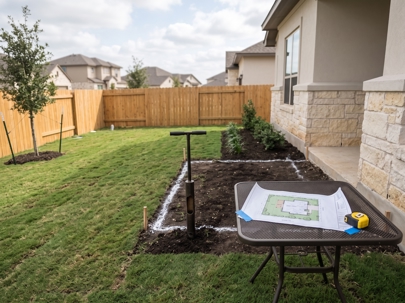
A brand-new home comes with a backyard that looks like a blank canvas, freshly graded and covered in a thin layer of sod, ready for whatever a homeowner wants to build on it. That appearance is misleading in two important ways. What sits beneath that new sod is often very different from the soil in an established yard, and what sits above it, in terms of neighborhood rules, frequently comes with an approval process many new homeowners don't realize applies until they're already partway into planning.
Paver patio installation on a new-construction lot in Leander, TX involves considerations that simply don't apply to a patio project in an older, already-settled neighborhood, and treating a new-build backyard the same way as an established one is one of the more common planning mistakes in this fast-growing part of Central Texas.
This mistake is understandable, since most general paver installation guidance was written without new-construction lots specifically in mind. A homeowner researching how to plan a patio project encounters advice calibrated for a yard that's had years to settle naturally, without any mention of the specific soil and procedural considerations that come with a home only recently built.
Why a New-Construction Lot Isn't a Blank Slate for Paver Patio Installation
The soil beneath a newly built home has typically been disturbed far more recently, and far more extensively, than soil in a neighborhood that's been established for years or decades.
What “Builder-Graded” Actually Means Beneath the Surface
Builder-ready backyard hardscaping starts from a foundation that's already been reshaped by heavy equipment during the home's construction, not from undisturbed native soil. Builders typically grade a lot for drainage away from the foundation and bring in fill material to establish that grade, which means the soil composition just a few inches below the new sod can vary considerably from one section of the yard to another, depending on how that fill was placed and compacted during construction.
Heroes Lawn Care approaches every new-construction assessment in Leander, TX with the expectation that fill soil composition will vary across the lot, rather than assuming uniform conditions the way a standard established-yard assessment might.
Fill Dirt, Construction Debris, and Inconsistent Compaction
New-construction backyard paver patios sometimes encounter buried construction debris, inconsistently compacted fill zones, or pockets of loose material left behind once heavy equipment finished its work and the lot moved on to final grading and sod installation. Paver patios for new construction homes that skip a proper subsurface assessment risk building directly on top of these inconsistencies, which can produce exactly the kind of uneven settling that shows up within the first year or two, well before an older, naturally settled yard would typically show comparable issues.
Construction debris in particular can be surprisingly easy to miss during a cursory visual inspection, since it's often buried beneath several inches of fill and topsoil by the time a homeowner is ready to plan a patio project. Small pieces of scrap lumber, packaging material, or leftover masonry fragments occasionally end up incorporated into fill soil during the construction process, and while a single small piece of debris might seem inconsequential, its presence often indicates broader inconsistency in how that section of fill was placed and compacted.
The HOA Approval Step Many New Homeowners Don't Expect
Many new-construction communities across Leander, TX operate under homeowners associations with specific architectural guidelines, and hardscape additions like paver patios typically fall squarely within what those guidelines govern.
The “Ground-Level Fallacy” — Why a Flush Patio Still Needs Approval
A common misconception is that because a paver patio sits flush with the ground, without walls or a roof, it doesn't count as a structure requiring approval the way a deck or pergola would. HOA-compliant paver patio installation almost always falls under community architectural review regardless of how low-profile the finished design looks, since most governing documents define hardscape modifications broadly enough to include any permanent change to a lot's surface, drainage, or overall appearance. Homeowners who skip this step, assuming a ground-level patio is exempt, risk fines or a forced removal order well after installation is already complete.
Heroes Lawn Care confirms HOA requirements as a standard early step for every Leander, TX project, regardless of how straightforward or low-profile a proposed patio design might appear, since assuming exemption based on appearance alone is precisely the assumption that leads to costly after-the-fact complications.
HOA Approval vs. City Permits: Two Separate Processes
HOA-approved hardscape materials satisfy a community's aesthetic and drainage-related standards, which is an entirely separate review from whatever city permitting requirements might also apply to the same project. Community-approved paver materials might be required for HOA sign-off even on a project that wouldn't otherwise need a city permit at all, and conversely, a project might clear HOA review while still requiring separate municipal approval depending on its scope. Treating these as a single combined step, rather than two distinct approval processes, is a common source of unexpected delay.
Homeowners sometimes discover this distinction only after assuming that HOA approval alone means a project is fully cleared to begin. A patio design might sail through architectural review focused on material color and setback compliance, only for the homeowner to later learn that a separate city permit is still required before construction can actually start, particularly if the project involves any change to drainage patterns that could affect adjacent properties beyond the HOA's own jurisdiction.
What a Strong HOA Submission Package Actually Includes
Submitting a vague or incomplete request is one of the most common reasons HOA hardscape applications get delayed or rejected outright, particularly in newer communities still refining how they review these requests.
Plat Maps, Site Plans, and Material Samples
A complete submission package typically includes the property's official plat map showing exact lot lines and any recorded utility easements, a marked-up site plan showing precisely where the proposed patio will sit relative to those boundaries, and physical or photographed samples of the specific paver material and color being proposed. HOA-approved patio design and installation that includes this level of documentation upfront tends to move through review considerably faster than a vague request describing the project only in general terms.
Incomplete submissions are one of the most common reasons a straightforward, otherwise compliant patio design still ends up delayed. A committee reviewing a request that lacks a clear site plan or specific material documentation often has no choice but to request additional information before proceeding, which can add weeks to a timeline that a complete initial submission would have avoided entirely. Preparing this documentation thoroughly the first time is almost always faster than submitting something incomplete and responding to follow-up requests afterward.
Why 3D Renderings Speed Up Approval
A photorealistic rendering showing exactly how a proposed patio will look against the specific home, rather than a generic stock image or a rough sketch, gives an HOA architectural review committee something concrete to evaluate rather than something to imagine and potentially misinterpret. Outdoor living patio design submitted with this level of visual clarity tends to reduce the back-and-forth that otherwise stretches out a review process, since committee members can see precisely what's being proposed rather than guessing at details left ambiguous in a written description alone.
This visual clarity matters because architectural review committees are typically composed of volunteer residents rather than design professionals, and asking them to mentally translate a written material list and a basic dimensioned sketch into an accurate picture of the finished result is asking for more interpretive work than most committees can reliably provide. A rendering removes that interpretive burden entirely, replacing it with a direct visual comparison between what's proposed and what the committee needs to evaluate against community standards.
Assessing Builder-Graded Soil Before Installation Begins
Because new-construction soil conditions differ meaningfully from established yards, the assessment process leading into installation needs to account for that difference rather than assuming standard soil behavior.
Why New-Build Soil Testing Differs From Established-Yard Testing
Residential new-build patio installation benefits from soil testing that specifically checks for fill consistency and compaction quality across the proposed patio footprint, not just a general soil composition check that might be sufficient for an established yard with soil that's had years to settle naturally. Interlocking paver patio services working regularly in new-construction Leander, TX communities typically test at multiple points across a proposed footprint precisely because fill consistency can vary meaningfully within the same small area, something far less common in soil that's remained undisturbed for a decade or more.
This multi-point testing approach reflects a fundamentally different assumption than testing in an established yard. An established yard's soil, having had years to settle and stabilize, tends to behave relatively consistently across a given area, which means fewer test points are usually needed to get an accurate overall picture. A new-construction lot, by contrast, may have been graded and filled by different equipment operators working at different times during the broader development process, introducing exactly the kind of localized inconsistency that a single test point in the center of a proposed footprint could easily miss entirely.
Building a Paver Patio That Works With — Not Against — a New-Construction Lot
Understanding these new-construction-specific factors changes how a paver patio project should actually be planned and sequenced, from initial assessment through final installation.
Coordinating Timing With Builder Landscaping and Warranty Periods
New-construction outdoor living spaces sometimes need to be planned around a builder's own landscaping warranty period, since some builders include limited warranty coverage on initial grading or sod that could be affected by later hardscape work. Custom paver patio installation coordinated with an awareness of these builder warranty terms avoids inadvertently voiding coverage that a homeowner might still want to rely on, while also taking advantage of the fact that soil conditions are often best understood and addressed while the yard is still relatively new and unobscured by years of subsequent landscaping.
Reviewing builder warranty documentation before finalizing a patio timeline is a simple step that's easy to overlook amid the broader excitement of planning a new outdoor space. Some builder warranties specifically exclude coverage for areas affected by subsequent homeowner modifications, which means a hardscape project undertaken without checking this documentation first could unintentionally forfeit protection the homeowner would otherwise still be entitled to for unrelated grading or drainage issues elsewhere on the property.
Heroes Lawn Care approaches every new-construction paver patio project in Leander, TX by testing builder-graded soil at multiple points across the proposed footprint and confirming HOA requirements before any design work begins, rather than assuming a new lot behaves like an established yard or that HOA approval is a formality to handle after the fact. Backyard paver patio construction planned this way avoids both the structural surprises that come from unassessed fill soil and the procedural delays that come from an incomplete or late HOA submission.
Professional patio paving services familiar with Leander's newer developments also tend to have existing familiarity with specific community architectural guidelines, since many nearby HOAs share overlapping material and design standards. Residential paver patio contractors who have already worked through several approval cycles within the same community can often anticipate committee preferences and documentation expectations more accurately than a contractor encountering that specific HOA's requirements for the first time.
This kind of community-specific familiarity can meaningfully shorten the overall timeline from initial design conversation to finished patio. A contractor who already knows a particular HOA's preferred submission format, typical review turnaround, and common points of pushback can prepare a submission proactively addressing those details, rather than discovering them reactively after an initial application draws unexpected questions or requests for revision.
Hardscape patio construction on a new-construction lot also benefits from thinking ahead to how the finished patio will interact with landscaping still being established elsewhere in the yard. Decorative paver installation services planned in coordination with an overall landscape timeline, rather than as an isolated first project before anything else has been decided, tend to integrate more naturally into the yard's eventual finished look than a patio installed in isolation, without much thought given to what will surround it later.
This kind of forward-looking coordination doesn't require finalizing every future landscaping decision before a patio can move forward. It simply means having a general sense of where planting beds, walkways, or future structures like a pergola or fire pit might eventually go, so the patio's footprint, orientation, and material choices don't inadvertently conflict with plans that haven't been executed yet but are already forming in a homeowner's mind.
For homeowners who move into a new-construction home and later decide the builder's original hardscape plan, or lack of one, doesn't suit their needs, patio remodeling with pavers remains an option even after builder landscaping has already been completed. Brick and stone patio installation added after the fact still needs to account for whatever soil conditions and grading decisions were made during original construction, which makes an updated soil assessment just as relevant for a later addition as it is for a patio planned from the very start.
The timing of this later addition can actually work in a homeowner's favor in one respect: soil that's had a year or two to settle naturally after initial construction sometimes behaves more predictably than soil tested immediately after a builder finishes grading, since some settling and consolidation happens naturally in the months following construction regardless of any hardscape work. That said, this natural settling doesn't eliminate the need for a proper assessment — it simply means the specific conditions being assessed have had slightly more time to stabilize than they would have immediately after move-in.
Conclusion
A new-construction backyard in Leander, TX might look like a straightforward blank slate, but it carries two considerations that an established yard typically doesn't: soil conditions shaped by recent construction activity rather than years of natural settling, and, in many communities, an HOA approval process that applies even to a low-profile, ground-level patio. Skipping either consideration, assuming builder-graded soil behaves like undisturbed ground or that a flush patio falls outside HOA review, tends to produce complications that a more informed approach would have avoided from the start.
Both of these considerations share a common thread: they're easy to overlook precisely because they aren't visible in the way a material choice or a design layout is. A homeowner can evaluate paver color and pattern options directly, but soil composition several inches below the surface and the specific language in a community's architectural guidelines both require deliberate investigation rather than casual observation. That extra step of investigation is exactly what separates a new-construction patio project that proceeds smoothly from one that runs into avoidable delays or structural issues down the road.
Heroes Lawn Care treats every paver patio installation project on a new-construction Leander, TX lot as its own distinct planning process, testing builder-graded soil specifically and confirming HOA-compliant backyard hardscape solutions before design work begins. Approaching a new-build backyard with that level of attention from the outset remains the most reliable way to end up with a patio that performs well structurally and clears community approval without unnecessary delay.