
The Irrigation and Tree Root Mistake That Sinks Paver Patio Retrofits in Round Rock, TX | Heroes Lawn Care
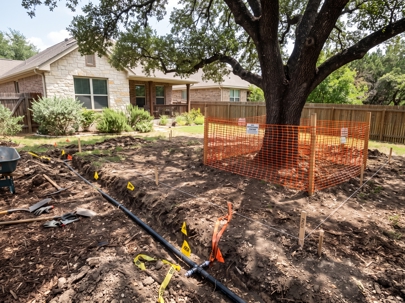
A patio built into an established yard faces a risk that a new-construction lot simply doesn't: everything already growing and running beneath the surface has had years, sometimes decades, to settle into place before anyone proposed digging into it. Sprinkler lines snake through the soil exactly where a homeowner's dream patio footprint happens to sit. Tree roots have spread outward, often much farther than the canopy above ground would suggest. Building a patio without accounting for either of these realities is one of the most consistent ways a retrofit project runs into trouble, sometimes not until months or years after the crew has already packed up and gone home.
Paver patio installation into an established Round Rock, TX yard requires a fundamentally different starting assumption than a blank-lot project: nothing about what's underground can be assumed, and everything needs to be located and accounted for before excavation begins.
This distinction matters more than it might initially seem, since most general outdoor living patio design content is written without much attention to the specific complications of retrofitting hardscape into a yard that's already mature. Guidance calibrated for a fresh lot simply doesn't address the underground realities that make an established-yard project meaningfully different from the start, which leaves homeowners researching their options with an incomplete picture of what their specific project actually requires.
Why Established Yards Present a Different Risk Profile for Paver Patio Installation
A mature yard has accumulated years of underground infrastructure and living root systems that a new lot simply hasn't had time to develop, which fundamentally changes what a contractor needs to investigate before design work can safely begin.
What's Already Underground in a Mature Round Rock, TX Yard
Backyard paver patio construction in an established yard has to account for irrigation lines installed at some point in the property's history, often without detailed records showing exactly where they run, alongside root systems from trees that have had years or decades to spread well beyond what's visible above ground. Neither of these realities announces itself clearly on the surface, which means a retrofit project starts from a position of genuine uncertainty about what's actually beneath the proposed footprint.
Heroes Lawn Care begins every established-yard assessment in Round Rock, TX with the explicit assumption that irrigation records may be incomplete or entirely unavailable, treating physical location verification as a required step rather than relying on whatever documentation, if any, a homeowner happens to have on hand.
Why This Risk Doesn't Exist on a New-Construction Lot
A brand-new lot, by comparison, typically has irrigation systems installed after any major hardscape planning has already happened, and any trees present are recently planted with root systems still confined to a relatively small, predictable area. Paver installation for existing landscapes carries a categorically different risk profile than new-construction work, precisely because established yards have had years to develop underground complexity that a fresh lot hasn't yet accumulated.
The Irrigation Line Mistake: Building Over What You Can't See
Irrigation lines represent one of the most common, and most consequential, underground surprises encountered during an established-yard patio retrofit.
Why a Broken Line Under a Patio Causes Collapse, Not Just a Leak
An irrigation line running beneath a section of yard is a minor, easily repaired issue as long as the surface above it is turf or planting beds. Once a paver patio sits on top of that same line, a break becomes a structural problem rather than a simple leak, since water escaping beneath the base can wash away the compacted material supporting the pavers directly above it, leading to localized sinking or collapse right at the point of failure. A paver patio retrofit for established yards that doesn't locate and address existing irrigation lines before construction is building directly over a hazard that may not surface as a problem until well after installation is complete.
Heroes Lawn Care treats irrigation location and rerouting as a prerequisite step completed before any base excavation begins, rather than a detail addressed reactively if a line happens to be struck during construction.
Locating and Rerouting Lines Before Excavation Begins
Professional patio paving services working in established yards typically coordinate with an irrigation specialist to map existing line locations before any excavation begins, rerouting lines that fall within the proposed patio footprint rather than building over them and hoping for the best. Interlocking paver patio services that skip this coordination step are relying on chance rather than verified information, which is a meaningfully different risk profile than a contractor who has actually confirmed what's running beneath a specific section of yard before committing to a final design.
This coordination step also protects against a subtler problem: even when an irrigation line survives the initial construction process undamaged, leaving it in place directly beneath a patio means any future repair or maintenance to that line requires tearing up finished hardscape to access it. Rerouting the line around the patio footprint entirely, rather than simply avoiding damaging it during construction, solves both the immediate structural risk and the longer-term maintenance access problem in a single step.
This same logic extends to how a homeowner should think about any other underground utility that might intersect a proposed patio footprint, not just irrigation. Low-voltage landscape lighting wiring, buried electrical conduit for outdoor outlets, or drainage lines from a nearby downspout can all present similar access problems if left directly beneath a finished patio rather than rerouted around it during the same planning process that addresses irrigation.
The Tree Root Mistake: Treating Root Zones as Empty Space
Mature trees present a different but related underground complication, one that affects the tree's long-term health as much as the patio's structural performance.
Why Drip-Line Construction Risks Long-Term Tree Decline
A tree's root system typically extends well beyond its canopy, often significantly beyond what the visible drip line above ground would suggest. Hardscape patio construction positioned within a tree's root zone compacts soil and restricts the oxygen exchange those roots depend on, a stress that frequently doesn't show up as visible tree decline until years after construction, well after the connection between the two events has become difficult for a homeowner to trace back to its actual cause. Established yard patio upgrades planned without an awareness of root zone extent risk slowly damaging trees that took decades to reach their current size, in exchange for a patio footprint that could often have been adjusted to avoid the conflict entirely.
This delayed timeline is part of what makes root zone damage so easy to overlook as a risk during initial planning. A tree showing no immediate signs of stress in the months following construction can still be in the early stages of decline that won't become visually apparent for several more years, by which point the original construction project is a distant memory rather than an obvious suspect. By the time thinning canopy or dieback becomes noticeable, the actual cause is rarely the first explanation a homeowner considers.
When Shifting the Patio Footprint Beats Fighting the Tree
Rather than insisting on a specific footprint regardless of what's growing nearby, custom paver patio installation planned around an established yard's existing trees often benefits from shifting the proposed layout a few feet in one direction, avoiding the most sensitive portion of a root zone without meaningfully compromising the overall design. Decorative paver installation services experienced with mature landscapes tend to treat established trees as a design constraint worth respecting from the outset, rather than an obstacle to be worked around only after root damage has already occurred.
A modest shift in footprint is almost always a smaller compromise than it initially feels like during the planning conversation. A patio moved a few feet to preserve a mature tree's root zone rarely changes the fundamental function or enjoyment of the finished space, while the tree being protected often represents decades of growth that no amount of new landscaping could quickly replace if lost to preventable root damage.
How Established Drainage Patterns Complicate a Retrofit
Beyond irrigation lines and tree roots, an established yard has also developed its own drainage behavior over years of rainfall, grading, and landscaping decisions that a retrofit project needs to work with rather than ignore.
Reading Years of Existing Grading Before Adding Hardscape
Residential paver patio contractors retrofitting a patio into a mature yard benefit from observing how water actually moves across the property during and after rainfall, rather than assuming a textbook grading pattern that may not reflect what years of settling and landscaping changes have actually produced. Paver patio renovation for existing yards that ignores this established drainage behavior risks creating a new low point where water collects, or redirecting runoff toward a part of the yard, or a neighboring property, that wasn't previously affected by it.
Years of incremental landscaping changes, a new flower bed here, a small grade adjustment there, can shift how water moves across a property in ways that aren't documented anywhere and aren't obvious without direct observation. A contractor relying solely on general grading principles, without actually watching how the specific yard behaves during rain, is working from an assumption rather than from what the property has actually demonstrated over years of real weather.
Designing the Retrofit Around What's Already There
Once irrigation lines, tree root zones, and established drainage patterns are properly understood, the actual design process can respond intelligently to what the yard already has, rather than treating those existing elements as inconveniences to minimize.
Custom Patterns and Entertaining Spaces That Work With Existing Layout
Custom paver patterns and decorative paver pattern installation offer real flexibility for working around irregular footprints shaped by existing trees, irrigation zones, or established landscaping features, since a patio doesn't need to be a simple rectangle to function well as a paver patio entertaining space. Outdoor entertaining patio design that embraces an established yard's existing quirks, curving around a mature oak or following the natural contour created by years of landscaping, often produces a more distinctive, better-integrated result than a design that fights the yard's existing character in pursuit of a perfectly uniform shape.
An irregular footprint driven by real constraints, rather than an arbitrary design choice, also tends to read as more intentional once the project is finished. A patio that curves around a mature tree looks like a deliberate design decision responding to the yard's existing character, while the same curve applied to an otherwise open, unconstrained space might look more like an unexplained stylistic flourish. Working with genuine constraints often produces better design outcomes than working entirely without them.
Backyard entertaining area installation planned this way also tends to preserve more of what originally made the yard appealing in the first place. A homeowner retrofitting a patio into a yard they've lived with for years usually isn't looking to erase everything that yard already offers, whether that's shade from a mature tree, an established garden bed, or simply the general character the space has developed over time. Backyard hardscape retrofit services that treat these existing features as assets to design around, rather than as obstacles to clear away, tend to produce results that feel like a natural extension of the yard rather than an imposition on it.
Sequencing Irrigation, Arborist, and Hardscape Work Together
Coordinating irrigation rerouting, any necessary tree root assessment, and the actual hardscape installation as a single sequenced process, rather than as separate, loosely connected steps, reduces the chances of a detail falling through the gap between specialists who aren't communicating directly with each other. Patio remodeling with pavers in an established yard benefits enormously from this kind of coordinated sequencing, since irrigation rerouting generally needs to happen before excavation begins, while any root pruning or protective measures around nearby trees typically need arborist input that a hardscape crew alone isn't positioned to provide.
The alternative, hiring an irrigation contractor, an arborist, and a hardscape crew independently without any shared coordination between them, tends to produce exactly the kind of gaps that lead to a struck line or an unnecessarily damaged root system. Each specialist working in isolation is focused on their own scope of work, without necessarily communicating findings to the others, which means a detail one specialist notices, an irrigation line spotted during a site walk, for example, may never reach the hardscape crew unless someone is actively managing that communication across all three parties.
Heroes Lawn Care coordinates irrigation location, tree root assessment, and hardscape installation as a single connected process for every established-yard retrofit in Round Rock, TX, rather than treating these as separate concerns to be addressed independently or, worse, discovered mid-excavation. Brick and stone patio installation planned this way accounts for what's already underground and already growing before a final design is ever finalized, rather than adjusting reactively once digging has already begun and an unexpected line or root system has already been struck.
Professional patio paving services that specialize in established-yard retrofits tend to build in more upfront investigation time than a comparable new-construction project would require, precisely because that investigation is what prevents the kind of mid-project surprises that damage both trees and irrigation systems, along with the finished patio itself. Residential paver patio contractors confident in their retrofit process are typically willing to explain specifically how they locate underground infrastructure and assess nearby root zones before finalizing a design, rather than treating this investigation as an assumed detail handled the same way regardless of whether a yard is newly graded or decades established.
Conclusion
The mistake that sinks so many paver patio retrofits in Round Rock, TX isn't a failure of design or material selection. It's a failure to properly investigate what's already underground and already growing before committing to a final footprint, treating an established yard's accumulated irrigation lines and mature tree roots as unknowns that will simply work themselves out rather than specific risks that need to be located and planned around from the very beginning.
This distinction between new-construction planning and established-yard retrofitting deserves more attention than it typically receives in general paver installation guidance. A yard's age and history aren't incidental details — they directly shape what kind of investigation a project actually needs before design work can proceed responsibly, and treating every project the same way regardless of that history is precisely how irrigation lines get struck and tree roots get compacted without anyone intending either outcome.
Heroes Lawn Care approaches every paver patio installation retrofit in Round Rock, TX by locating irrigation lines and assessing nearby tree root zones before finalizing any design, treating an established yard's existing underground reality as the starting point for planning rather than a set of unknowns to be discovered along the way. Respecting what's already there, both underground and growing above it, remains the most reliable way to end up with a retrofit that performs well structurally and doesn't quietly damage the mature landscaping that made the yard worth investing in to begin with.