
The Placement Mistake That Turns a Georgetown, TX Acreage Patio Into Wasted Space | Heroes Lawn Care
More land creates more decisions, and one of the first questions an acreage homeowner faces is deceptively simple: where, exactly, should the patio go. The instinctive answer is often to chase the best view, the most scenic corner of the property, the spot furthest from the road or nearest to a stand of mature oaks. That instinct, reasonable as it sounds, is one of the most common ways an acreage patio ends up beautiful, expensive, and rarely used.
Paver patio installation on a Georgetown, TX acreage property succeeds or fails based on a factor that has surprisingly little to do with the view: how close the finished space actually sits to daily life in the house.
This distinction matters more on acreage than it does almost anywhere else, since a standard suburban lot rarely offers enough room for the placement mistake to fully play out. Custom paver patio installation on a quarter-acre lot is naturally constrained to a relatively small radius around the house. An acreage property removes that constraint entirely, which is precisely what makes deliberate placement planning so much more consequential.
The Placement Instinct That Undermines Most Acreage Paver Patio Installation Projects
Homeowners moving from a standard suburban lot to acreage often carry over an assumption that doesn't actually hold up once there's real space to work with: that more land means the patio should go wherever looks most impressive, rather than wherever will actually get used.
Why “Best View” Isn't the Same as “Best Location”
A patio positioned for maximum scenic impact, tucked into a distant corner overlooking a pond or a sweeping stretch of pasture, photographs beautifully and often becomes the centerpiece of the initial design conversation. Large backyard patio design driven primarily by view, without equal weight given to how far that view sits from the back door, frequently produces a space that gets used for special occasions and rarely anything else.
This isn't to say a scenic view has no place in the overall plan. It simply means that view alone shouldn't be the deciding factor for where the property's primary, most frequently used outdoor space actually sits. A stunning view is an asset worth incorporating somewhere into the overall design, but treating it as the automatic location for the main patio conflates two separate questions: where does the best view happen to be, and where will a patio actually integrate into how the household lives day to day.
The Proximity Principle: Why Distance From the House Predicts Usage
Outdoor living patio design research consistently points to the same pattern: the farther an amenity sits from the house, the less frequently it actually gets used, regardless of how attractive that amenity is on its own. A fire pit, dining area, or seating zone requires a certain amount of friction to reach, and even a short walk across open yard is enough friction to turn a “let's go sit outside for a bit” impulse into something that happens only when specifically planned for, rather than spontaneously on an average evening.
Heroes Lawn Care raises this proximity principle directly with every acreage homeowner during initial planning, since the instinct to prioritize a scenic distant location is common enough that it deserves to be addressed explicitly rather than left as an unspoken assumption guiding the entire design.
What Happens When a Patio Is Placed Too Far From Daily Life
The gap between how a distant patio is imagined during planning and how it actually gets used once built tends to be one of the more common sources of buyer's remorse on acreage properties.
The Underused Destination Patio Pattern
A patio built specifically as a destination, something to walk out to rather than simply step onto, tends to see far less regular use than homeowners anticipate during the planning process. Custom patio layouts for acreage homes built entirely around a scenic destination concept often become special-occasion spaces visited a handful of times each season, rather than the daily-use extension of the home that most homeowners are actually hoping to create when they first start planning.
This pattern tends to surprise homeowners precisely because it runs counter to how the space felt during planning. Standing at a proposed distant site on a pleasant weekend afternoon, imagining a finished patio there, feels entirely different from the reality of deciding, on a random Tuesday evening after a long day, whether the walk out to that same spot is worth the effort. The planning-stage experience and the actual day-to-day experience are systematically different in ways that are easy to underestimate until the space is already built and the pattern has had a chance to play out.
How Weather, Convenience, and Habit Work Against Distant Spaces
Texas heat, sudden rain, and simple daily convenience all work against a distant patio in ways that are easy to underestimate during a planning conversation held on a pleasant afternoon. Patio location planning for acreage that doesn't account for how these everyday factors affect actual usage patterns tends to produce a space that looks perfect in initial renderings but sits empty on most ordinary days, precisely the days a well-placed patio should be getting the most consistent use.
Central Texas summer heat is particularly relevant here, since a walk of even a hundred feet across open, unshaded yard in July temperatures is a meaningfully different proposition than the same walk on the mild spring day when the patio location was originally chosen. A distant patio that seemed perfectly reasonable to reach during a comfortable planning walkthrough can feel like a genuine deterrent once actual Texas summer conditions are factored into the daily calculation of whether it's worth making the trip.
The Multi-Zone Alternative for Georgetown, TX Acreage Properties
The solution isn't necessarily choosing between the scenic distant spot and a purely convenient one close to the house. Acreage properties have enough space to support both, as long as they're planned as distinct zones serving different purposes rather than a single all-purpose patio expected to do everything.
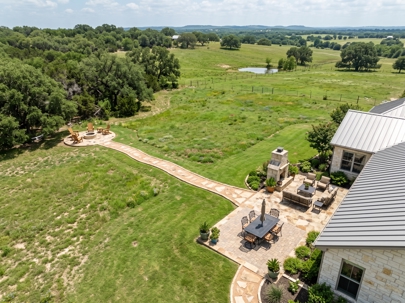
Keeping the Primary Zone Close, Reserving Destination Zones for Occasional Use
Acreage patio placement planning that positions the primary, most frequently used entertaining and dining zone close to the house, while reserving a more distant, scenic secondary zone for occasional destination use, tends to produce a property that actually gets enjoyed daily rather than one where the impressive feature sits mostly unused. Estate property outdoor living design built around this two-tier approach acknowledges that different zones serve different purposes: a primary zone optimized for everyday convenience, and secondary zones optimized for the occasional deliberate outing.
Heroes Lawn Care designs acreage properties around this two-tier zone structure as standard practice, ensuring the primary outdoor living space sits within easy daily reach before any secondary destination zone is even discussed as part of the broader plan.
Connecting Zones With Purposeful Pathways
Multi-zone patio planning for large lots benefits significantly from pathways that make traveling between zones feel like part of the experience rather than an obstacle. Large-lot patio planning services that design intentional walking routes between a primary patio and a more distant secondary space, rather than leaving that connection as an afterthought of open lawn, make the secondary zone meaningfully more likely to actually get visited regularly, since a defined path lowers the psychological friction of the trip in a way that open, undefined yard space doesn't.
A well-designed pathway does more than simply mark a route from one point to another. Thoughtful lighting, occasional seating along the way, or a change in paving material as the path transitions from primary to secondary zone all contribute to making the walk itself feel like an intentional part of the property's design, rather than an unremarkable stretch of yard that has to be crossed to reach the destination on the other side.
Sizing and Siting a Patio Correctly on a Large Lot
Beyond placement relative to the house, the size and specific siting of a patio within a large property carries its own set of considerations that don't apply the same way on a standard suburban lot.
Why Bigger Isn't Automatically Better
A common assumption on acreage properties is that having more available space justifies building a correspondingly larger patio, when in practice an oversized patio disconnected from a sense of scale relative to its surroundings can feel just as impersonal and underused as a patio placed too far from the house. Expansive property hardscape planning that sizes a primary patio around realistic entertaining needs, rather than simply filling available space because the space exists, tends to produce a more inviting, more consistently used result than one sized primarily to make a visual statement.
An oversized patio also introduces its own version of the friction problem discussed earlier, just at a smaller scale. A dining set positioned in the corner of an enormous, mostly empty paved surface can feel just as disconnected and underused as a well-proportioned patio placed too far from the house, since the excess space surrounding daily activity areas creates its own kind of psychological distance even when the physical distance from the house is minimal.
Working With Slope, Outbuildings, and Existing Structures
Paver patio placement for large properties often needs to account for existing barns, workshops, or guest structures already positioned across the property, along with whatever natural slope or elevation change exists between the house and any secondary outdoor zones. Custom hardscape solutions for expansive yards that work with these existing features, connecting a workshop or barn into the overall pathway plan rather than treating it as an unrelated structure elsewhere on the property, produce a more cohesive, unified feel across the entire acreage rather than a patchwork of disconnected outdoor spaces.
Slope in particular offers an opportunity rather than simply a complication on a large property. A gentle grade change between a primary patio near the house and a secondary zone farther out can be incorporated as a deliberate design element, perhaps a few wide, gradual steps or a naturally terraced transition, rather than something to be engineered away entirely. Working with a property's existing topography generally produces a more distinctive, better-integrated result than forcing a perfectly flat connection between zones that weren't naturally level to begin with.
Planning an Acreage Patio Strategy That Actually Gets Used
Bringing placement, sizing, and multi-zone planning together points toward a strategy that treats an acreage property's outdoor living potential as a connected system rather than a single isolated patio decision.
Questions to Ask Before Committing to a Location
Useful questions include how frequently a proposed location would realistically be visited on an average weekday, not just a weekend gathering, how far that location sits from the kitchen or nearest entry point, and whether a scenic distant spot might work better as a secondary destination zone rather than the property's primary outdoor living space. Residential paver patio contractors experienced with acreage properties can typically walk through these tradeoffs specifically, helping a homeowner separate genuine daily-use potential from the emotional pull of a beautiful but impractical view.
A useful exercise during this planning stage is physically walking the proposed route between the house and any candidate location, at different times of day and, ideally, in less-than-perfect weather conditions rather than only on a pleasant afternoon. That walk-through tends to surface the same friction factors that will eventually determine actual usage patterns once the patio is built, giving homeowners a far more accurate preview of daily reality than a scaled site plan or rendering alone could provide.
Heroes Lawn Care approaches every Georgetown, TX acreage project by starting with realistic daily-use patterns before finalizing patio placement, rather than defaulting to whichever spot on the property photographs most impressively. Backyard paver patio construction planned this way positions the primary entertaining zone within easy, low-friction reach of the house, while still making room for a more distant scenic zone where the property's natural features genuinely warrant a destination space.
Professional patio paving services familiar with Georgetown's mix of established neighborhoods and larger acreage properties recognize that placement strategy needs to shift meaningfully once lot size moves beyond a typical suburban footprint. Interlocking paver patio services applied without adjusting for that larger scale often default to suburban placement logic, positioning a patio simply based on where the house's back door happens to face, without considering how an acreage property's additional space and existing features should actually inform a more deliberate placement strategy.
This distinction between suburban and acreage placement logic is worth making explicit, since the two contexts call for genuinely different starting assumptions. A suburban lot's constrained size naturally limits placement options to a fairly narrow range close to the house, which means the proximity principle is largely baked into the property's physical constraints without anyone needing to think about it deliberately. An acreage property removes that built-in constraint, which is exactly why the placement decision deserves the level of deliberate attention it often doesn't receive.
Decorative paver installation services and hardscape patio construction alike benefit from this same underlying planning discipline, regardless of which specific materials or patterns eventually get selected for the finished spaces. Patio remodeling with pavers on an existing acreage property that's already dealing with an underused, poorly placed patio can apply these same proximity and multi-zone principles retroactively, often relocating or supplementing an existing space rather than starting entirely from scratch.
Brick and stone patio installation planned around a genuine multi-zone strategy, with the primary gathering space close to the house and secondary destination zones reserved for occasional deliberate use, produces an acreage property that feels genuinely lived-in across its full footprint, rather than one where an impressive investment sits mostly unvisited while daily life continues to happen exclusively near the back door.
Conclusion
The placement mistake that turns so many Georgetown, TX acreage patios into wasted space isn't a failure of design or material selection. It's the instinct to prioritize the most scenic available spot over the spot that will actually integrate into daily life, an instinct that feels reasonable when a property offers so much more space to work with than a standard suburban lot ever could.
This mistake is entirely avoidable once it's named directly, which is precisely why raising the proximity principle explicitly during early planning matters so much. Left unaddressed, the instinct to chase the best view tends to win by default, simply because it's the more emotionally compelling option the moment a homeowner first walks the property imagining where a patio might go. Naming that instinct and weighing it against realistic daily-use patterns gives homeowners the information needed to make a more deliberate choice.
Heroes Lawn Care plans every paver patio installation for Georgetown, TX acreage properties around realistic daily-use patterns first, reserving distant scenic locations for secondary zones rather than defaulting to a single patio placed purely for visual impact. Getting this proximity principle right from the start remains the most reliable way to end up with an acreage outdoor living space that gets used every week, not just on the rare occasion someone remembers to make the walk.