
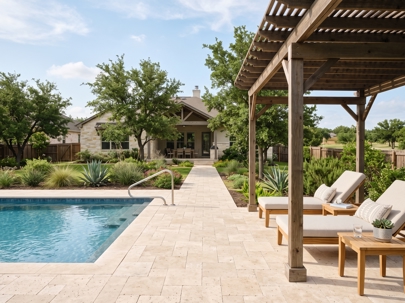
The Complete Guide to Pool Deck Paver Installation for Liberty Hill, TX Active-Adult Communities | Heroes Lawn Care
A pool deck built for a young family with children splashing in and out all day has a different set of priorities than one built for homeowners in an active-adult community who plan to use that space daily for years, often decades, to come. Material choices that seem interchangeable at first glance, textured versus polished, dark versus light, porcelain versus natural stone, actually carry meaningfully different implications once safety, long-term comfort, and ongoing upkeep become the primary considerations rather than an afterthought.
Paver patio installation for a pool deck in a Liberty Hill, TX active-adult community deserves a planning approach built specifically around those priorities, rather than a generic pool deck design borrowed from a younger family's backyard.
Most general pool deck guidance available online is written without this specific audience in mind, defaulting to considerations like family entertaining space or general material style comparisons rather than the safety and long-term-use factors that matter most for homeowners planning to spend years, not just a few active summers, enjoying that same space.
Why Pool Deck Paver Patio Installation Requires Different Priorities for Active-Adult Homeowners
Three considerations tend to matter more for active-adult community outdoor living spaces than they typically do for a general residential pool deck: safety underfoot, comfort during long stretches of use, and minimal ongoing maintenance.
Safety, Comfort, and Low Maintenance as the Three Pillars
Slip resistance carries more weight for active-adult community landscaping than it might for a younger household, since fall risk on a wet pool deck surface is a more significant concern as mobility and balance change with age. Durable poolside paver surfaces selected specifically for slip resistance, rather than primarily for appearance, address this priority directly, and that emphasis on safety doesn't need to come at the expense of an attractive finished result.
Heroes Lawn Care evaluates slip resistance as a primary selection criterion for every active-adult community pool deck project in Liberty Hill, TX, rather than treating it as a secondary detail addressed only after aesthetic preferences have already narrowed the material options.
How These Priorities Differ From a Family Backyard Pool Deck
A family with young children often prioritizes a pool deck that can withstand toys, spilled sunscreen, and heavy foot traffic during a few concentrated hours of daily use. Paver patios for active-adult communities are more often used consistently throughout the day, sometimes for extended periods of sitting, walking, or entertaining, which shifts the priority list toward sustained comfort, consistent surface temperature, and a finish that holds up to daily use over years rather than surviving a single intense summer season.
This difference in usage pattern has real design implications beyond material selection alone. A family pool deck might reasonably prioritize a compact footprint focused tightly around the pool itself, while a design built for daily, extended active-adult use often benefits from more generous space for seating, walking, and simply spending unhurried time outdoors, since the deck itself becomes a primary living space rather than a secondary feature visited mainly during pool use.
Choosing a Pool Deck Material That Stays Cool and Slip-Resistant
Material selection is the single decision that most directly affects both safety and comfort on a finished pool deck, making it worth more deliberate consideration than a purely aesthetic choice would require.
Porcelain, Travertine, and Textured Concrete Compared
Pool-deck paver installation using porcelain offers a dense, non-porous surface that resists staining and UV fading without requiring periodic sealing, making it one of the lowest-maintenance options available for a poolside surface. Travertine offers a naturally cool, slip-resistant surface prized for its comfort underfoot, though it does require resealing every couple of years to maintain that performance over time. Textured concrete pavers provide a more accessible option with solid slip resistance, though color and finish selection become especially important for managing heat retention in direct Central Texas sun.
Why Color and Texture Matter More Than Style Alone
Darker paver surfaces can reach uncomfortably hot temperatures in direct summer sun, sometimes dramatically hotter than lighter-colored alternatives positioned in the exact same location. Pool deck paver design and construction that prioritizes lighter tones and genuinely textured, rather than merely decorative, surface finishes addresses both heat and slip resistance simultaneously, which matters considerably more for daily comfort and safety than color coordination with a home's exterior alone.
This distinction between decorative texture and functional texture is worth understanding clearly. Some paver finishes are textured primarily for visual interest, a subtle pattern or embossed detail that reads well in photos but provides only modest additional traction underfoot. A genuinely slip-resistant finish is engineered specifically for grip in wet conditions, which sometimes means sacrificing a small amount of visual polish in exchange for meaningfully better performance where it actually matters most, immediately after someone steps out of the pool dripping wet.
What “Low-Maintenance” Actually Means for a Paver Pool Deck
The phrase “low-maintenance” gets used broadly across pool deck marketing material, but it means meaningfully different things depending on which material and installation approach is actually being described.
Sealing Schedules, Joint Stability, and Individual Paver Repair
Low-maintenance paver surfaces still require some periodic attention, even at the lower end of the maintenance spectrum, but the type and frequency of that attention varies significantly by material. Porcelain requires essentially no sealing at all, while travertine benefits from resealing on a multi-year cycle to maintain its stain resistance and appearance. Low-maintenance patio installation planned around a homeowner's actual willingness to perform or schedule this periodic upkeep, rather than around marketing claims alone, produces a result that stays genuinely low-effort over the years it's actually lived with.
Understanding this distinction upfront prevents a common source of later disappointment: a homeowner choosing a material marketed broadly as “low-maintenance” without realizing that specific material still carries a resealing schedule they hadn't planned to manage. Asking directly what ongoing maintenance a specific material actually requires, rather than relying on the general low-maintenance label alone, is a simple question that clarifies expectations well before installation begins.
One of the more practical long-term advantages of paver construction generally, regardless of specific material, is that individual pavers can be lifted and replaced without disturbing the surrounding surface, unlike a poured concrete slab that typically requires a much larger repair or full replacement if it cracks or stains significantly. Easy-care backyard hardscaping benefits from this modularity considerably, since a single damaged or stained paver near a pool deck's edge can be addressed as an isolated repair rather than triggering a much larger, more disruptive project.
This advantage compounds over the years a pool deck remains in active use. A concrete pool deck that develops a crack or persistent stain generally requires resurfacing or full replacement to fully resolve the issue, a substantial undertaking that disrupts pool access for an extended period. A paver deck facing the same kind of localized damage can typically be repaired in a matter of hours, with the pool remaining accessible throughout most of the process, which matters considerably for homeowners who use their pool deck as a daily part of their routine rather than an occasional seasonal feature.
Designing a Pool Deck for Liberty Hill's Hill Country Climate
Beyond the general material and safety considerations that apply to any active-adult pool deck, Liberty Hill's specific Hill Country conditions add another layer worth planning around from the outset.
Heat, Caliche Soil, and Drainage Considerations Specific to This Region
Central Texas summers push surface temperatures higher than many pool deck materials are marketed to handle in cooler climates, which makes heat-conscious material selection especially relevant for Liberty Hill, TX installations specifically. The region's caliche and rocky soil also affects base preparation and drainage planning in ways that differ from installations in areas with deeper, more forgiving soil, requiring a base and drainage approach calibrated to these specific regional conditions rather than a generic national standard. Backyard paver patio construction that accounts for both heat performance and regional soil behavior from the start avoids the kind of drainage or settling issues that a design borrowed from a different climate might not anticipate.
Heroes Lawn Care factors Liberty Hill's specific caliche soil conditions and summer heat intensity into every pool deck material recommendation, since a material performing well in a cooler or deeper-soil market elsewhere doesn't automatically translate to the same performance under Hill Country conditions.
Building a Pool Deck That Works for an Active-Adult Community Long-Term
Bringing safety, comfort, low maintenance, and regional climate considerations together points toward a pool deck design that performs reliably for years without demanding constant attention or introducing unnecessary hazards.
Smooth Transitions, Consistent Surfaces, and Entertaining Space Design
Interlocking paver patio services designed around active-adult use benefit from minimizing abrupt elevation changes and ensuring consistent surface texture across the entire pool deck footprint, rather than mixing materials or finishes in ways that could create unexpected trip hazards at transition points. Outdoor living patio design for 55+ community outdoor living spaces often includes shaded seating areas positioned away from direct pool splash zones, along with clearly defined pathways connecting the pool deck to the rest of the outdoor entertaining area, supporting both comfortable extended use and straightforward navigation for residents at any mobility level.
Lighting deserves consideration alongside these physical design elements, particularly for a pool deck likely to see use during early morning or evening hours when natural light is more limited. Well-placed, adequately bright pathway and step lighting reduces the risk of missteps during lower-light conditions, complementing the slip-resistant surface itself rather than functioning as an unrelated, purely decorative addition.
Custom paver patio installation for these spaces also benefits from thinking through furniture placement and traffic flow during the design phase rather than after installation is already complete. A pool deck with adequate clearance for chairs, tables, and walking paths between them accommodates daily use far more comfortably than one designed purely around visual proportions without considering how the space will actually function once furnished and in regular use.
Clearance requirements deserve particular attention for residents who use mobility aids or simply prefer wider, more comfortable walking paths as a matter of personal preference. A pathway width that feels adequate on paper can prove tight once furniture, planters, and everyday foot traffic are all accounted for simultaneously, which is why walking through a proposed layout at actual scale, rather than relying solely on a scaled drawing, often reveals clearance issues that wouldn't otherwise be apparent until after construction. This kind of physical walkthrough, conducted before any material is ordered or excavation begins, remains one of the simplest and most effective ways to catch a spacing problem while it's still easy to correct.
Decorative paver installation services experienced with active-adult communities also tend to understand the value of consistency across an entire property, coordinating pool deck material and pattern choices with any existing patio remodeling with pavers elsewhere on the property, so the finished result reads as a cohesive outdoor living environment rather than a collection of mismatched separate projects. Hardscape patio construction planned this way tends to hold its value and appeal more consistently over time than a pool deck treated as an entirely isolated addition disconnected from the rest of the property's outdoor spaces.
This coordination matters especially for properties where a pool deck represents just one piece of a larger outdoor living vision that might eventually include a covered patio, additional entertaining space, or landscaping updates elsewhere on the lot. Planning material and design continuity from the start, even for phases that won't be built immediately, prevents the awkward visual disconnect that can result when each project is designed independently without any reference to what came before it or what might come after.
Residential paver patio contractors familiar with active-adult community expectations typically factor in realistic long-term maintenance capacity during initial design conversations, recognizing that a homeowner's willingness or ability to manage ongoing upkeep may shift over the years a pool deck remains in use. Professional patio paving services that have this conversation upfront, rather than assuming every homeowner wants the same maintenance commitment regardless of life stage, tend to recommend materials and designs that genuinely fit how the space will actually be used and cared for over its full lifespan.
This forward-looking approach also considers how a homeowner's needs might evolve over the years a pool deck remains in place. A design and material selection that works well today should ideally continue serving a homeowner comfortably years from now, without requiring a premature renovation simply because early material choices didn't account for how priorities or physical needs might shift over time.
Heroes Lawn Care approaches every pool deck project for Liberty Hill, TX active-adult communities with these priorities built into the design conversation from the very beginning, rather than applying a standard residential pool deck approach and adjusting only if a homeowner specifically raises concerns about safety or maintenance. Brick and stone patio installation and porcelain or travertine pool decking alike are evaluated specifically against slip resistance, heat performance, and realistic long-term upkeep, rather than selected primarily for initial visual appeal.
This proactive approach reflects a broader philosophy worth expecting from any contractor working in an active-adult community setting: the safety and long-term usability considerations that matter most for this audience shouldn't need to be raised by the homeowner as a special request. They should already be built into how a contractor approaches design and material selection as a matter of standard practice for this kind of project.
Conclusion
A pool deck built for an active-adult community in Liberty Hill, TX benefits from a fundamentally different set of priorities than a standard family backyard installation: slip resistance and fall prevention carry more weight, heat management affects daily comfort more directly, and genuinely low-maintenance outdoor living spaces matter more when the space is meant to be enjoyed consistently for years without becoming an ongoing source of upkeep and concern.
None of these priorities require sacrificing visual appeal in exchange for safety and practicality. Modern pool deck materials offer genuine slip resistance, comfortable heat performance, and minimal upkeep alongside attractive finishes and color options, which means a well-planned design can deliver on all of these fronts simultaneously rather than forcing a tradeoff between how a space looks and how safely and comfortably it actually functions day to day.
This is ultimately the standard a pool deck project for an active-adult community should be measured against: not simply how it photographs on the day it's finished, but how well it continues to serve the people using it years into the future, through every summer's heat and every season of daily use, without becoming a source of worry or unexpected upkeep along the way.
Heroes Lawn Care builds every paver patio installation for Liberty Hill, TX pool decks around these specific priorities, selecting materials and design details that address safety, comfort, and realistic long-term maintenance from the very first planning conversation. Approaching a pool deck project with this level of intentionality remains the most reliable way to end up with an outdoor space that stays genuinely enjoyable, and genuinely low-effort, for as long as it's actually lived with.