


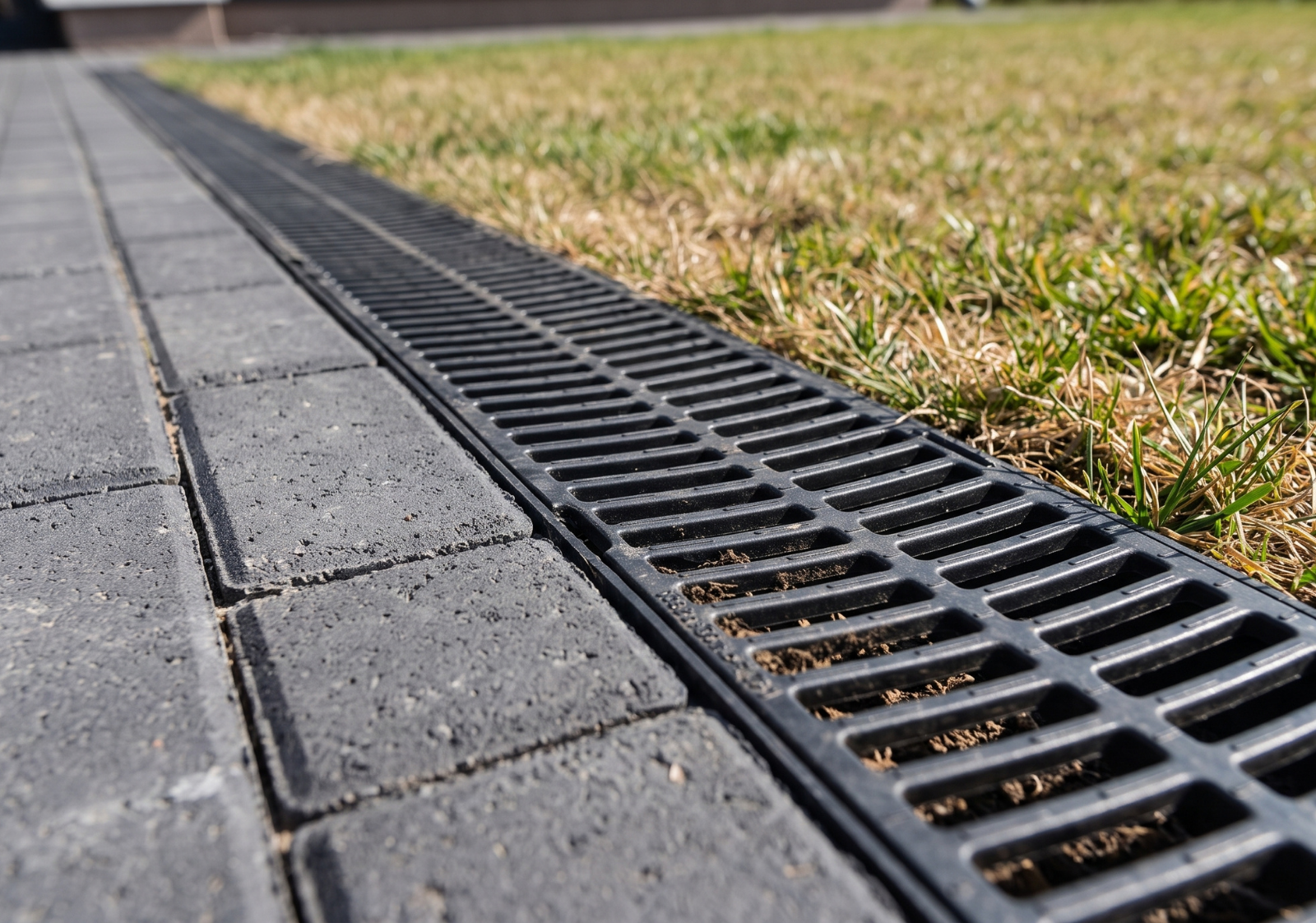
Where catch basins collect water that has already concentrated into a low spot, channel drains intercept water in motion — across a patio surface flowing toward a back door, across a driveway apron where rain sheets off the concrete, or along a pool surround where splash and rainfall accumulate at the water's edge. The result is water captured and conveyed underground before it reaches the structure, the interior, or the adjacent landscape zones it would otherwise saturate.
In Bellaire's heavy rainfall environment, surface water channel drainage systems installed at the right interception line protect outdoor living investments — concrete patios, outdoor kitchens, covered pergola areas, pool surrounds, and driveway surfaces — from the water accumulation and damage that Houston's intense rain events deliver. Channel drains are the most effective single drainage installation for hardscape surfaces, and the one most commonly included in professional outdoor living builds in this market.
What Does Channel Drain Installation Include?
Site Assessment & Interception Line Planning: We evaluate the surface's slope direction, water velocity and volume during rain events, and the most effective interception line — the location where a channel drain collects the maximum flow before it reaches a problem area. Placement determines performance; a channel drain installed on the wrong line collects nothing useful during the events it was designed for.
Channel Body & Grate Selection: We specify the appropriate channel body size — standard residential applications use 3-inch to 6-inch internal width — and grate material for the application. Stainless or galvanized steel grates are specified for areas with foot traffic and light vehicle access; heavier load-rated grates are used for driveway installations where full vehicle tire weight crosses the drain.
Saw-Cutting & Excavation: On existing concrete or paver surfaces, the channel trench is saw-cut precisely to the channel body dimensions. Accurate cutting determines how cleanly the grate sits flush with the finished surface — an uneven cut produces a drain that sits proud of the surface or creates a tripping hazard.
Channel Setting & Concrete Encasement: The channel body is set at the correct elevation in the trench and encased in concrete to prevent movement and ensure the grate surface remains flush with the surrounding hardscape through Bellaire's soil movement cycles.
Outlet Pipe Connection & Discharge: The channel body's outlet is connected to an underground pipe that conveys collected water to the appropriate discharge point — a pop-up emitter in the lawn, connection to a catch basin system, or daylight outlet at the property edge.
Our Channel Drain Installation Process
- Assessment & Line Specification — We walk the hardscape area during or after a rain event where possible to observe actual water flow direction and velocity, confirming the optimal interception line before any cutting begins.
- Grate & Channel Specification — Channel body width, depth, and grate load rating are specified for the application — residential foot traffic, poolside, or vehicle driveway crossing — and material selection is confirmed.
- Saw-Cutting — For concrete surfaces, the trench is saw-cut to precise width and depth. For paver surfaces, pavers are removed along the installation line. Both are done with professional equipment for clean, accurate cuts.
- Trench Excavation & Base Preparation — Material below the saw cut is excavated to the depth required for the channel body plus concrete encasement. A stable, compacted base is established.
- Channel Setting & Concrete Pour — The channel body is set level at the correct elevation and encased in concrete to the correct depth. The grate surface is confirmed flush with surrounding hardscape before concrete sets.
- Outlet Connection & Surface Restoration — Outlet pipe is connected from the channel end cap to the discharge system. Surrounding concrete or paver surfaces are restored to match the existing finish as closely as possible.
Channel Drain Applications for Bellaire Properties
Patio and Outdoor Living Drainage: The most common channel drain application in Bellaire — a linear drain installed at the low edge of a concrete patio or covered outdoor living area to intercept sheet flow before it reaches a door threshold, outdoor kitchen base, or structure wall. In Bellaire's rainfall intensity environment, a covered patio without a channel drain at its low edge consistently accumulates water during significant storms, making the space unusable during rain events and exposing the adjacent structure to repeated moisture. Patio and walkway drainage systems installed at the design stage of an outdoor living project prevent this problem from the first rain.
Driveway Apron Drainage: At the transition from the public street to a driveway, grade changes create a concentrated sheet flow zone that can back water toward the garage approach during heavy rain. A driveway channel drain installation set at the driveway apron line — perpendicular to the slope — intercepts this flow before it reaches the garage. In Bellaire's established neighborhoods where driveway aprons are a permit-relevant connection to the public right-of-way, channel drains at this transition are increasingly specified in renovation and new installation projects.
Pool Surround Drainage: Pool decks on Bellaire properties accumulate both splash and rainfall on a nearly impermeable surface surrounding a large body of water. Without a stormwater linear drain installation at the pool's edge or along the deck perimeter, that accumulated water flows across the full deck surface toward the nearest grade transition — often toward the house or onto adjacent landscape. A channel drain along the pool surround edge captures both splash and rain at the source and conveys it underground rather than allowing it to flow across the full deck.
Side Yard and Walkway Drainage: Narrow side yards and walkways between structures are high-velocity runoff channels during heavy rain — water moving from front to back or back to front concentrates in these narrow zones and often erodes exposed soil at the edges. A channel drain across a side yard or at the low end of a walkway provides controlled collection that eliminates the erosion and waterlogging these zones experience.
Why Choose Professional Channel Drain Installation?
Interception Line Accuracy: A channel drain installed on the wrong line misses the majority of the water flow it was designed to collect. Correct placement requires observing how water actually moves across the specific surface — not estimating from a dry inspection. Our assessment process prioritizes observing real flow conditions before specifying the interception line.
Grate Load Rating: Driveway channel drain systems must be specified with grates rated for vehicle tire loading — standard residential grates rated for foot traffic will deflect and eventually crack under repeated vehicle weight. Getting this specification right at installation is essential; replacing grates after failure requires reopening the concrete encasement.
Flush Setting for Safety & Aesthetics: A channel drain that sits above or below the surrounding surface is both a tripping hazard and an indication of poor installation. Professional saw-cutting and channel setting produce a drain that sits flush with surrounding hardscape — functionally correct and visually clean.
System Integration: Channel drains discharge through underground pipe to an outlet — and that outlet must be correctly specified for the water volume the drain will collect during peak events. An undersized outlet pipe or one with insufficient slope backs up the channel during peak flow, reducing or eliminating its effectiveness at the moment it's needed most. We design the full system from drain to discharge.
FAQ: Channel Drains
What's the difference between a channel drain and a catch basin?
A channel drain intercepts water in motion across a surface — it's a linear structure installed perpendicular to the flow direction that collects sheet flow along its full length. A catch basin is a point collector — it captures water that has already concentrated into a low spot. Channel drains are the right tool for hardscape surfaces where water moves across a broad area in sheets; catch basins are right for point-concentration low spots in turf or at the base of slopes. Most complete Bellaire drainage projects use both, with channel drains at hardscape edges and catch basins at turf low spots.
Can a channel drain be installed in an existing concrete patio or driveway?
Yes — saw-cutting into existing concrete is standard practice for channel drain installation. The cut is made precisely to the channel body width, material is excavated beneath, and the channel is set and encased in new concrete. The surrounding existing concrete surface is matched as closely as possible at the repair edges. This is one of the most common drainage additions to existing outdoor living spaces in Bellaire.
How wide should a channel drain be for a residential patio or driveway?
For residential patio applications with foot traffic only, a 3-inch to 4-inch internal channel width is appropriate for most Bellaire property dimensions. For driveway applications where the drain receives vehicle crossings, a wider body — 4 to 6 inches — with a correspondingly heavier load-rated grate is specified. Channel body depth is also sized for the outlet pipe connection and the anticipated flow volume. We specify both dimensions based on the application during the assessment.
What grate material is best for outdoor residential channel drains in Bellaire?
For most Bellaire residential applications — patios, walkways, pool surrounds — polymer channel bodies with stainless steel or galvanized steel grates offer the best combination of corrosion resistance, appearance, and durability. Stainless steel holds up best in Bellaire's humidity without surface rust. Cast iron is an option for applications requiring maximum load capacity but is heavier and more expensive without offering meaningful performance benefits over steel grates for standard residential loading.
GET STARTED WITH A FREE CHANNEL DRAIN ESTIMATE
Call (346) 436-6286 or Request an Estimate and we'll assess your hardscape drainage conditions, specify the right channel and grate for the application, and install an efficient outdoor water drainage system that intercepts surface flow before it reaches the places it shouldn't.

-
Eco-Conscious Process
 We utilize environmentally responsible products and techniques to both protect your lawn and the world around it.
 -
World-Class Service
We are committed to providing the highest quality service and support you need to take the hassle out of lawn care.
-
Quality Guarantee
Each member of our lawn care crew is trained to perform on-the-job quality assurance before completing any project.
-
Right-Sized Estimates
Our lawn care and landscaping pros create custom quotes tailored to your property and your goals, so you get exactly what you need at a price that works.






Explore Our Family Of Brands




.2408271112489.png "Groovy Hues")