
Trimming is distinct from structural pruning: it's focused on shape, clearance, and appearance management rather than correcting structural or health issues. In practice, good trimming work accounts for both — maintaining the visual character of a tree while observing and addressing structural concerns that emerge during the process. What it isn't is aggressive cutting that removes more than a tree needs or distorts its natural form. Bellaire's tree canopy is one of the neighborhood's most valued features, and the trees on individual properties contribute to that character. We trim to maintain and enhance that character, not to reduce trees to stubs.
Our tree trimming services cover trees up to ten feet in height — the scope where our team's training and equipment allow us to deliver precise, safe, controlled results. For larger trees, we advise honestly and refer to licensed arborists for that work.
What Does Tree Trimming Include?
Clearance Trimming: Removing branches that overhang structures — roofs, HVAC equipment, gutters, fences — create low clearance over driveways and walkways, or grow into contact with exterior walls. This is the most common trimming request on Bellaire's established lots, where trees planted years ago have grown into positions that require management.
Canopy Shaping: Selectively trimming the outer canopy to restore a balanced, proportional form — reducing branches that have grown significantly longer or heavier than the surrounding canopy, thinning dense sections that create wind resistance, and improving the visual silhouette of the tree within the landscape.
Dead Limb Removal: Dead, dying, or storm-damaged branches removed before they become safety hazards or disease entry points. Dead limb removal is included as part of any trimming visit — we don't leave observable deadwood in place when we're working on a tree.
Shrub-Form Tree Shaping: For ornamentals, multi-trunk trees, and Crepe Myrtles that function as landscape focal points, trimming addresses their specific shape requirements — maintaining clean lines, balancing the canopy spread, and removing interior clutter without distorting the natural growing form.
Our Tree Trimming Process
- Property Walk & Tree Assessment — We evaluate each tree to be trimmed, identify the clearance, shape, and dead limb objectives, and assess whether any structural concerns (crossing branches, weak attachments, signs of disease) should be addressed during the same visit.
- Trimming Execution — Working from bottom to top on each tree, we address clearance first — raising the canopy to the required clearance above structures, walkways, and turf — then shape the outer canopy for balance and proportion.
- Dead Wood Removal — Observable dead, dying, or storm-damaged branches are removed at the correct cut location during the same visit, not left for a separate service.
- Canopy Review — We step back after each tree to assess the result from the property perspective — confirming the shape reads correctly from the street and from the yard before moving to the next tree.
- Debris Removal — All trimmings and removed material are collected and removed from the property. No debris is left for the homeowner to manage.
Trimming Bellaire's Most Common Trees Correctly
Crepe Myrtles — The Most Important Trimming Conversation in Bellaire
Crepe Myrtle trimming is the service where the quality difference between a knowledgeable team and an uninformed one is most visible — and most permanent. "Crape murder" — the practice of severely topping Crepe Myrtles by cutting all branches back to thick stubs — is performed by crews across the Houston area because it's fast and requires no skill. The results compound over years: knobby stubs that produce excessive weak regrowth, loss of the natural branching structure that makes the tree beautiful, structurally compromised attachment points that fail under wind load, and a permanently disfigured form that never recovers.
Correct Crepe Myrtle trimming maintains the tree's natural branching structure. Height reduction, where genuinely needed, is achieved through selective reduction cuts to lateral branches — not heading cuts to stubs. Interior crossing and rubbing branches are removed to improve airflow and visual openness. The goal is a tree that looks like a better version of itself — not a truncated version that will spend the next growing season producing a thicket of weak suckers from every stub. We discuss Crepe Myrtle trimming specifically during every assessment because it's the service where technique matters most and where previous damage is often visible.
Live Oaks — Clearance and Timing
Live Oaks within our ten-foot scope are most commonly trimmed for low-canopy clearance — raising lower branches above mowing height, driveways, and walkways. For any Live Oak trimming, we observe the Oak Wilt timing guidance established on our pruning page: late fall through January is the preferred window, outside the February through June higher-risk period for Oak Wilt transmission through pruning wounds. For clearance work on lower branches that genuinely needs to happen at other times of year, we advise on the relative risk and recommended precautions.
Ornamentals and Multi-Stem Trees
Small flowering ornamentals — Redbuds, Japanese Hollies, ornamental figs, and similar species common on Bellaire's established lots — are trimmed for shape and clearance with awareness of bloom cycle timing. Most spring-flowering ornamentals are trimmed immediately after bloom to avoid removing next season's flower buds. We advise on species-specific timing during the assessment.
Why Choose Professional Tree Trimming?
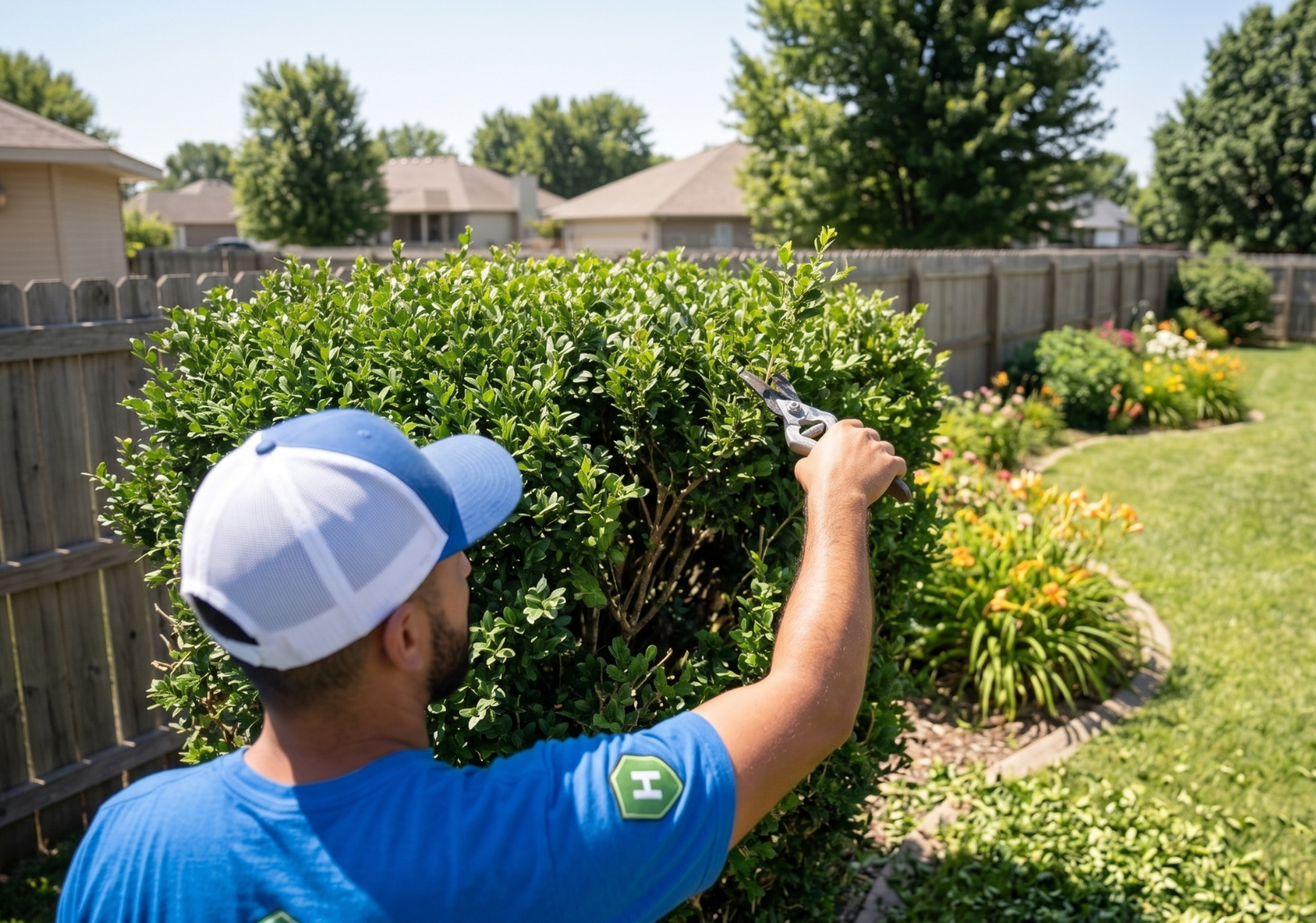
Technique Matters More Than It Looks: Heading cuts — indiscriminate cuts that leave branch stubs rather than reducing to a lateral branch — produce profuse, weakly attached regrowth that requires more trimming the following season and progressively weakens branch structure. Correct selective reduction technique produces natural-looking results that grow back in proportion. The difference in outcomes compounds over multiple trimming cycles.
Clearance Requires Judgment: Overgrown branch removal services that simply cut everything at a fixed height produce a lollipop shape rather than a properly cleared tree. Effective clearance trimming identifies which branches genuinely conflict with structures or usage, removes them at the correct reduction point, and leaves the canopy looking intentional rather than flat-topped.
Coordinated with the Landscape: Landscape tree maintenance services that don't account for what's below the canopy can inadvertently change turf conditions — opening a shaded zone to direct sun that damages existing plantings, or over-thinning a canopy that was providing shade for a patio. We consider the full outdoor environment before and during every trimming session.
Debris Removal Is Part of the Service: Every trimming visit includes full debris collection and removal. There's no separate charge and no pile left for the homeowner to manage — all material removed from the tree leaves the property with our team.
FAQ: Tree Trimming
How often should trees be trimmed in Bellaire's climate?
Most residential tree trimming services on Bellaire properties benefit from annual attention during the dormant or early growth season — before Houston's spring flush produces maximum growth and before summer heat stresses recently trimmed trees. Annual trimming keeps clearances manageable, prevents the accumulated overgrowth that requires more aggressive correction, and allows us to observe tree health consistently across seasons. Some ornamentals and faster-growing species benefit from trimming twice a year; slower-growing shade trees may need attention every other year depending on growth rate and clearance requirements.
What is the correct way to trim a Crepe Myrtle in Bellaire?
Correct Crepe Myrtle trimming removes crossing interior branches, dead wood, and selected laterals to improve airflow and visual openness — without topping the main leaders to stubs. Where height reduction is needed, reduction cuts are made to lateral branches that assume the leader role rather than heading cuts that leave exposed stubs. Late winter, before spring bud break, is the ideal timing. If your Crepe Myrtles have been topped in previous years, we can discuss restoration pruning options during the assessment — though full recovery from severe topping takes multiple growing seasons.
How much clearance should branches have above my roof or driveway?
Standard guidance for roof clearance is a minimum of ten feet between the nearest branches and the roof surface — this prevents abrasion damage to roofing material, reduces debris accumulation in gutters, and creates a buffer against pest migration from tree canopy to structure. For driveways, clearance to at least 14 feet is standard where vehicles use the drive regularly. We establish clearance objectives during the initial assessment based on the specific structures and usage patterns on your property.
Can you trim trees that are touching power lines?
No — we don't trim trees in contact with or immediately adjacent to power lines. That work requires coordination with CenterPoint Energy (the local utility provider for the Houston area) and is performed by their certified contractors or authorized tree services. We advise on this during the assessment and can trim the portions of the same tree that are clear of utility contact — but the utility-adjacent work must go through the appropriate channel for safety and liability reasons.
GET STARTED WITH A FREE TREE TRIMMING ESTIMATE
Call (346) 436-6286 or Request an Estimate and we'll assess your trees, advise on trimming objectives and timing, and deliver seasonal tree care and trimming that keeps your Bellaire landscape looking the way it should — every season.

-
Eco-Conscious Process
 We utilize environmentally responsible products and techniques to both protect your lawn and the world around it.
 -
World-Class Service
We are committed to providing the highest quality service and support you need to take the hassle out of lawn care.
-
Quality Guarantee
Each member of our lawn care crew is trained to perform on-the-job quality assurance before completing any project.
-
Right-Sized Estimates
Our lawn care and landscaping pros create custom quotes tailored to your property and your goals, so you get exactly what you need at a price that works.







Explore Our Family Of Brands




.2408271112489.png "Groovy Hues")