


The critical word in that last sentence is correctly. French drains installed in Bellaire's heavy clay soil environment have a specific failure mode that most homeowners and many low-cost contractors don't account for: without properly installed geotextile filter fabric wrapping the gravel bed, clay particles migrate into the gravel voids over time, progressively clogging the system until it stops functioning. A French drain that worked well in its first season and performs poorly in its third is almost always a filter fabric failure — and it's a failure that requires excavating and reinstalling the system to correct.
Our French drain installation process treats filter fabric as a non-negotiable component, not an optional upgrade. Combined with correct pipe slope, appropriate aggregate specification, and proper outlet design, our installations are built to perform through Bellaire's wet-dry clay cycles for the long term — not just for the season after installation.
What Does French Drain Installation Include?
Property Drainage Assessment: We evaluate water entry points, soil conditions, existing grade, and the most effective interception line for the French drain before recommending layout. A French drain installed in the wrong location intercepts limited water while the actual problem area continues to saturate — placement precision is essential.
Filter Fabric Specification & Installation: Commercial-grade woven geotextile fabric is wrapped around the full gravel bed — sides and top — before pipe placement. In Bellaire's clay soil, this fabric is what separates a French drain that maintains performance for fifteen years from one that fails progressively within three. We discuss this component with every customer because it's the most consequential installation decision and the one most commonly omitted in budget installations.
Perforated Pipe & Aggregate Installation: Perforated drainage pipe is bedded in clean angular aggregate — typically ¾-inch crushed stone — at the correct slope throughout the trench length. Pipe slope of at least 1% — one inch of fall per 8 feet of run — is maintained to ensure water moves toward the outlet under gravity rather than standing in the pipe between events.
Outlet Connection & Treatment: The pipe terminates at a pop-up emitter, daylight outlet, or connection to an existing drainage system at an elevation lower than the collection point. Outlet treatment prevents soil erosion at the discharge point and maintains the aesthetic of the finished landscape.
Our French Drain Installation Process
- Site Assessment & Layout Planning — We walk the property, evaluate soil conditions and drainage patterns, and establish the optimal trench path from the water interception point to the outlet. In Bellaire's flat terrain, confirming adequate slope from collection to outlet is the first and most critical design step.
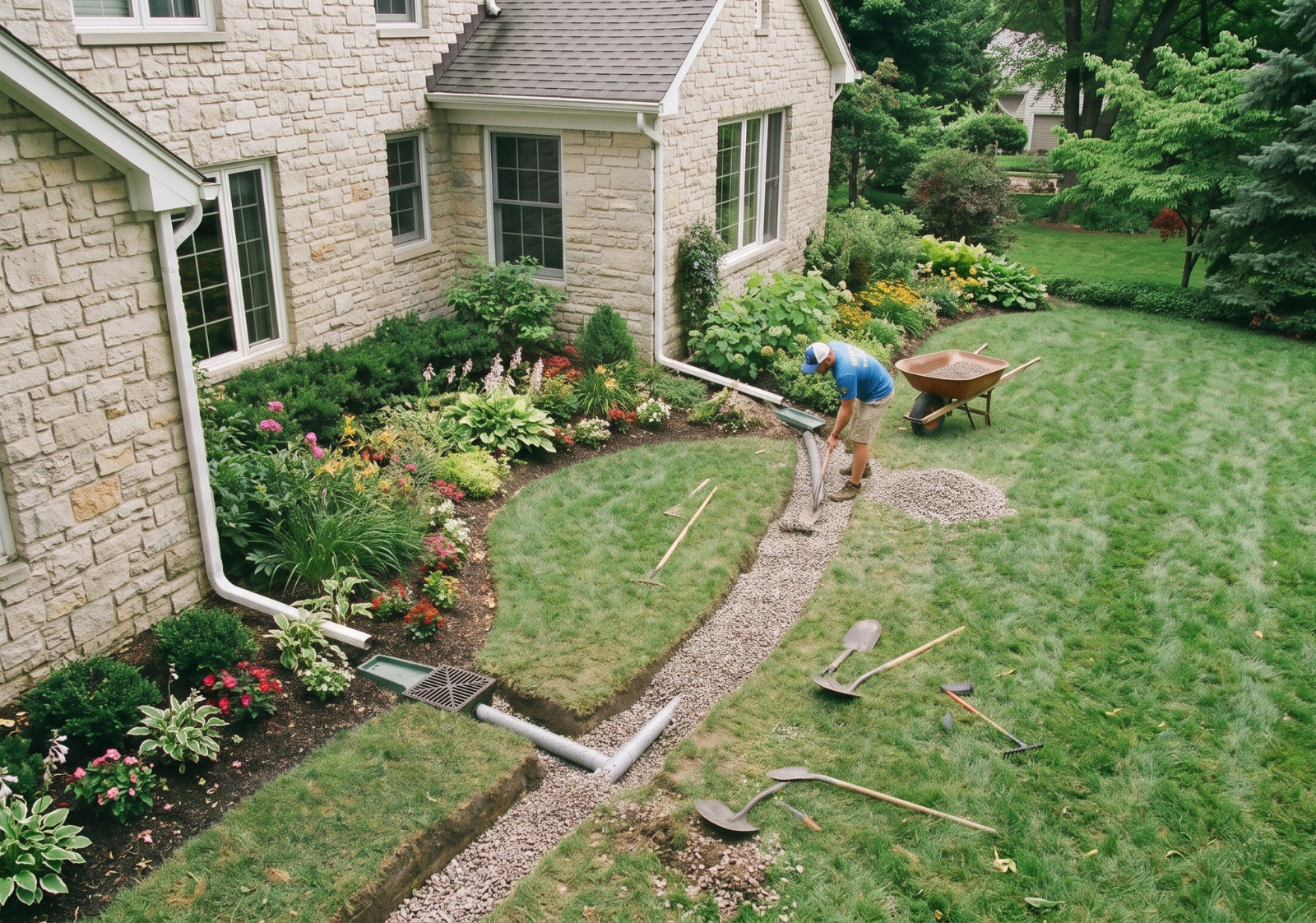
- Trench Excavation — The trench is excavated to the specified depth and width — typically 12 to 18 inches deep and 12 inches wide for standard residential applications, deeper where water table or interception depth requires it. Excavated material is removed from the site or stockpiled for backfill where appropriate.
- Filter Fabric Installation — Geotextile fabric is draped into the trench, extending up both walls and over the lip to ensure complete enclosure of the gravel bed. Seams are overlapped a minimum of 12 inches. This is the step that determines long-term system performance in clay soil.
- Aggregate Placement & Pipe Bedding — Clean crushed stone is placed in the trench bottom to the correct bed depth. Perforated pipe is laid on the aggregate bed with perforations facing down, at the correct slope throughout the full trench length.
- Aggregate Topping & Fabric Closure — Additional aggregate is placed over and around the pipe to the specified depth. The geotextile fabric is folded over the top of the aggregate bed and overlapped, fully enclosing the gravel zone before any backfill material is placed above it.
- Backfill & Surface Restoration — Clean backfill material is placed over the fabric-enclosed aggregate to grade. Turf is restored over the trench line — sod for immediate coverage, seeding where appropriate — and the outlet is finished and tested.
French Drain Applications for Bellaire Properties
Foundation Perimeter Drainage: The most high-value French drain application for Bellaire properties. A perimeter French drain installation placed along the foundation perimeter — typically intercepting water moving toward the foundation from the yard, neighbor runoff, or downspout discharge — reduces the moisture cycling in foundation-adjacent clay that drives differential foundation movement. The drain intercepts subsurface water moving toward the structure and redirects it to an outlet away from the foundation before it saturates the soil adjacent to the footing.
Side Yard Interception: Side yards in Bellaire's established neighborhoods are often narrow drainage channels — water from front to back or from a neighbor's higher lot moves through these corridors and concentrates in the backyard. A French drain installed across the side yard path intercepts that flow and redirects it underground before it reaches the backyard accumulation point. This is one of the most common French drain applications we install on Bellaire's established lots.
Low Spot Subsurface Drainage: Where a yard low spot accumulates water that doesn't drain from the surface adequately — either because the soil is too dense or because there's no surface outlet — a French drain provides an underground collection and conveyance path for the subsurface water that's keeping the area saturated between events.
Retaining Wall Drainage: Retaining walls without adequate drainage behind them accumulate hydrostatic pressure from water in the backfill — the primary cause of retaining wall failure over time. A French drain installed behind and below the wall's footing level relieves this pressure and extends wall life significantly.
French Drains and Bellaire's Clay Soil: An Honest Assessment
What French drains do well in clay soil:
A French drain creates a preferential pathway — a zone of high permeability gravel surrounded by low-permeability clay — that collects water moving through the soil profile and conveys it to an outlet. Water that would otherwise accumulate in saturated clay zones adjacent to the trench is intercepted and removed from the system. This is highly effective for water moving laterally through the soil toward a foundation or low area.
Where French drains have limitations in clay soil:
Clay soil's very low permeability means that water moves through it slowly. A French drain can only collect water that actually reaches the gravel zone — in very dense clay, water moves so slowly that a French drain's collection rate is limited by the soil's hydraulic conductivity rather than the system's capacity. For drainage problems driven primarily by surface water volume — heavy rainfall producing fast-moving sheet flow — a French drain alone may not be sufficient. These situations typically benefit from a combined approach: French drain for subsurface interception, surface drainage (catch basin, channel drain, or regrading) for the surface volume component. We assess which approach — or combination — is appropriate for your property's specific conditions and are honest about the realistic performance of each option.
Why Choose Professional French Drain Installation?
Filter Fabric Is Not Optional: Yard water redirection systems in Bellaire's clay soil installed without geotextile filter fabric will fail progressively as clay infiltrates the gravel bed. Correcting a failed French drain requires excavating and reinstalling the entire system — a cost that dwarfs the difference between a correctly specified installation and a budget one. We install filter fabric as a non-negotiable component.
Pipe Slope Requires Accurate Grade: Underground water diversion solutions require consistent pipe slope to move water to the outlet — in Bellaire's flat terrain, maintaining minimum slope throughout a long trench run requires careful grade management during excavation and pipe placement. Without consistent slope, water stands in the pipe between events and the system underperforms.
Outlet Design Matters: A French drain that terminates without an appropriate outlet — or outlets at an elevation that allows backflow — creates a system that fills and stops draining when it's needed most. Outlet placement, elevation, and treatment are specified as part of every installation.
Coordinated with Surface Drainage: For Bellaire properties with both subsurface saturation and surface water volume issues, French drains work best as part of a system that also addresses surface drainage. We design the full drainage solution rather than installing a single component and leaving the surface problem unaddressed.
FAQ: French Drains
Why does filter fabric matter so much in Bellaire's soil?
Houston's clay soil is composed of very fine particles that move readily with water. Without a geotextile barrier between the clay and the gravel bed, those particles migrate into the gravel voids under the hydraulic pressure of each rain event. Over two to five seasons, the gravel bed progressively loses its void space — the permeability that makes the system work — and the perforated pipe clogs. The system fails gradually, performing noticeably worse each year until it stops draining meaningfully. Filter fabric prevents this by keeping the gravel zone separated from the surrounding clay while still allowing water to pass through. It is the single most important component of a French drain installation in this soil type.
How deep does a French drain need to be in Bellaire?
Standard residential French drains for surface water interception are typically installed at 12 to 18 inches of depth — sufficient to intercept water moving through the upper soil profile where root zone saturation occurs. Foundation perimeter drains may be installed deeper to match footing elevation or to intercept water at the level where it's exerting pressure against the foundation. We specify depth based on the specific drainage objective and soil conditions at each property.
Can a French drain solve my foundation drainage problem completely?
A correctly installed perimeter French drain significantly reduces foundation-adjacent moisture cycling — one of the primary controllable contributors to differential foundation movement in Bellaire's clay soil. It doesn't eliminate all foundation risk, particularly if drainage problems from multiple sources are contributing simultaneously. For properties with active foundation movement, we recommend consulting a structural engineer alongside any drainage work and coordinating the drainage installation with their recommendations. We're direct about this rather than overpromising what drainage alone can achieve.
How long does a properly installed French drain last in Bellaire?
A French drain installed with proper filter fabric, correct aggregate, adequate slope, and appropriate outlet should perform reliably for 20 or more years in Bellaire's soil conditions. The filter fabric prevents the clogging failure mode; the slope ensures the pipe doesn't stand water between events; the outlet prevents backflow. Systems that fail early almost always have one or more of these components missing or incorrectly specified. We build the system correctly from the start — which is why we discuss each component transparently before the installation begins.
GET STARTED WITH A FREE FRENCH DRAIN ESTIMATE
Call (346) 436-6286 or Request an Estimate and we'll assess your property's drainage conditions, explain what a French drain can and can't solve for your specific situation, and install a foundation drainage protection solution built to perform in Bellaire's clay soil for the long term.

-
Eco-Conscious Process
 We utilize environmentally responsible products and techniques to both protect your lawn and the world around it.
 -
World-Class Service
We are committed to providing the highest quality service and support you need to take the hassle out of lawn care.
-
Quality Guarantee
Each member of our lawn care crew is trained to perform on-the-job quality assurance before completing any project.
-
Right-Sized Estimates
Our lawn care and landscaping pros create custom quotes tailored to your property and your goals, so you get exactly what you need at a price that works.






Explore Our Family Of Brands




.2408271112489.png "Groovy Hues")