
Where trimming manages overall shape and size, pruning corrects problems: dead wood that creates disease entry points, crossing branches that damage each other under wind load, co-dominant leaders that produce structurally weak branch attachments, and interior growth so dense it restricts airflow and creates conditions favorable to fungal disease. Done correctly and at the right time of year, pruning extends tree life, reduces storm damage risk, and improves the performance of the landscape below the canopy. Done incorrectly — wrong cuts, wrong timing, wrong species guidance — it causes damage that takes years to manifest and can't be undone.
Our tree pruning services cover trees up to ten feet in height — the scope where our team's training and equipment allow us to deliver precise, correct results. For larger trees requiring high-canopy access, we advise honestly and refer appropriately. Within our scope, we apply correct pruning technique, species-specific timing, and Bellaire-specific canopy knowledge to every project.
What Does Tree Pruning Include?
Tree Assessment & Pruning Plan: Before any cuts are made, we evaluate the tree's current structure — branch spacing, attachment angles, deadwood, crossing limbs, and signs of stress or disease — and develop a pruning approach that addresses the specific structural or health objectives for that tree.
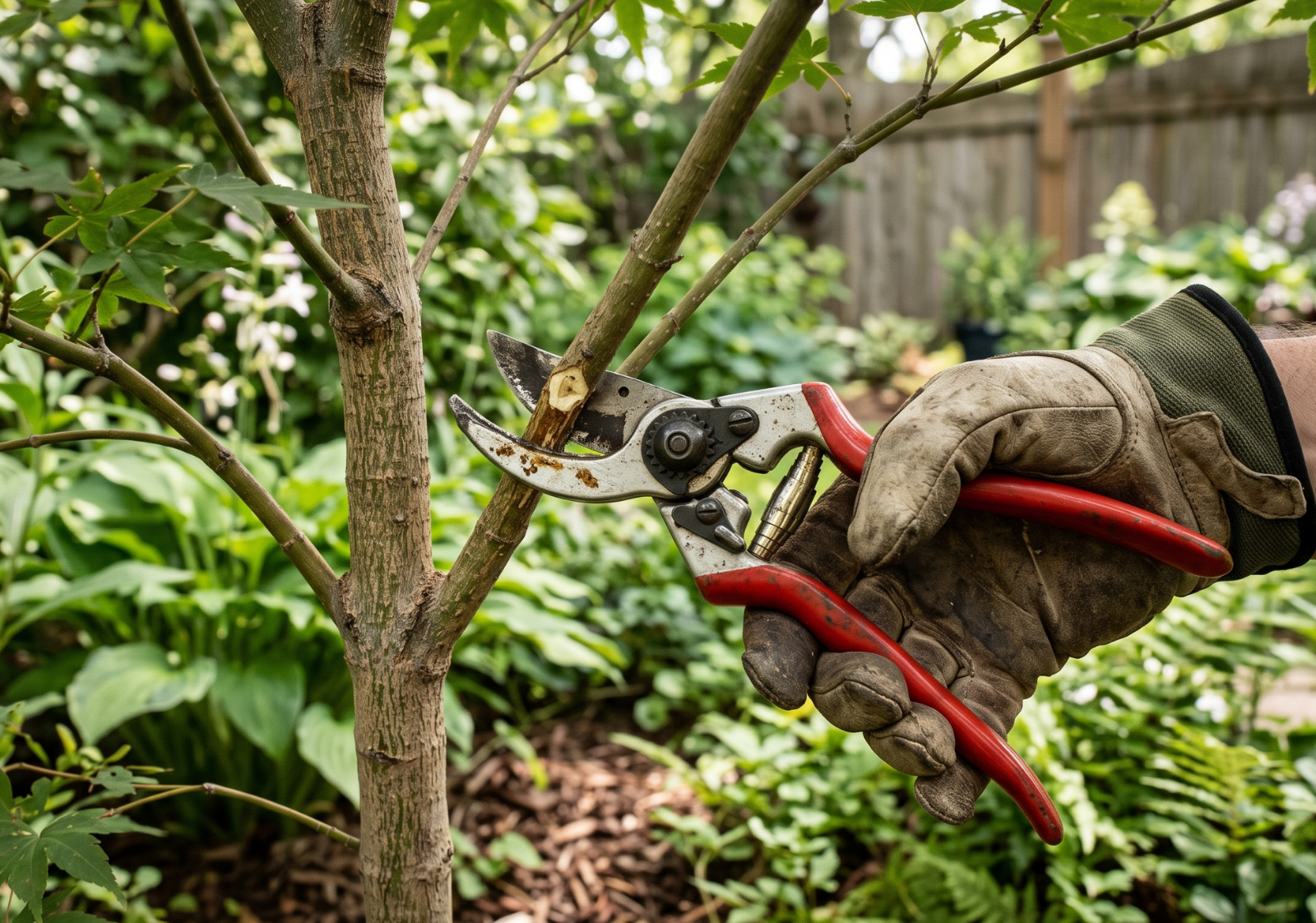
Dead Branch Removal: Dead, dying, or structurally compromised branches are removed at the correct cut location — outside the branch collar, at the angle that allows the tree to compartmentalize the wound effectively. Flush cuts that remove the branch collar and stub cuts that leave exposed dead wood are both incorrect technique that we don't use.
Canopy Thinning: Selectively removing interior branches to improve airflow, light penetration, and structural balance throughout the canopy. Tree canopy shaping and thinning reduces the wind resistance that makes dense canopies susceptible to storm damage and creates the light conditions that allow turf to recover in previously shaded zones.
Structural Pruning for Young Trees: For smaller trees within our scope that are still developing their permanent structure, corrective pruning to establish a single dominant leader and well-spaced scaffold branches produces long-term structural strength that's difficult to correct once the tree reaches mature size.
Our Tree Pruning Process
- Visual Assessment — We evaluate the tree from multiple angles, identifying deadwood, crossing branches, structural weaknesses, signs of disease or pest activity, and the relationship between the tree's canopy and surrounding structures, turf, and plantings.
- Pruning Plan — We establish the objectives for the pruning session — structural correction, dead wood removal, canopy thinning, clearance — and identify the specific branches to be addressed.
- Cut Execution — Cuts are made with sharp, clean tools at the correct location outside the branch collar, at the correct angle to shed water away from the wound. Tools are cleaned between trees to prevent disease transmission.
- Canopy Review — After each major cut, we assess the canopy balance and adjust the pruning plan as needed. Good pruning is iterative — the tree's response to early cuts informs subsequent ones.
- Debris Removal — All pruned material is collected and removed from the property. No debris is left for the homeowner to manage.
Species-Specific Pruning for Bellaire's Tree Palette
This is where local knowledge makes the most difference — and where generic pruning applied without species consideration causes the most damage.
Live Oaks — Timing Is Critical
Live Oaks are Bellaire's most iconic tree species and the most important to prune correctly and at the right time. Oak Wilt (Bretziella fagacearum) is a fatal fungal disease that spreads through root grafts between nearby trees and through pruning wounds exposed to sap-feeding beetles during the growing season. In Texas, the high-risk window for Oak Wilt transmission through pruning wounds runs roughly from February through June — the period when sap-feeding nitidulid beetles are most active and most likely to carry fungal spores to fresh cuts.
The correct pruning window for Live Oaks in Bellaire is late fall through January — when beetle activity is lowest, wound compartmentalization is most effective, and the risk of Oak Wilt transmission is minimal. We advise on this timing for every Live Oak service and will communicate if a requested pruning falls within the high-risk window so the homeowner can make an informed decision.
Crepe Myrtles — Structure Over Habit
Crepe Myrtles are the most commonly mistreated ornamental tree in Bellaire. "Crape murder" — severe topping that removes the entire flowering canopy to thick stubs — is practiced by many landscape crews because it's fast and requires no skill. The results are predictable and cumulative: knobby, weakened branch stubs that produce excessive weak regrowth, reduced flowering, structurally compromised attachment points, and a permanently disfigured tree form that never recovers its natural character.
Correct Crepe Myrtle pruning removes crossing branches, dead interior wood, and selected lateral branches to improve airflow and maintain natural form without topping. Height reduction, where genuinely needed, is accomplished through selective reduction cuts to lateral branches — not heading cuts to stubs. The late winter window, before spring bud break, is ideal for Crepe Myrtle pruning in Bellaire.
Ornamental and Flowering Trees
Ornamental trees — Japanese Maples, Southern Magnolias, Redbuds, and similar species common on Bellaire's established lots — require pruning timed to bloom cycle and species growth habit. Most spring-flowering ornamentals are pruned immediately after flowering to avoid removing next season's buds. We advise on species-specific timing during the assessment rather than applying a uniform pruning schedule to all tree types.
Why Choose Professional Tree Pruning?
Correct Cut Technique: Dead branch removal services made at the wrong location — flush cuts that remove the branch collar or stub cuts that leave exposed dead wood — create wounds the tree cannot properly compartmentalize. The result is decay that progresses into the trunk over years. Professional technique makes cuts at the correct position every time.
Oak Wilt Awareness: Seasonal tree care and maintenance for Live Oaks in Bellaire is a disease management decision as much as an aesthetic one. A pruning company that doesn't advise on Oak Wilt timing is exposing your Live Oaks to a fatal risk that's entirely preventable with correct scheduling. We provide this guidance as a standard part of every Live Oak assessment.
Canopy and Turf Integration: Pruning decisions affect what grows below the tree. Tree canopy shaping and thinning that opens light to previously shaded turf zones can allow St. Augustine grass to recover in areas where it has been struggling. We consider the landscape below the canopy — not just the tree — in every pruning plan.
Debris Management: All pruned material is removed as part of the service. No trimmings, cut branches, or debris are left for the homeowner to manage or dispose of separately.
FAQ: Tree Pruning
What is the difference between tree pruning and tree trimming?
Pruning is targeted and objective-driven — removing specific branches to achieve structural, health, or safety goals. Trimming is more aesthetic, addressing overall shape and size without necessarily correcting structural issues. In practice, we approach most tree work with both objectives in mind — maintaining shape while also addressing any structural or health concerns we observe during the service. The distinction matters most for Live Oaks and ornamentals where timing and technique are critical to the tree's health outcome.
When should Live Oaks in Bellaire be pruned?
Late fall through January — outside the February through June high-risk window for Oak Wilt transmission. If your Live Oak requires pruning during the higher-risk months for safety reasons (dead branch over a walkway, storm damage), any fresh cuts should be immediately sealed with pruning paint to reduce wound exposure to sap-feeding beetles. We advise on this during every Live Oak assessment and can help you decide whether to wait for the safer window or proceed with precautions.
How much of a tree's canopy should be removed in a single pruning session?
A general guideline is removing no more than 25% of a tree's total canopy in a single session — removing more than this creates significant stress that impairs the tree's ability to recover and respond to the wound sites. For Live Oaks specifically, conservative removal during a single session is standard good practice. We assess each tree individually and advise on appropriate removal percentages based on the tree's current health and vigor.
Can pruning improve the turf growing under my trees?
Yes — selectively thinning the canopy increases light penetration to the ground below, which can meaningfully improve St. Augustine turf performance in areas that have been thinning due to shade stress. This is one of the most practical benefits of residential tree pruning services in Bellaire, where dense canopy and shade-tolerant turf coexist but often require management to stay in balance.
GET STARTED WITH A FREE TREE PRUNING ESTIMATE
Call (346) 436-6286 or Request an Estimate and we'll assess your trees, advise on species-specific timing, and perform tree health maintenance pruning that protects both the tree and the landscape around it.

-
Eco-Conscious Process
 We utilize environmentally responsible products and techniques to both protect your lawn and the world around it.
 -
World-Class Service
We are committed to providing the highest quality service and support you need to take the hassle out of lawn care.
-
Quality Guarantee
Each member of our lawn care crew is trained to perform on-the-job quality assurance before completing any project.
-
Right-Sized Estimates
Our lawn care and landscaping pros create custom quotes tailored to your property and your goals, so you get exactly what you need at a price that works.





Explore Our Family Of Brands



.2408271112489.png "Groovy Hues")