


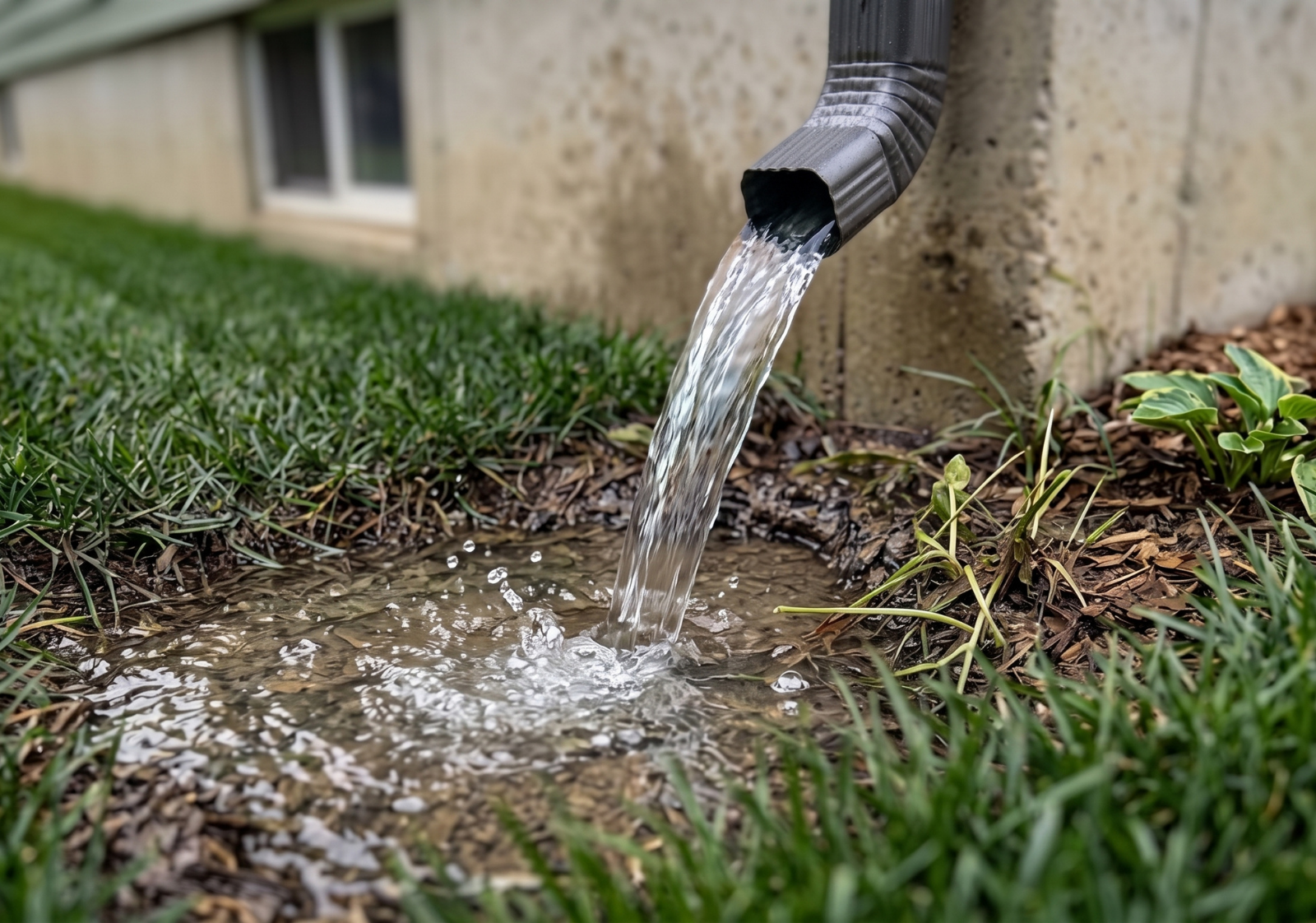
Here's what's happening on most Bellaire properties with standard downspout terminations: every time it rains, your gutters collect roof runoff from hundreds or thousands of square feet of roof surface and concentrate it at three to six discharge points around the home's perimeter. Each of those discharge points — a standard elbow terminating at grade level — releases that concentrated volume directly against the foundation in clay soil that absorbs it slowly. On Bellaire's flat terrain, that water has limited movement options. It saturates the soil adjacent to the foundation, pushes into planting beds, creates standing water zones that persist for days after a rain event, and contributes to the wet-dry clay cycling that is the primary driver of foundation movement in the Houston area.
A gutter water redirection solution — extending the discharge point away from the foundation to an appropriate outlet — eliminates this problem at the source. It is the single most protective drainage improvement most Bellaire homes can receive per dollar spent, and it is frequently the first recommendation we make when a homeowner describes foundation-adjacent drainage concerns.
What Does Downspout Extension Service Include?
Downspout Assessment & Discharge Mapping: We evaluate every downspout on the property — current termination location, discharge volume estimate based on contributing roof area, ground conditions at the discharge point, and available routes to appropriate outlets. Properties with multiple downspouts discharging in close proximity to each other may benefit from a single underground system connecting multiple outlets to one discharge point.
Extension Type Selection: We recommend the appropriate extension type for each downspout based on property conditions, available outlet distance, and long-term performance in Bellaire's environment. Surface extensions, flexible corrugated pipe, and underground pop-up emitter systems each have specific applications — we explain the tradeoffs and recommend accordingly.
Installation & Outlet Treatment: Extensions are installed from the downspout termination to the specified outlet location. Underground systems are trenched, bedded, and connected to a pop-up emitter or daylight outlet with appropriate energy dissipation. Surface extensions are secured to prevent displacement and positioned to discharge onto stable ground or into a drainage path.
Coordination with Existing Drainage: Where downspout extensions are part of a larger drainage project — connecting to a French drain, discharging into a dry creek, or routing to a catch basin — we coordinate the full system layout so every component works together.
Our Downspout Extension Process
- Property Walk & Assessment — We walk the full perimeter, evaluate every downspout termination, assess foundation-adjacent soil conditions, and identify the drainage problems currently being created by concentrated roof discharge.
- Outlet Route Planning — For each downspout, we identify the optimal outlet location — far enough from the foundation to prevent moisture cycling, positioned to discharge onto stable ground or into a designed drainage path, and achievable within the property's layout.
- Extension Type Specification — We recommend surface, flexible, or underground extension based on distance required, yard conditions, and long-term performance. Underground pop-up emitter systems are the standard recommendation for Bellaire properties where aesthetics and permanence matter.
- Trenching & Pipe Installation (underground systems) — Underground extensions are trenched at the correct slope from the downspout connection to the pop-up emitter location, bedded in gravel, connected at both ends, and backfilled with compacted soil and sod restoration over the trench.
- Surface Restoration — Trench lines are restored, turf is reseeded or sodded where disturbed, and all connection points are sealed against infiltration.
- System Test — We test each extension with a garden hose to confirm flow direction, outlet function, and pop-up emitter operation before completing the installation.
Extension Types: Understanding Your Options
This is where honest guidance makes a real difference — and where most competitors either oversimplify or default to whatever's easiest to install.
Surface Elbow Extensions: A rigid or flexible elbow that angles the downspout discharge away from the foundation at grade level. Effective for short distances — three to six feet — where the discharge point is on stable ground sloping away from the home. The limitation for Bellaire properties: surface extensions in active lawn areas get mowed over, disconnected by foot traffic, shifted by ground movement, and typically end up terminating much closer to the foundation than originally intended within a few seasons. They are an appropriate temporary solution or a supplement to other drainage work — not the permanent answer for foundation-adjacent downspouts discharging high volumes.
Flexible Corrugated Pipe Extensions: Corrugated drainage pipe connected at the downspout base and run along the surface to a discharge point further from the home. Longer reach than a simple elbow, relatively low cost, and can route around landscaping obstacles. The limitation: corrugated pipe lying on the lawn surface is prone to disconnection, crushing under foot traffic, and creates tripping hazards and mowing complications. In Bellaire's established landscaping environments, surface-run corrugated pipe consistently becomes a maintenance problem within a few years.
Underground Pop-Up Emitter Systems: The permanent, professional solution for Bellaire properties. Solid smooth-wall pipe — 4-inch or larger — is trenched from the downspout connection underground to a pop-up emitter installed at the outlet location. The emitter sits flush with the lawn surface when no water is flowing and pops open under water pressure to discharge during rain events, then closes again when flow stops. No surface hardware to mow around, no connections to come loose, no trip hazards. The outlet is positioned far enough from the foundation — typically ten feet or more — that discharged water flows away from the structure rather than back toward it. This is the system we install on most Bellaire properties where the goal is permanent, maintenance-free foundation protection.
Why Bellaire Properties Are Especially Vulnerable to Downspout Discharge Damage
Large Roof Collection Areas, Concentrated Discharge: Bellaire's established homes are substantial — many have roof collection areas of 2,000 to 4,000 square feet or more distributed among only a few downspouts. During a one-inch rainfall event, a 2,000 sq ft roof collection area delivers approximately 1,200 gallons of water to those discharge points. On clay soil that may absorb only a fraction of that volume per hour, the rest either saturates the foundation perimeter or spreads across the adjacent lawn.
Clay Soil Foundation Risk: Houston's expansive clay soil is highly sensitive to moisture cycling — it expands when wet and contracts when dry. Downspouts discharging consistently against the foundation create localized wet-dry cycles that are more severe than the surrounding yard, producing differential soil movement that stresses the foundation. Foundation water protection solutions that simply move discharge away from the structure reduce this cycling immediately and measurably.
Flat Terrain Limits Natural Dissipation: On a sloped lot, roof discharge that reaches grade level continues moving away from the structure under gravity. On Bellaire's flat lots, discharge that reaches grade level stops moving — or moves toward the foundation — unless a designed outlet directs it otherwise. The flat terrain that defines Bellaire makes downspout extension more important here than in most other Houston suburban markets.
Mosquito Breeding at Discharge Points: Standard downspout discharge creates a consistently moist, disturbed soil area at the termination point — a prime environment for water pooling after rain events and the mosquito breeding that follows. Underground pop-up systems eliminate this zone entirely by moving discharge away from the foundation and onto stable ground that drains naturally.
Why Choose Professional Downspout Extension Installation?
Permanent vs. Temporary: Rainwater drainage redirection services that use surface extensions and corrugated pipe solve the immediate problem but create maintenance issues that homeowners deal with indefinitely. Underground pop-up emitter systems installed professionally are permanent — no ongoing displacement, reconnection, or repositioning required.
Outlet Placement Matters: Moving discharge ten feet from the foundation in a direction that slopes back toward the house creates a different problem rather than solving the original one. Outlet placement — distance, direction, and discharge surface — must be specified correctly for the individual property's grade and drainage conditions.
System Integration: Where downspout extensions connect to larger drainage systems — French drains, catch basins, underground pipe networks — the connection must be sized and configured to handle the combined water volume without backflow into the extension pipe. We design the full system rather than installing extensions in isolation.
Soil Restoration: Underground trench installations disturb turf and soil that must be properly restored to prevent settling, erosion at the trench line, and turf damage. Our installations include full surface restoration as a standard component.
FAQ: Gutter Downspout Extensions
How far should a downspout extension discharge from the foundation in Bellaire?
A minimum of six feet from the foundation is the commonly cited guideline, but for Bellaire's flat terrain and clay soil conditions, we recommend ten feet or more where property layout allows. The goal is to discharge into an area that slopes away from the structure or connects to a designed drainage path — not just to move the discharge point a minimal distance. An underground pop-up emitter positioned correctly achieves this consistently and permanently.
What's the difference between a pop-up emitter and a daylight outlet?
A pop-up emitter is a valve installed flush with the ground surface that opens under water pressure during flow and closes when flow stops. It prevents debris and pests from entering the pipe between rain events and sits flush with the lawn for clean mowing. A daylight outlet is simply the open end of the pipe emerging at a slope — appropriate where the pipe terminates at a property edge, drainage swale, or area where the pipe end can be set above grade permanently without creating a hazard. Both are appropriate in different situations — we recommend based on the specific outlet location conditions.
Can downspout extensions be connected to my existing underground drainage system?
Yes — and this is one of the most efficient drainage improvements available on properties that already have underground drainage infrastructure. Where a French drain, catch basin system, or underground pipe network exists, downspout extensions can be connected as additional inlets, adding roof runoff management to the existing system without installing a separate outlet. We assess system capacity before making connections to confirm the existing pipe sizing can handle the combined volume.
Will extending my downspouts actually help protect my foundation?
Yes — and this is documented in structural engineering guidance for the Houston area specifically. The Texas Department of Insurance recommends directing roof runoff at least five feet from foundations as a foundation protection measure. For Bellaire's clay soil conditions, the recommendation is frequently extended to ten feet or more. Moving concentrated roof discharge away from the foundation reduces the moisture cycling that drives differential foundation movement in expansive clay — it doesn't eliminate all foundation risk, but it removes one of the most controllable contributing factors.
GET STARTED WITH A FREE DOWNSPOUT EXTENSION ESTIMATE
Call (346) 436-6286 or Request an Estimate and we'll walk your property's perimeter, assess every downspout discharge point, and install a home water runoff control system that protects your foundation and eliminates the drainage problems that standard downspout terminations create on Bellaire's flat, clay-soil lots.

-
Eco-Conscious Process
 We utilize environmentally responsible products and techniques to both protect your lawn and the world around it.
 -
World-Class Service
We are committed to providing the highest quality service and support you need to take the hassle out of lawn care.
-
Quality Guarantee
Each member of our lawn care crew is trained to perform on-the-job quality assurance before completing any project.
-
Right-Sized Estimates
Our lawn care and landscaping pros create custom quotes tailored to your property and your goals, so you get exactly what you need at a price that works.





Explore Our Family Of Brands




.2408271112489.png "Groovy Hues")