


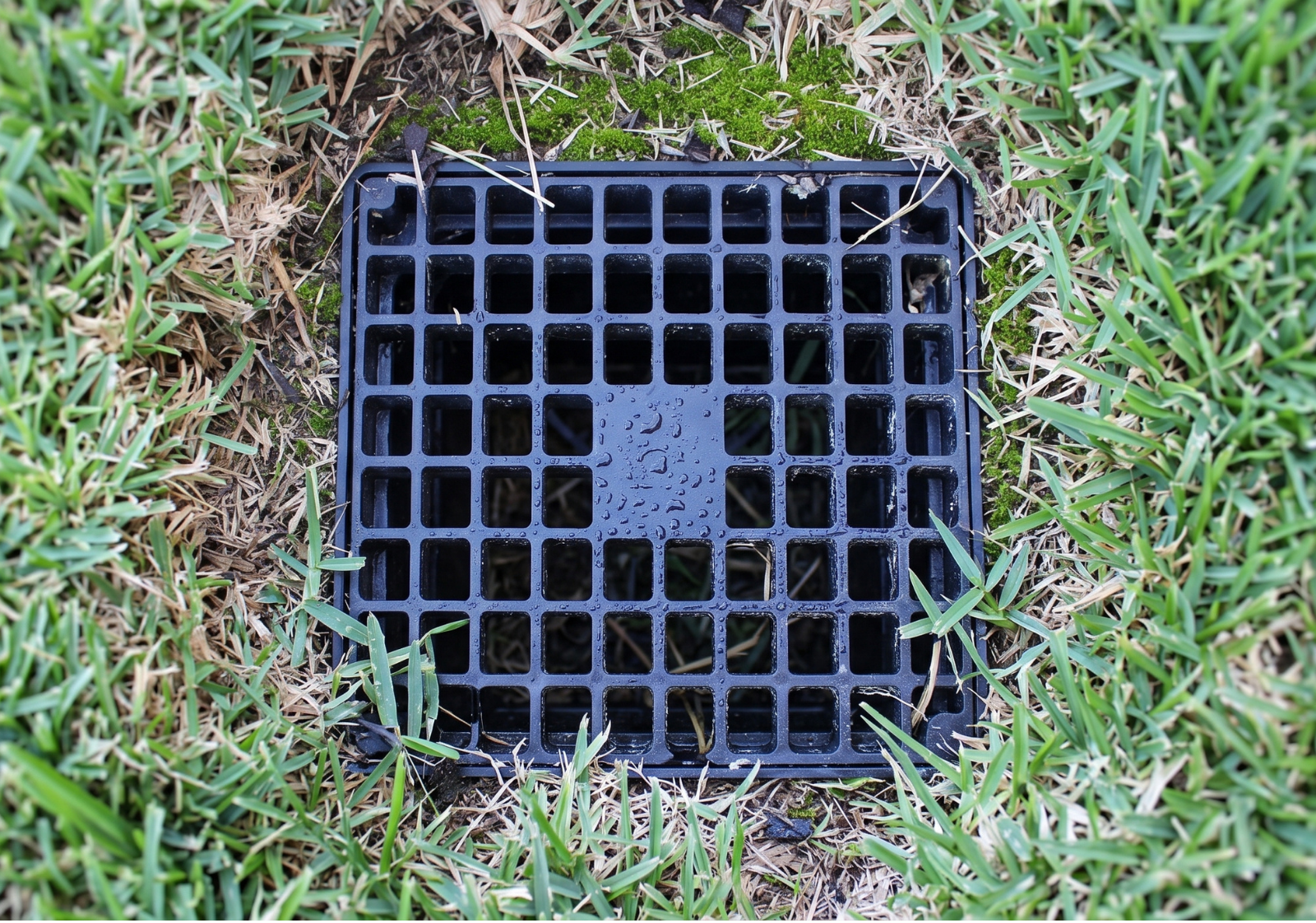
A yard drain addresses this problem directly. It's a surface collection point — a grated inlet set at grade level in the problem area — connected to an underground pipe that carries collected water to an outlet away from the low spot. Unlike a catch basin, which is designed for high-volume collection and typically larger in scale, a yard drain is sized for the moderate surface water volumes that accumulate in lawn low spots and is installed flush with the turf surface so the surrounding lawn can be maintained normally above it.
In Bellaire's clay soil environment, where even moderate rainfall can produce standing water that persists for one to three days — because the soil absorbs it far more slowly than it falls — a yard drain is often the most direct and cost-effective single drainage installation available for properties with isolated low-spot problems. It doesn't require regrading the entire yard. It doesn't require a large excavation. It removes the water at the collection point and conveys it underground to a proper outlet, restoring the low spot to a usable, healthy section of lawn.
What Does Yard Drain Installation Include?
Site Assessment & Collection Point Verification: We assess the low spot — its depth relative to surrounding grade, the surface area that drains toward it, and whether the collection volume is appropriate for a yard drain versus a catch basin. We also confirm a viable outlet location with adequate pipe slope from the drain to the discharge point. On Bellaire's flat lots, confirming outlet grade before installation begins is essential.
Drain Body & Grate Selection: Yard drains are available in multiple body sizes and grate configurations. We select the appropriate body diameter for the anticipated flow volume and a grate style that sits flush with the surrounding turf — minimizing the visual presence of the drain and allowing normal mowing over and around the grate without obstruction.
Excavation & Drain Setting: The drain body is set at the correct elevation — at or just below surrounding grade — to ensure water flows into the drain consistently rather than pooling around it. The surrounding soil is compacted and graded to direct flow toward the grate.
Underground Pipe Installation & Outlet: Solid pipe is trenched from the drain outlet to the discharge point — a pop-up emitter in a lower area of the lawn, connection to an existing drainage system, or daylight outlet at the property edge — at the minimum slope required to maintain flow. Outlet treatment prevents erosion at the discharge point.
Our Yard Drain Installation Process
- Assessment & Outlet Route Confirmation — We evaluate the low spot, measure grade from collection to potential outlet locations, and confirm viable outlet placement at sufficient elevation differential to maintain pipe slope throughout the run.
- Drain & Pipe Specification — We specify drain body size, grate type, outlet pipe diameter, and pipe slope based on the anticipated flow volume and available grade. Standard residential yard drains use 6-inch to 9-inch body diameter with 4-inch outlet pipe; higher-volume situations use larger specifications.
- Excavation & Drain Setting — The drain area is excavated to the correct depth. The drain body is set at the correct elevation and the surrounding soil is compacted and finish-graded to direct flow toward the grate consistently.
- Pipe Trenching & Installation — The outlet pipe trench is excavated at the correct slope from the drain body to the outlet point. Pipe is bedded, connected to the drain outlet, and backfilled with compacted material.
- Outlet Installation & Surface Restoration — The outlet is finished with a pop-up emitter or appropriate discharge treatment. Trench lines over turf are restored with sod or seed. The drain grate is set flush with the finished grade.
- Flow Test — We test the system to confirm drainage direction, outlet function, and grate performance before completing the installation.
When a Yard Drain Is the Right Solution — and When It Isn't
This is the honest guidance that most companies skip. A yard drain is the right solution for some Bellaire drainage problems and the wrong one for others — and installing the wrong solution produces a disappointing result regardless of installation quality.
A yard drain is the right solution when:
The problem is a discrete low spot that collects surface water from a defined area — the water pools in one location, the surrounding yard drains adequately, and the volume is moderate. If you can point to one spot in the yard that's always wet after rain while the rest of the yard drains fine, a yard drain is very likely the correct and sufficient intervention.
A yard drain is not sufficient when:
The problem is a broad saturated zone rather than an isolated low spot — a large area of the yard that stays wet throughout the root zone between events. This indicates subsurface saturation that a surface inlet can't address, and a French drain is the more appropriate solution. Similarly, if the low spot is collecting water from multiple high-volume sources — roof runoff, neighbor's grade, large hardscape areas — the volume may exceed what a standard yard drain handles efficiently, and a catch basin is the correct specification. We assess which solution — or combination — is right for the specific conditions during our property walk and advise accordingly.
Yard Drains and Bellaire's Mosquito Connection
This is worth stating explicitly: a persistent low spot in a Bellaire yard that holds water for one to three days after every significant rain event is one of the most productive mosquito breeding environments on the property. Aedes aegypti — Bellaire's primary disease-transmitting mosquito — requires as little as a bottle cap's worth of standing water to complete a larval development cycle in Houston's warm temperatures.
A yard drain that eliminates the standing water eliminates the breeding habitat. For Bellaire homeowners managing mosquito pressure through our Mosquito Legion program, drainage improvements and mosquito management work in the same direction — and we coordinate both on properties where standing water is a documented part of the mosquito problem.
Coordination with Lawn Aeration for Enhanced Drainage Performance
One additional option worth noting for Bellaire properties where yard drain installation is combined with a broader lawn improvement program: core aeration of the surrounding soil zone around a new yard drain installation can meaningfully improve the drain's effective performance in clay-heavy turf.
In compacted clay soil, even after a drain removes the pooled surface water, the surrounding turf zone remains hydrophilic — water is slow to move laterally through the dense clay toward the drain inlet. Aeration opens the soil canopy, allows water to infiltrate vertically through the root zone, and improves lateral movement toward the collection point. A yard drain in aerated soil performs more effectively than the same drain in heavily compacted clay with no permeability improvement. Our Fertilizer Force and Drainage teams coordinate this combination on properties where the soil compaction is contributing to the low-spot drainage problem alongside the grade issue.
Why Choose Professional Yard Drain Installation?
Outlet Grade Confirmation: A yard drain that doesn't drain — because the outlet has insufficient elevation differential to maintain pipe slope — is a grated standing water container. Confirming viable outlet grade before installation is the most critical step and the one most likely to be skipped in a budget installation. We confirm outlet grade in every assessment.
Correct Drain Sizing: Stormwater yard drainage systems sized below the anticipated flow volume back up during peak events — water exceeds the drain's inlet capacity and continues to pool around the grate. We specify drain body and pipe diameter for the actual volume each installation will handle.
Flush Setting for Turf Compatibility: A yard drain that sits above grade creates a mowing obstacle and a tripping hazard. One set below grade creates a collection bowl that concentrates debris and prevents the grate from functioning. Correct flush setting — at grade, allowing water to flow into the grate consistently — is a precision installation detail that determines both function and lawn compatibility.
Mosquito Prevention: A yard drain that doesn't drain between events becomes a permanent standing water feature — and a mosquito breeding site enclosed in a grated structure. Correct installation and outlet specification prevent this failure mode completely.
FAQ: Yard Drains
What's the difference between a yard drain and a catch basin?
Both are surface collection structures, but they differ in scale and application. A yard drain is a smaller inlet — typically 6 to 9 inches in diameter — designed for the moderate surface water volumes that accumulate in lawn low spots. A catch basin is a larger structure with a sump below the outlet inlet, designed for higher-volume collection from multiple directions or large hardscape areas. The distinction matters for sizing — a yard drain in a location that receives high-volume runoff from multiple sources will be overwhelmed during peak events. We specify the appropriate structure based on the collection volume at each location.
Can a yard drain be installed in an active lawn without destroying the surrounding turf?
Yes — the installation disturbs a limited footprint. The drain body requires a small excavation at the drain location; the outlet pipe trench is the primary disturbance to the surrounding lawn. Both are restored with sod or seed as part of the installation. Within one to two growing seasons, the trench line is typically invisible in the turf. We minimize the disturbance footprint throughout the installation and restore the surface to match the surrounding lawn condition.
How long does a yard drain take to install?
A single yard drain with a straightforward outlet pipe run — under 30 to 40 feet to the outlet — is typically completed in one day. Multiple drains or longer pipe runs take longer. We provide a specific project timeline with the estimate based on your property's conditions.
Will a yard drain solve my standing water problem completely?
If the problem is an isolated low spot collecting surface water in moderate volume, yes — a correctly installed yard drain with a properly specified outlet typically resolves the issue completely. If the surrounding soil is heavily saturated between events beyond the immediate collection zone, a yard drain at the surface may not fully address the subsurface saturation component, and a French drain for the broader zone may be recommended alongside or instead. We assess whether a yard drain alone addresses the full problem during our site evaluation and give you an honest answer before installation begins.
GET STARTED WITH A FREE YARD DRAIN ESTIMATE
Call (346) 436-6286 or Request an Estimate and we'll assess your low spot, confirm outlet options, and install a residential yard drainage solution that removes standing water at the source and restores that section of your Bellaire lawn to the condition the rest of your yard is already in.

-
Eco-Conscious Process
 We utilize environmentally responsible products and techniques to both protect your lawn and the world around it.
 -
World-Class Service
We are committed to providing the highest quality service and support you need to take the hassle out of lawn care.
-
Quality Guarantee
Each member of our lawn care crew is trained to perform on-the-job quality assurance before completing any project.
-
Right-Sized Estimates
Our lawn care and landscaping pros create custom quotes tailored to your property and your goals, so you get exactly what you need at a price that works.





Explore Our Family Of Brands




.2408271112489.png "Groovy Hues")