
Small Lot, Big Impact: How Winter Landscape Design in West University Place, TX Makes Every Square Foot Count | Heroes Lawn Care of Bellaire
The Small-Lot Challenge Every West U Homeowner Knows
Walk through almost any block in West U and the pattern is easy to see. Elegant two-story homes stand shoulder to shoulder, separated by narrow side yards, with front lawns that are short from sidewalk to door and backyards that can be crossed in a few steps. The houses are beautiful, but the outdoor space around them is limited, and every decision about how to use it carries more weight than it would on a larger lot.
That is exactly why planning matters so much. On a small lot, there is no room for a patio that drains toward the back door, a bed that blocks the only path to the side gate, or a lawn that struggles in the shade of a neighbor’s two-story home. Thoughtful landscape design in West University Place, TX turns those constraints into a clear, intentional plan, where every square foot has a purpose and every element works with the ones around it.
Winter is the ideal time to create that plan. With growth slowed, the structure of the lot is easy to read, winter rains reveal how water really moves, and a finished design can be ready to install the moment spring arrives. This guide explains how small-lot design works in West U and why the cool season gives homeowners such an advantage.
How West University Place Lots Became So Tight
West University Place, often called the Neighborhood City, covers only about two square miles and is home to roughly 15,000 residents, about six miles from downtown Houston. Typical lots are around 5,000 square feet, and on many older blocks they are just 40 to 50 feet wide. For decades, those lots held modest bungalows and cottages with generous yards around them.
That changed as the city redeveloped. In the 15 years ending in 2002, roughly half of the existing houses were torn down and replaced, often with larger two-story homes that fill much more of each lot. Redevelopment has continued since, which means many West U homes now sit on parcels where the house takes up most of the available ground. The result is a city of beautiful homes with compact, high-value outdoor spaces that demand careful design.
Why Winter Is the Right Season to Design a Small Yard
It may seem natural to wait until spring to think about the yard, but for a small lot, the cool season offers several clear advantages.
Seeing the Bones of the Lot
In winter, summer annuals have faded and many plants are dormant. That makes the underlying structure of the yard much easier to see: the true dimensions of each space, the paths people actually use, the sightlines from inside the house, and the way neighboring homes and trees cast shade across the lot. On a small property, these details shape every design decision, and winter shows them without the distraction of summer growth.
Watching Winter Rain Do Its Work
Winter fronts often bring steady, soaking rain, and that rain is the best possible test of how a lot drains. On tight West U parcels, roof runoff from tall homes often lands in narrow side yards with nowhere to go, and water can collect against foundations or along fences shared with neighbors. Winter storm runoff assessment and subsurface French drain integration for heavy gumbo clay let the design solve those problems from the start.
A French drain built for clay uses commercial-grade woven geotextile fabric to keep fine soil from clogging the system, clean angular stone around a perforated pipe, and a consistent slope that carries water by gravity to an outlet set lower than the collection point. Designing drainage before patios, paths, and beds are placed ensures that every surface works with the water rather than against it.
A Plan Ready Before Spring
Designs completed in winter can be reviewed, refined, and scheduled before the spring rush. That allows installation to begin in late winter or early spring, so new plantings have time to establish before summer heat and hardscape is finished in time for the first warm evenings outdoors.
Off-Season Landscape Master Planning
Off-season landscape master planning for spring installation readiness follows a clear sequence. It begins with an on-site consultation, where the homeowner and designer walk the property together and discuss priorities and how the space will be used. That is followed by a full assessment of drainage, grade, soil quality, sun exposure in each area, and the health of existing plants.
From there, a design plan brings turf, planted zones, hardscape, drainage, and irrigation together into a single vision, with clear phasing if the work will be completed in stages. Most residential designs are delivered within a week of the site visit. The homeowner reviews the plan and provides feedback, and installation does not begin until everyone is fully aligned. On a small lot, that level of planning prevents the cluttered look that results when features are added one at a time without a unifying idea. Heroes Lawn Care of Bellaire builds every small-lot plan this way, so drainage, hardscape, planting, and irrigation are resolved on paper before any ground is broken.
Design Strategies That Make Every Square Foot Count
Small-lot design is less about fitting in as many features as possible and more about choosing the right ones and placing them with precision. The strategies below help West U yards feel larger, work harder, and look more refined.
Front Yards That Make an Entrance
On many blocks in West University Place, TX, the front yard is only a short distance deep, yet it carries most of the home’s curb appeal. Small-lot design treats it as an entry sequence rather than a lawn to fill. A clear, generous walkway from the sidewalk to the front door, set on a properly prepared base so it stays level on clay, immediately makes the home feel welcoming. Beds framing the walk and the foundation are designed in proportion to a two-story facade, which usually means fewer, larger plant groupings rather than a long row of small shrubs that looks lost against tall walls.
Scale matters at every step. A bed that looks generous on paper may appear thin beside a tall brick facade, so front beds are often deeper than homeowners expect, with taller plants near the house and lower layers toward the lawn. A raised planter flanking the entry, filled with seasonal color in winter and heat-tolerant perennials in summer, adds height without crowding the walk. The goal is a front yard that looks complete from the street, frames the architecture, and leaves enough open lawn to keep the space feeling light.
Turning Narrow Side Yards Into Working Space
Side yards are often the most neglected part of a West U property. They are narrow, shaded by neighboring homes, and frequently wet, so they become a muddy corridor for trash bins and utility access. Compact urban courtyard and narrow side-yard drainage-to-hardscape spatial design treats them as valuable space instead.
A well-planned side yard starts with drainage. Channel drains along patio edges and yard drains at low points capture runoff before it pools, while downspout extensions move roof water away from the foundation. Where water needs to travel the length of the side yard, a French drain below a paver path or a narrow dry creek bed of river rock can carry it toward the street. With water under control, a paver walkway set on a properly compacted aggregate base creates a clean, usable passage, and a slim planting strip along the fence softens the space. What was once a forgotten corridor becomes a functional and attractive part of the home.
The Courtyard Backyard
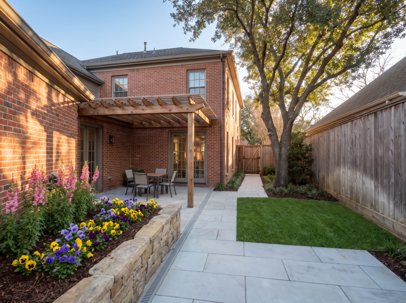
On many West U lots, the backyard is better treated as an outdoor room than as a miniature version of a large suburban yard. A courtyard approach defines a central gathering space, often a paver or concrete patio, and surrounds it with planting beds and a modest lawn panel or artificial turf area rather than spreading grass from fence to fence.
Pergolas are especially valuable on small lots. They add shade, create a sense of enclosure and privacy from neighboring second-story windows, and define the outdoor room without blocking light the way a solid roof would. A compact fire pit with a built-in seating wall, or a modest outdoor grill station along one edge, adds function without crowding the space. In shaded or high-traffic areas where natural grass struggles, artificial turf performs consistently and stays green year-round, while drainage built into its base keeps water from pooling. Every element is chosen so the backyard feels deliberate and uncluttered.
Designing Around Mature Oak Canopies
Mature oaks are one of West U’s defining features, and on a small lot a single tree can shade most of the yard. Good landscape design works with the canopy rather than against it. That begins with understanding how light moves through the year and where the deepest shade falls, then selecting turf and plants that can thrive there. St. Augustine handles shade better than any other warm-season grass used in the Houston area, and Palmetto performs well in moderate shade; where shade is too deep for any grass, planted beds or artificial turf often make more sense.
Heritage live oak root-zone awareness matters just as much as light. Oak roots spread widely and compete with turf and plantings for water, so drainage plans and soil preparation beneath the canopy must account for that competition. Designs should avoid heavy grade changes or deep excavation over major roots, and planting areas under trees benefit from adjusted soil preparation. Winter is also the recommended season for pruning live oaks in the area, from late fall through January, before the oak wilt high-risk period begins in February. Pruning for trees up to ten feet tall can be coordinated with the landscape project, while larger trees that need high-canopy work are best referred to a licensed arborist.
Raised Planters and Layered Beds
When ground space is limited, height becomes a design tool. Low walls of 12 to 24 inches create raised planting zones that add dimension, define spaces, and lift roots above slow-draining gumbo clay, which helps plants that dislike wet soil. Built from natural stone for a traditional or organic look, or concrete block for a cleaner modern profile, these walls can also double as informal seating around a patio.
Within those beds, freeze-resilient Gulf Coast architectural planting palettes focus on plants suited to Houston’s heat, humidity, and soil, chosen with an eye to how they handle the occasional sharp winter cold front as well as the long summer. Heat-tolerant perennials such as salvia, lantana, and Esperanza provide dependable color, while ornamental grasses add movement and texture. On a small lot, repeating a limited number of plants in bold groupings creates a calm, unified look that makes the space feel larger, while a scattered mix of many different plants tends to make it feel crowded.
Winter Color That Earns Its Space
Every bed on a small lot is highly visible, so seasonal color has an outsized impact. Cool-season formal border and winter color bed designs featuring pansies and snapdragons bring brightness to entries, patio edges, and raised planters during the months when the rest of the garden rests. Pansies offer a broad range of colors and handle cool temperatures well, while snapdragons add height and vertical interest.
Seasonal color works best as part of a planned rotation. Cool-season annuals go in during fall, and warm-season choices such as vinca, begonia, and pentas take over in late spring, with annuals typically refreshed twice a year. Concentrating color in a few key spots, such as the front entry and the view from the main living area, delivers far more impact on a compact lot than spreading it thinly everywhere.
Zoned Drip Irrigation for Small Spaces
Irrigation on a small lot has to be precise. Overspray onto walls, walkways, and the neighbor’s side of the fence wastes water and can stain surfaces, while uneven coverage leaves some beds soggy and others dry. Hydrozoned drip irrigation design solves that by building each zone around the plants it serves. Rotary heads cover open lawn areas, fixed spray heads fit tighter beds, and drip irrigation delivers targeted root-zone watering to gardens, shrubs, ornamentals, and trees, with emitter spacing and output matched to the plants in each zone.
Drip is especially valuable in raised planters, narrow side-yard strips, and beds beneath tree canopies, where spray heads struggle to reach the root zone. Weather-responsive smart controllers adjust or pause watering based on real-time rainfall data and forecasts, so the system waters less during cool, rainy months and supports cool-weather root development without keeping clay saturated. When summer arrives, the same zoning delivers water efficiently exactly where it is needed.
Why One Team Makes Small-Lot Design Work
On a small property, every trade overlaps. Drainage runs beneath the paths, irrigation lines share space with planting beds, and hardscape edges meet turf within a few feet of the house. When separate landscapers handle each piece, conflicts are almost inevitable. Heroes Lawn Care of Bellaire approaches every project with one plan and one team. The same crew that designs a project installs it, so nothing is lost between the drawing and the ground.
Design work is guided by a Texas A&M-trained agronomist with 15 years of landscape design experience across the Houston area, ensuring that soil, drainage, plants, and turf are planned as one connected system. After installation, Heroes Lawn Care of Bellaire also provides ongoing lawn care services, fertilization, weed control, and disease control using products largely formulated in-house, so the finished landscape is cared for by the same team that built it. The company is licensed by the Texas Department of Agriculture and the Texas Commission on Environmental Quality.
For homeowners in West University Place, TX, that integrated approach means a compact yard can be designed, built, and maintained with the same attention to detail as the home it surrounds.
Conclusion: Make Winter the Season Your Small Yard Gets a Plan
A small lot leaves little room for error, but it also rewards good planning more than almost any other property. Effective landscape design in West University Place, TX starts in the quiet months, when the bones of the lot are visible and winter rains reveal how water moves. From there, a single master plan can turn narrow side yards into usable passages, shape the backyard into a true outdoor room, work with mature oak canopies, add height with raised planters, concentrate seasonal color where it matters most, and deliver water precisely through zoned drip irrigation.
With a finished design in hand before spring, installation can begin on time and the yard is ready to enjoy when warm weather returns. Heroes Lawn Care of Bellaire brings the design expertise, drainage knowledge, and single-team accountability to make every square foot count. A winter site consultation is the first step toward a West U yard that feels larger, works harder, and looks finished in every season.