
Why Most Landscaping in Bellaire, TX Fails Within Three Years — and What Thriving Yards Do Differently | Heroes Lawn Care of Bellaire
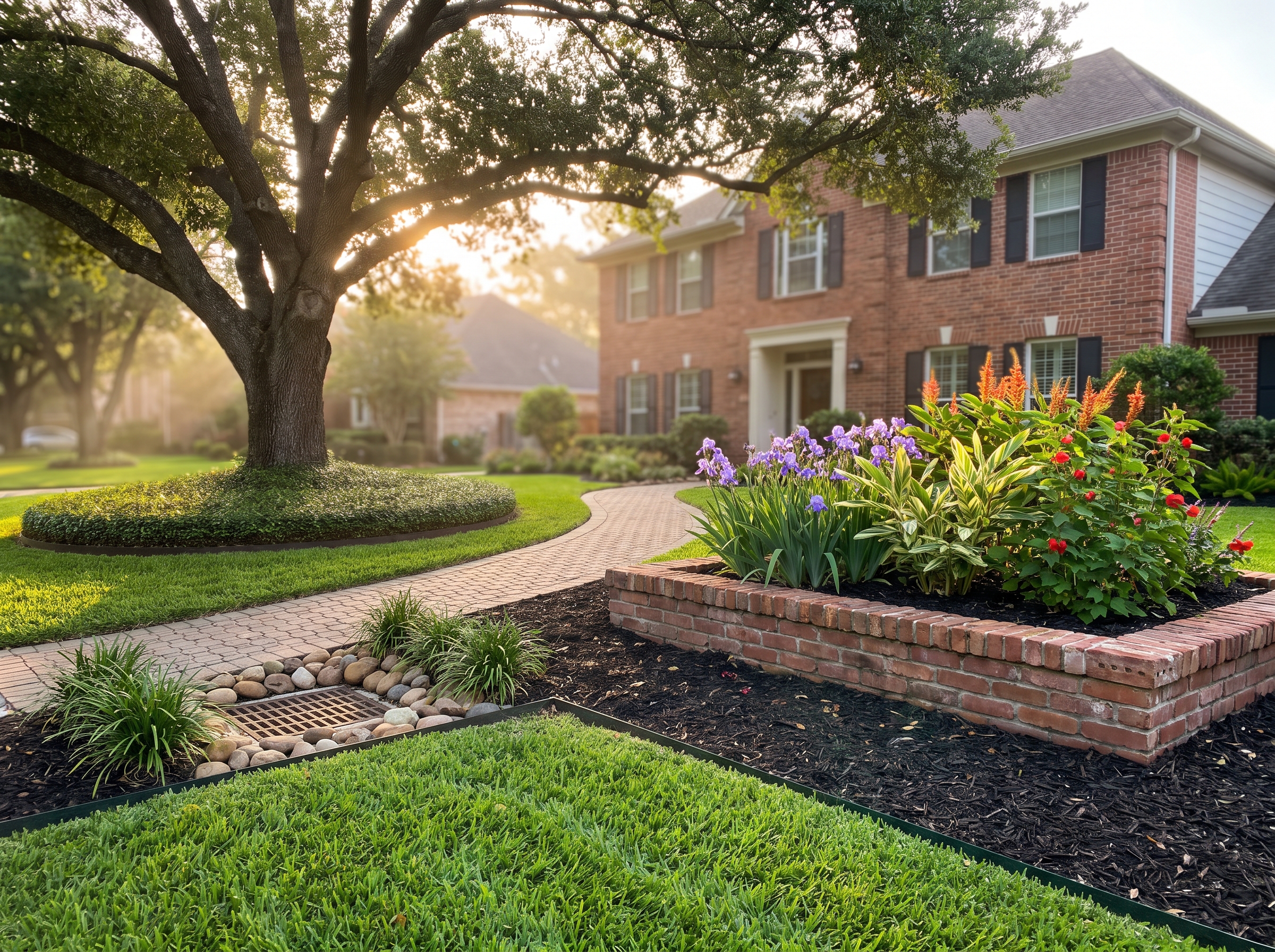
Drive through almost any neighborhood in the City of Homes and a familiar pattern appears. One front yard looks freshly finished: crisp bed lines, glossy shrubs, and a seamless carpet of new sod. A few houses down sits a yard that probably looked exactly the same not long ago, now marked by yellowing turf, thinning shrubs, mulch washed onto the sidewalk, and a bed corner that holds water for days after every storm. The difference between the two is rarely effort or budget. It is time. A large share of landscaping projects in Bellaire, TX look their best on installation day and quietly begin to decline from that moment forward.
The decline tends to follow a predictable arc. The first year is the honeymoon. New plants feed on the nursery soil packed around their roots, fresh sod is watered constantly, and new mulch hides everything underneath. By the second year, roots have used up that borrowed soil and hit native clay, a full storm season has exposed every drainage flaw, and the first disease patches start to appear in the lawn. By the third year, the homeowner is replacing plants, patching turf, and wondering what went wrong.
What went wrong is almost never a single mistake. It is a design that ignored the conditions that make Bellaire, TX one of the most demanding places in the Houston area to grow anything: dense gumbo clay, flat and slow-draining lots, intense summer heat followed by soggy, mild winters, heavy oak canopy, and a city that closely regulates how much of each lot can be paved. Thriving yards are not luckier. They are built around those conditions instead of against them.
Field teams at Heroes Lawn Care of Bellaire see the same four failure points come up again and again. Understanding them is the first step toward a landscape that keeps improving with age instead of fading after a few seasons.
Failure Point One: Sod and Plants Installed on Untreated Gumbo Clay
Houston gumbo clay earns its nickname. When wet, it turns sticky and dense enough to hold a footprint for weeks. When dry, it shrinks and splits into cracks wide enough to swallow a pencil. Its fine particles pack tightly together, leaving very little space for air or water to move through. Roots that try to push into it either stall near the surface or suffocate when the soil stays saturated after a heavy rain.
The most common installation shortcut is to strip the old grass, rake the surface smooth, and lay new sod or set new plants directly on top of native clay. Everything looks perfect for a season, because the sod arrives with a thin layer of farm soil attached and every shrub arrives with a ball of nursery mix. Once those borrowed soils are exhausted, the roots meet a wall. The result is shallow-rooted turf that browns out at the first hot spell and shrubs that seem to stop growing altogether.
What Real Clay Conditioning Involves
Heavy Houston gumbo clay soil conditioning and remediation is not a single product. It is a process. It typically begins by breaking up compaction through core aeration or tilling where the site allows, followed by incorporating generous amounts of finished compost. Expanded shale is widely used in Texas clay because its porous granules create lasting pore space that does not break down the way organic matter eventually does. Sand on its own is a common mistake: mixed into clay in small amounts, it can produce a dense, almost concrete-like layer instead of better drainage.
Conditioning also continues after installation. Annual core aeration, light compost top-dressing on turf, and mulch that slowly breaks down in planting beds keep building soil structure year after year. Over two to three seasons, well-managed clay becomes noticeably looser, darker, and more forgiving. Skipping this ongoing work is one of the main reasons beds that started strong eventually stall.
Establishing St. Augustine Palmetto the Right Way
St. Augustine remains the dominant lawn grass in Bellaire for good reason. It tolerates heat and humidity, spreads aggressively by above-ground runners, and handles more shade than most warm-season grasses. Palmetto is among the most popular cultivars because it copes with partial shade, holds its color well, and has a finer texture than older varieties. Even so, St. Augustine Palmetto sod installation and establishment can fail quickly when the basics are skipped.
Successful establishment begins with clean, healthy sod. Soilborne diseases such as take-all root rot are known to spread when infected grass, thatch, or soil is moved from one site to another, so inspecting pallets before installation is worth the effort. Pieces should be laid tight with staggered seams, rolled to press the roots into firm contact with the prepared soil, and watered thoroughly the same day.
The first two weeks call for frequent, light watering to keep both the sod and the soil beneath it moist. After that, watering should shift toward deeper, less frequent cycles that encourage roots to follow moisture downward. Turf that is kept constantly wet after it roots stays shallow and becomes a prime target for fungal disease. The first mowing usually happens once the sod resists a gentle tug, typically two to three weeks after installation during the growing season.
Failure Point Two: Water With Nowhere to Go
Bellaire sits on flat ground with slow-draining soil, and many lots were graded decades ago, long before today's larger homes, wider driveways, and expansive patios. Every new square foot of roof and pavement sends more runoff into the same yard. When that water has no planned exit, it collects in beds and low turf areas, drowns roots, invites fungus, and can even creep toward the foundation.
Standing water creates a second problem that many homeowners never connect to their landscape: mosquito breeding. Puddles under shrubs, clogged bed drains, and soggy low spots can produce a new generation of mosquitoes within days of a summer storm, turning an outdoor space meant for family time into one nobody wants to use.
Submerged Sump Pump Landscape Basins for Flood-Prone Yards
For yards where gravity alone cannot move water off the lot, a submerged sump pump landscape basin for flood-prone yards is one of the most effective solutions available. A catch basin is set at the lowest point of the property, connected to surface drains or a French drain network, and fitted with a submersible pump controlled by a float switch. When water accumulates, the pump activates and pushes it through a discharge line toward an approved outlet, usually the street.
Well-designed basins disappear into the landscape. A decorative grate surrounded by river rock or moisture-loving plants reads as an intentional design feature rather than a utility. The details that matter most include a check valve to prevent backflow, an accessible lid for routine maintenance, and a discharge route that never sends water onto a neighboring property, something Bellaire's drainage standards specifically address.
Staying Within Bellaire's Permeable Surface and Stormwater Rules
Bellaire limits how much of a residential lot can be covered by hard surfaces. The city's lot coverage calculations count far more than the house itself: driveways, sidewalks, patios, and paved decks all add to the total, and wooden decks count partially. Significant site changes can require drainage review by the building department, and grading that redirects stormwater onto adjacent lots can trigger code enforcement.
For any outdoor project, City of Bellaire permeable surface and stormwater landscape compliance should shape the design from the very beginning rather than surfacing at permit time. Permeable pavers set on an open-graded base, decomposed granite or gravel paths with proper edging, stepping stones set into groundcover, and rain gardens planted with moisture-tolerant species all add usable outdoor space while keeping rainwater on site and soaking into the ground. Because ordinances are updated periodically, confirming current requirements with the city before construction remains an essential step.
Failure Point Three: Plants Chosen for the Nursery Bench, Not the Microclimate
Many plants sold each spring look spectacular on the nursery bench and struggle in a Bellaire bed. Some cannot tolerate wet roots through a rainy fall and winter. Others collapse in August heat or demand far more water than local watering rules comfortably allow. Choosing plants on appearance alone is one of the quietest causes of landscaping failure, because the decline happens slowly enough that it is often blamed on fertilizer, pests, or bad luck.
Tropical and Subtropical Moisture-Tolerant Ornamentals
Thriving Bellaire beds lean on plants built for a humid Gulf Coast climate. Tropical and subtropical moisture-tolerant ornamental plant installation can include Louisiana iris and canna for wet edges, shell ginger and firespike for lush color in partial shade, Turk's cap for heat tolerance and pollinators, crinum lilies for tough and long-lived structure, and dwarf palmetto for a native, storm-hardy accent. Grouping plants by water needs, rather than scattering thirsty and drought-tolerant species through the same bed, keeps irrigation simple and roots healthy.
Placement matters as much as the plant list. Moisture lovers belong near downspouts, rain gardens, and basin edges. Heat-tolerant, drier-preferring plants belong on raised ground and in full sun along driveways and walkways, where reflected heat is strongest.
Raised Brick Garden Beds for Poor-Draining Soil
When native ground stays wet too long for most ornamentals, lifting the root zone is often the smartest move. Raised brick garden bed construction for poor-draining soil gives plants twelve to eighteen inches of well-blended planting mix above the clay, so roots can breathe even after a downpour. Brick complements the traditional architecture common throughout Bellaire, TX and holds up to heat and humidity far better than untreated timber.
Good construction includes a solid footing, weep holes at the base of mortared walls so trapped water can escape, and a planting mix matched to the plants going in. Raised beds should never pile soil against a home's exterior walls above the foundation, where it can trap moisture and invite pests, and they should never bury the trunk flare or root zone of a mature tree. Both mistakes can cause costly damage that takes years to show.
Failure Point Four: Fighting Shade Instead of Designing for It
Bellaire's mature trees are one of the city's greatest assets, but they create shade patterns that shift as canopies grow. A lawn that thrived in full sun a decade ago may now receive only a few hours of filtered light. Homeowners often respond by resodding and fertilizing harder, yet grass that lacks sunlight cannot be fed back into health. Texas research has also linked heavy shade to more frequent take-all root rot symptoms in St. Augustine, adding disease pressure to an already weakened lawn.
Shade-tolerant turf alternatives and groundcover planting offer a better path. In moderate shade, Palmetto St. Augustine or a shade-capable zoysia mowed at the higher end of its recommended range can still perform well. Where shade is deep, turf should give way to groundcovers that actually prefer those conditions, such as Asian jasmine, liriope, mondo grass, cast iron plant, inland sea oats, and native horseherb. Paired with a clean mulch ring or a flagstone path, these plantings create a finished, intentional look in spaces where grass was never going to win.
What Thriving Bellaire Yards Do Differently
Yards whose landscaping still looks excellent five and ten years after installation share a handful of habits. None of them is complicated, but each requires local knowledge and steady follow-through.
They Protect the Canopy Before It Becomes a Liability
Heritage live oaks define Bellaire streetscapes, and they are often the most valuable living asset on a property. Yet many decline slowly because of what happens at ground level. Most of a live oak's feeder roots sit in the top foot or so of soil and spread well beyond the dripline. Compaction from foot traffic and equipment, grade changes, trenching for irrigation or drainage, and soil piled against the trunk all choke those roots over time.
Heritage live oak canopy deep-root fertilization and aeration addresses this directly. Aeration relieves compaction across the root zone, and deep-root feeding delivers nutrients where active roots can absorb them instead of feeding the turf above. Mulch spread in a wide, flat ring, never mounded against the trunk, moderates soil temperature and keeps mowers and string trimmers away from the bark. Bellaire also enforces tree protection rules, so any project near a mature tree should account for them before the first shovel goes in.
Storm preparation is the other half of canopy care. Hurricane-season windbreak tree pruning and root collar protection reduce the chance that a mature tree becomes a hazard when the wind picks up. Structural pruning removes dead, crossing, and weakly attached limbs and reduces wind resistance, while keeping the root collar exposed and free of buried soil or mulch helps prevent decay at the tree's most important structural point. Timing matters for oaks in particular: Texas guidance recommends avoiding oak pruning from roughly February through June, when the beetles that spread oak wilt are most active, and painting every fresh oak wound immediately. That makes the cooler months after hurricane season ends the ideal window to prepare oaks for the next one. Lower-limb clearance and root-zone care fit naturally into regular landscape visits, while upper-canopy work on large trees calls for a certified arborist with aerial equipment.
They Treat Fungal Disease as a Calendar Item, Not an Emergency
Two diseases account for much of the dead St. Augustine across the Houston area, and both are far easier to prevent than to cure. Effective take-all root rot and large patch fungal lawn disease control depends on knowing exactly when each one strikes.
Take-all root rot attacks the roots and the runners that anchor the grass. It often shows up in spring or early summer as irregular yellow patches that gradually thin out, and infected runners lift from the soil easily because the roots beneath them have rotted away. No commercial St. Augustine variety has shown meaningful resistance, so management centers on healthy cultural practices: avoiding overwatering, mowing at the proper height, relieving compaction, and lowering surface soil pH. Topdressing with sphagnum peat moss in spring has shown good results in Texas research, and targeted fungicides work best when applied before symptoms spread.
Large patch behaves differently. It thrives when temperatures cool and the soil stays wet, which makes autumn its prime season. It forms roughly circular patches, often with a bronze or orange margin, and affected blades slip easily from their base. Preventive fungicide applications are most effective once fall soil temperatures begin dropping below about 70°F, before patches have a chance to spread. Cutting back irrigation as nights cool, avoiding heavy nitrogen in the fall, and keeping St. Augustine in the 2.5- to 3.5-inch mowing range all reduce the risk.
Telling these diseases apart from chinch bug damage, drought stress, or simple shade decline is critical, because the treatments differ completely. Seasonal lawn care service plans from Heroes Lawn Care of Bellaire build these prevention windows into the yearly schedule, so treatments arrive before damage appears rather than after the lawn is already thinning.
They Commit to a Year-Round Maintenance Rhythm
Installation is the beginning of a landscape, not the end. Thriving yards follow a steady seasonal routine: weekly mowing during the growing season, which produces denser turf, better weed control, and less thatch than every-other-week cuts; core aeration to keep clay from recompacting; fertilization timed to the grass's natural growth cycle; and bed maintenance that refreshes mulch before it thins out.
Irrigation belongs in that rhythm as well. Weather-based smart controllers adjust watering to actual rainfall and temperature, which can reduce outdoor water use by roughly 30 to 50 percent while helping homeowners stay within local watering rules. On clay soil, shorter cycles with soak time in between allow water to penetrate instead of running down the curb.
A few simple homeowner habits also make professional lawn care services more effective. Marking irrigation heads before core aeration protects the system, and skipping watering on aeration day keeps the soil workable. After a fertilizer application, children and pets should stay off the treated grass for four hours. Small steps like these keep every visit productive and every treatment working as intended.
They Partner With a Team That Combines Science and Local Experience
A quick search for "best lawn service near me" anywhere in the Houston area returns dozens of options, and many landscapers offer nearly identical menus of mowing, planting, mulch, and seasonal color. The difference that matters in Bellaire, TX is whether the people behind the work understand clay chemistry, turf pathology, drainage, and local regulations well enough to design around them.
Heroes Lawn Care of Bellaire brings an unusual depth of expertise to that challenge. Its ownership includes two decades of research-and-development chemistry focused on lawn products, and roughly 90 percent of the fertilization, weed, insect, and fungal products the team applies were developed and registered in-house. Those formulations include natural, 25(b) minimum-risk, and organic options designed with children and pets in mind. Landscaping projects are overseen by a Texas A&M-trained agronomist with 15 years of landscape design experience across the Houston area, so soil conditioning, plant selection, drainage, and turf establishment are planned as one connected system rather than as separate jobs.
That integrated approach is what turns a good-looking installation into a landscape that keeps improving. The team can diagnose why a yard has struggled, correct the soil and drainage conditions underneath, select turf and plants suited to each microclimate on the property, and maintain everything through the seasons with Bellaire lawn care programs built around the city's specific conditions. Licensed through the Texas Department of Agriculture and the Texas Commission on Environmental Quality, crews also schedule equipment work within Bellaire's noise ordinance hours, a small detail that reflects how closely the work is tailored to the community.
Conclusion: Building a Bellaire Landscape That Outlasts Year Three
Most landscaping failures in Bellaire, TX trace back to the same handful of causes: sod and plants set on unconditioned gumbo clay, water with no planned exit, plants chosen for looks instead of conditions, and turf forced into shade where it cannot survive. Add neglected live oak roots, poorly timed storm pruning, and fungal diseases that arrive on a predictable calendar, and it becomes clear why so many yards peak early and decline fast.
Thriving yards reverse every one of those patterns. They start with remediated soil, move water deliberately through basins, permeable surfaces, and rain gardens, rely on moisture-tolerant and shade-appropriate plantings, protect the canopy at ground level, and follow a maintenance calendar that stays one step ahead of disease. None of it is guesswork; it is the product of science applied consistently to local conditions.
For homeowners tired of replanting the same beds every few years, Heroes Lawn Care of Bellaire offers the combination of proprietary science, agronomic design, and local knowledge needed to build a landscape that grows better with age. A professional site evaluation is the first step toward a yard that is still thriving long after year three.