
Four Seasons, One Yard: The Yard Maintenance Calendar That Keeps Bellaire, TX Properties Ahead of Weeds, Disease, and Storms | Heroes Lawn Care of Bellaire
Most homeowners think about their yard in bursts. A patch of weeds appears in March, so a product gets spread. Brown circles show up in the lawn in June, so a treatment gets ordered. A tropical storm floods the back corner in September, so the drain finally gets looked at. Each problem is handled as it shows up, and each one takes more effort than it would have if it had been handled weeks earlier.
The yards that look consistently sharp across Bellaire follow a different rhythm. Their care is planned around the calendar, so each task happens just before the problem it prevents. Pre-emergent goes down before weed seeds germinate. Fungicide protection is in place before disease season begins. Drains are cleared before the storms arrive. Professional yard maintenance in Bellaire, TX works best as a year-round sequence in which every season prepares the property for the next.
This calendar walks through that sequence season by season. It explains what happens and when, and why the timing matters so much on the heavy clay, in the humidity, and through the storms that shape every yard near Brays Bayou.
What Makes Bellaire Yards Different
Three local conditions drive almost every decision on the calendar. The first is the soil. Houston gumbo clay holds water after rain, packs down under foot traffic, and shrinks and cracks during dry spells. Roots struggle to push through it, and nutrients and water often run off instead of soaking in.
The second is the climate. Long, humid summers with warm nights create ideal conditions for fungal disease in St. Augustine turf. Mild winters let cool-season weeds germinate and spread while the lawn is dormant.
The third is water. Bellaire sits within the Brays Bayou watershed, and the Gulf Coast hurricane season runs from June through November. Heavy rain can arrive in any month, and yards with poor drainage can stay soggy for days. A yard maintenance plan that ignores any of these three forces will always be one step behind.
Spring: Building the Season’s Foundation
Spring sets the tone for the whole year. Work done between late winter and late spring decides how many weeds break through, how well the turf greens up, and how prepared the lawn is when summer heat and humidity arrive.
Pre-Emergent Timing Guided by Soil Temperature
Weed prevention starts before a single weed is visible. A pre-emergent application forms a barrier near the soil surface that stops weed seeds from germinating. Timing is everything. Applied too late, the seeds have already sprouted and the barrier does little. Applied too early, it can wear off before germination peaks.
A split-application pre-emergent and post-emergent broadleaf weed eradication program handles both sides of the problem. The spring pre-emergent goes down in late winter to early spring, timed by soil temperature rather than a fixed date on the calendar, since a warm February can start germination weeks ahead of an average year. Weeds that make it through are handled with post-emergent treatments aimed at the specific weed type. Broadleaf weeds, grassy weeds, and sedges each respond to different products, so correct identification comes first. Nutsedge, a common Houston problem, often needs follow-up treatments to control regrowth.
Preventive Fungicide Before Disease Season
Fungal disease is far easier to prevent than to cure, and spring is when prevention begins. Brown patch, caused by the Rhizoctonia fungus, is the most common fungal disease affecting lawns in the area. It thrives in high humidity when nighttime temperatures stay above 70°F, which puts its main risk window from late spring through early fall. Gray leaf spot is another frequent summer problem in St. Augustine.
Preventative fungicide monitoring for brown patch and gray leaf spot begins with a spring assessment of the turf and soil. That is followed by a preventive fungicide application before warm, humid weather settles in. Protecting the lawn ahead of peak disease pressure is far more effective than reacting after brown rings have already spread across the yard.
Spring Green-Up Fertilization
As St. Augustine comes out of dormancy, a seasonal fertilization program supports spring green-up. Feeding at the right moment, once the turf is actively growing, helps the lawn fill in quickly and crowd out weeds. Applying it too early mostly feeds the weeds. Children and pets should stay off treated grass for four hours after each application.
The First Catch Basin Check of the Year
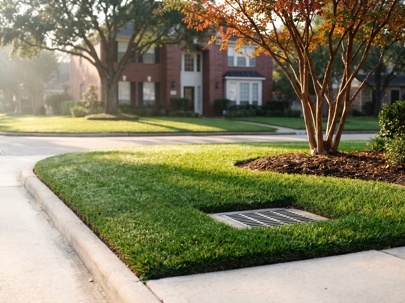
Before the rainy months arrive, the drainage system deserves a close look. A subsurface catch basin is only as good as its grate. Leaves, mulch, grass debris, and sediment wash onto it with every storm, and a clogged grate sends water across the yard instead of into the drain. Subsurface catch basin grate clearing for flood-resilient runoff should happen at least twice a year, and a spring check is the first.
Inside the basin, sediment slowly builds up in the sump. Once that sediment reaches the outlet pipe, the basin loses capacity and needs cleaning, typically every two to five years depending on how much soil and debris the property sheds. Neglected basins lose effectiveness gradually, which is why many homeowners do not notice a problem until a heavy storm overwhelms the system.
Summer: Holding the Line Through Heat and Storms
Summer in Bellaire, TX brings the season’s heaviest workload. Heat, humidity, insects, and the start of hurricane season all arrive at once, and the work done in spring is put to the test.
Active Disease Monitoring
Summer is peak disease season, so the focus shifts from prevention to close observation. Turf is checked regularly for the early signs of brown patch and gray leaf spot. If an outbreak is found, a curative treatment is applied promptly to stop it from spreading. Catching disease while patches are small makes recovery much faster and keeps damage confined to a small area.
Watering habits make a large difference in summer. Irrigating in the early morning gives grass blades time to dry during the day, while evening watering leaves the turf wet overnight, which is exactly the condition fungi need. Irrigation coverage that is too heavy in one zone and too light in another can create disease hot spots in one area and drought stress in the next.
Insect Watch: Chinch Bugs, Armyworms, and Fire Ants
Hot, dry stretches in summer favor chinch bugs, tiny insects that feed on St. Augustine and leave yellowing, dying patches that are easily mistaken for drought stress. They often appear first in the sunniest parts of the lawn and along hot pavement. Armyworms can arrive suddenly and strip large areas of turf within days. Fire ant mounds make the lawn unpleasant and unsafe for children and pets.
A professional insect control program targets each of these pests with treatments matched to the threat, and it gets the diagnosis right first. Treating a chinch bug problem as drought stress by adding more water does nothing to stop the insects, so knowing the difference is essential.
Core Aeration for Compacted Gumbo Clay
By early summer, Bellaire clay is often tightly compacted from foot traffic, play, and months of rain followed by drying. Mechanical core aeration for compacted Houston gumbo clay pulls small plugs of soil from the lawn and leaves open channels behind. Those channels let water, air, and nutrients reach the root zone instead of running off the hard surface.
Aeration is most effective while St. Augustine is actively growing, so the turf can recover quickly and fill in around the openings, and the exact timing is chosen for each yard. Before an aeration visit, irrigation heads should be clearly marked so equipment can work around them without damaging the sprinkler system.
Clean Lines Along Every Hard Surface
St. Augustine spreads aggressively with above-ground runners, and in summer it can creep over sidewalks, driveways, and patio edges in a matter of weeks. Trenched edging along concrete curbs, flatwork, and patios keeps those runners in check and gives the whole property a sharp, finished look.
Consistent edging does more than improve appearance. It defines where the lawn ends and the hardscape begins, keeps grass from growing into expansion joints, and makes the property look cared for from the street. Detailed trimming around beds, structures, and fence lines completes the clean look that sets well-kept yards apart.
Hurricane-Season Readiness
With hurricane season underway, summer is the time to make sure water has a clear path off the property. Catch basin grates should be checked again before any forecasted storm. Downspout extensions should point away from the house, and low spots that held water after spring storms should be noted for attention. A drainage consultation can identify the areas where water collects and recommend practical solutions before the most active part of the season.
Fall and Winter: Recovering, Protecting, and Planning Ahead
Many homeowners stop thinking about the yard once the summer heat breaks. In Bellaire, the cooler months are some of the most important on the calendar. Fall work decides how well the lawn recovers from summer stress and how many weeds take hold over winter. Winter is the ideal time for structural work on ornamental trees.
Fall: The Season of Recovery and Prevention
As temperatures ease, the turf begins to recover from summer heat, and the calendar shifts toward strengthening roots and blocking the next wave of problems.
The second pre-emergent application of the year is timed for late summer to early fall, again guided by soil temperature. This barrier targets cool-season weeds such as henbit and chickweed, which germinate in autumn and spread through the winter while St. Augustine is dormant. Skipping the fall application is one of the most common reasons lawns are carpeted with weeds by February.
Fall also brings the second preventive fungicide application, which matters most for lawns that had disease activity earlier in the year. Cooler nights and lingering moisture can bring fungal problems back, and a lawn that struggled in summer is especially vulnerable.
Seasonal fertilization turns toward root development, helping the turf build strength before dormancy. Fall is also when grub management comes into play. White grubs feed on roots below the surface, and a lawn that pulls up easily like a loose carpet is a classic warning sign.
Finally, the fall drainage check completes the twice-yearly schedule for catch basins. Falling leaves from live oaks and other trees can bury grates quickly, so keeping them clear through autumn prevents water from backing up during late-season storms.
Winter: Structural Care for Ornamental Trees
Winter is the quietest season for the lawn, but it is the best time to care for crape myrtles, one of the most popular and most mistreated ornamental trees in Bellaire. Severe topping, where every branch is chopped back to the same height each year, is so common that it has its own nickname, “crape murder.” It weakens the tree and produces a thicket of weak shoots from every stub.
Crape myrtle corrective canopy thinning takes the opposite approach. Rather than shortening every branch, it selectively removes interior branches that cross, rub, or crowd the center of the tree. That improves airflow and light, reduces wind resistance, and preserves the tree’s natural, graceful shape. Removing no more than about 25 percent of the canopy in a single session protects the tree from stress, and cleaning tools between trees helps prevent the spread of disease. Late winter, while the trees are dormant and their branch structure is easy to see, is an ideal time for this work. Professional pruning in this service covers trees up to ten feet tall, and larger trees that need high-canopy access are best referred to a licensed arborist.
Winter also has a weed role. Any cool-season broadleaf weeds that slipped past the fall barrier can be treated with targeted post-emergent applications before they flower and drop seed for next year.
Year-Round: The Quarterly Property Assessment
A calendar is only as good as the information behind it. A quarterly property assessment steps back from individual tasks to evaluate the whole yard. It looks at turf density, weed pressure, signs of disease, and soil condition. Each assessment shows what is working and what needs adjusting, so the plan for the next season is based on how the property is actually responding rather than on assumptions.
This regular review turns a fixed yard maintenance schedule into an adaptive one, tailored to how each property in Bellaire, TX actually behaves. A lawn that had heavy disease pressure in summer may need closer monitoring the next year. A yard where water kept pooling in the same corner may need a drainage consultation. A thinning area under a growing tree canopy may need a different approach entirely. Assessments catch these patterns early, while they are still simple to correct.
Why One Team for the Whole Calendar Changes the Results
Following this calendar without help means tracking soil temperatures, identifying weeds, diagnosing fungal disease, spotting insect damage, monitoring drainage, and knowing the right way to prune ornamental trees. Many homeowners juggle several landscapers and specialists to cover it all, and important timing windows fall through the cracks between them.
Heroes Lawn Care of Bellaire brings every part of the calendar under one program. Its full maintenance package combines scheduled service visits, clean edging, seasonal fertilization, pre-emergent and post-emergent weed control, disease control, insect control, and quarterly property assessments. Add-on services such as core aeration, sod repair, and drainage consultations are available as each yard needs them. Tree pruning for ornamental trees up to ten feet, including crape myrtles, rounds out the year.
What sets the program apart is the science behind it. Roughly 90 percent of the fertilization, weed, insect, and fungal products Heroes Lawn Care of Bellaire applies were developed and registered in-house by an owner with two decades of research-and-development chemistry experience. Those formulations include natural, 25(b) minimum-risk, and organic options. The program is guided by a Texas A&M-trained agronomist with 15 years of landscape experience across the Houston area, and the company is licensed by the Texas Department of Agriculture and the Texas Commission on Environmental Quality.
For homeowners comparing Bellaire lawn care options, that combination means every application is timed to local conditions and every season builds on the one before it. Heroes Lawn Care of Bellaire handles the calendar so homeowners can simply enjoy the yard.
Conclusion: A Yard That Stays One Season Ahead
The difference between a yard that struggles and a yard that thrives is rarely effort. It is timing. Effective yard maintenance in Bellaire, TX follows the seasons. In spring, pre-emergent goes down by soil temperature and preventive fungicide goes on before disease season, while green-up feeding and a catch basin check prepare the yard for rain. Summer brings disease and insect monitoring, core aeration for compacted clay, crisp edging, and storm readiness. In fall, the second weed barrier and fungicide application go down, along with root-building nutrition, grub management, and another drainage check. Winter is reserved for careful crape myrtle thinning, with quarterly assessments keeping the whole plan on track.
With each task arriving just before the problem it prevents, the property stays ahead of weeds, disease, and storms all year. Heroes Lawn Care of Bellaire offers lawn care services that follow this calendar from start to finish, with proprietary science, agronomic expertise, and deep local knowledge. A quarterly assessment of any yard is the natural first step toward a property that looks its best in every season.