
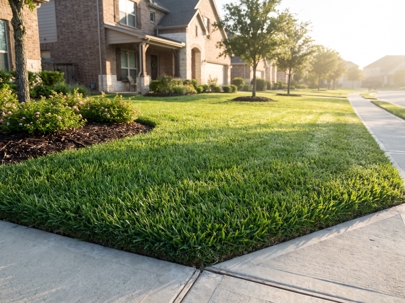
Why Weeds Keep Coming Back to Missouri City, TX Lawns — and the Two-Barrier Weed Control Strategy That Finally Stops Them | Heroes Lawn Care of Bellaire
It usually starts in spring. A few spiky clumps appear along the driveway, then a patch of bright green blades shoots up faster than the rest of the lawn. A weekend is spent pulling, spraying, and bagging. For a few weeks the yard looks better. Then the same weeds return in the same places, sometimes in greater numbers, and by fall a different set of invaders has taken their place. Season after season, the lawn never quite gets ahead.
That cycle is not a sign of laziness or bad luck. It is the predictable result of treating weeds only after they appear. Most of the weeds in a lawn come from seeds and underground structures that are already waiting in the soil, ready to sprout the moment conditions allow. Effective weed control in Missouri City, TX works by getting ahead of that process. It relies on two well-timed barriers, one in spring and one in fall, that stop most weeds before they ever emerge, followed by targeted treatments for the few that slip through and a dense, healthy lawn that leaves little room for new invaders.
This article explains why weeds keep returning, how the two-barrier strategy works, and how to deal with the especially stubborn weeds common across the area.
Why Missouri City Lawns Are a Weed Magnet
Missouri City, TX sits in Fort Bend County on Gulf Coast clay soil that drains slowly and stays wet after heavy rain. Many of its neighborhoods, from long-established areas like Quail Valley and Lake Olympia to newer master-planned communities, rely on regular irrigation to keep lawns green through hot summers. That combination of moisture, warmth, and fertile soil is ideal for grass, and equally ideal for weeds.
Mild winters add another layer. In colder regions, freezing temperatures interrupt the weed calendar for months. Around Missouri City, cool-season weeds germinate in fall and grow quietly through winter while St. Augustine sits dormant, then warm-season weeds take over in spring and summer. There is almost no time of year when something is not trying to move in. Newer construction brings its own challenges, too, as freshly installed sod and disturbed soil often contain weed seeds that have not yet faced any competition.
The Three Reasons Weeds Keep Returning
Most recurring weed problems trace back to one or more of three common mistakes. Recognizing them is the first step toward breaking the cycle.
Treating What Shows Instead of What Is Coming
Every lawn holds a seed bank: a reserve of weed seeds lying in the top layer of soil, sometimes for years. Pulling or spraying a visible weed removes that single plant, but it does nothing about the hundreds or thousands of seeds waiting below. A single crabgrass plant left unchecked can produce thousands of seeds, refilling that reserve for the following season. Without a strategy that addresses germination, the lawn is simply resetting the problem each year.
Using the Wrong Product for the Weed
Weeds fall into three broad groups: broadleaf weeds, grassy weeds, and sedges. Each responds to different treatments. A product that controls dandelions does nothing against nutsedge, and a treatment designed for broadleaf weeds will not touch crabgrass. Many homeowners spray a general weed killer across the lawn, see little improvement, and conclude that nothing works. In reality, the product simply did not match the weed. Correct identification has to come before any treatment.
Thin Turf Leaves the Door Open
Weeds are opportunists. They thrive in bare spots, thin areas, compacted soil, and places where turf has been weakened by disease, drought, or insects. A thick, healthy lawn is itself one of the best defenses against weeds, because dense grass shades the soil surface and leaves little room for weed seeds to sprout. When turf thins out, the gaps fill with whatever is waiting in the seed bank.
Barrier One: The Spring Pre-Emergent
Pre-emergent treatments are the foundation of effective weed control. Rather than killing existing weeds, they form a barrier in the top layer of soil that stops weed seeds from developing as they begin to germinate. Applied at the right moment, a single barrier can prevent a large share of a season’s weeds from ever appearing.
Stopping Crabgrass and Goosegrass Before They Start
Split-application pre-emergent barrier treatments for crabgrass and goosegrass control begin with the spring application. Crabgrass is a summer annual grassy weed that spreads outward in coarse, low clumps and produces enormous amounts of seed. Goosegrass is a close relative that germinates a little later in spring and favors compacted, high-traffic areas such as the edges of sidewalks, driveways, and play areas, where it forms tough, flattened clumps with a silvery center.
Because these weeds germinate at slightly different times, the spring barrier must be in place before the earliest germination and remain active long enough to cover the later arrivals. That is one reason a split approach, with treatments in both spring and fall, works far better than a single application each year.
Timing by Soil Temperature, Not the Calendar
The difference between a barrier that works and one that fails is often a matter of a week or two. Crabgrass typically begins to germinate when soil temperatures hold around 55°F for several days. In the Houston area, that often means a spring pre-emergent window from late February into early March, but a warm winter can move germination earlier and a cool one can push it later. Tracking soil temperature rather than relying on a fixed calendar date ensures the barrier is in place before the first seeds sprout. Watering the application in according to label directions activates the barrier in the soil, where it needs to be.
Barrier Two: The Fall Pre-Emergent
Many homeowners stop thinking about weeds once summer ends, which is exactly when the next wave begins. Cool-season weeds germinate as soil temperatures drop in autumn, then spend the winter establishing themselves while St. Augustine slows down. By late winter, they are the most visible plants in the yard.
Fall pre-emergent herbicide barriers targeting Poa annua (annual bluegrass), henbit, and rescuegrass interrupt that cycle. Poa annua forms light-green clumps that produce white seedheads in late winter and early spring. Henbit, a winter annual broadleaf weed with square stems and small purple flowers, spreads quickly through thin turf and bed edges. Rescuegrass is a coarse, clumping cool-season grass that grows rapidly in winter and stands out sharply against dormant St. Augustine. Chickweed, another common winter broadleaf, forms low mats in moist, shaded areas. In the Houston area, the fall barrier typically goes down from late August through mid-September, again guided by soil temperature. Skipping it is one of the most common reasons lawns are covered in winter weeds by February.
Handling the Weeds That Slip Through
No barrier stops every weed. Some species spread through underground structures that a pre-emergent cannot affect, and others germinate after the barrier begins to fade. The second half of a successful strategy is targeted post-emergent treatment, matched to the specific weed and timed for maximum effect.
Nutsedge: The Weed That Fights Back
Nutsedge is a particular challenge across the greater Houston area, including Missouri City. Although it looks like grass, it is a sedge, easily identified by its triangular stems; rolling a stem between the fingers reveals distinct edges. It grows faster than surrounding turf, so bright green spikes quickly stand out above the rest of the lawn, and it thrives in wet, poorly drained soil.
Yellow nutsedge and purple nutsedge both spread through underground tubers, often called nutlets. Purple nutsedge forms chains of tubers that can extend deep into the soil. Pulling the visible plant almost always leaves those tubers behind, and each one can send up new shoots. That is why hand-pulling tends to make the problem worse over time. Post-emergent eradication of yellow and purple nutsedge requires a specialized product designed for sedges and, in most cases, more than one treatment cycle, with follow-up applications to control regrowth from surviving tubers. Patience and consistency matter more here than with almost any other weed.
Virginia Buttonweed and Doveweed in Wet Clay
Two of the most frustrating weeds in Gulf Coast lawns share a love of moisture. Virginia buttonweed is a perennial broadleaf weed with opposite leaves and small white, star-shaped flowers. It spreads by seed, by creeping stems that root where they touch the ground, and by root fragments, which means mechanical removal often spreads it further. Doveweed is a summer weed that looks somewhat like grass, with smooth, shiny leaves and tiny purple flowers, and it spreads aggressively in damp areas once temperatures warm.
Targeted suppression of invasive Virginia buttonweed and doveweed in moist clay soils combines several approaches. Correct identification determines which treatment is appropriate, and repeat applications are often necessary for buttonweed. Addressing the moisture that attracts these weeds is just as important. Overwatering, irrigation zones that run too long, and low spots where water collects all create ideal conditions for both species. Adjusting irrigation and correcting drainage problems reduces the pressure that keeps them returning.
Chamberbitter and Prostrate Spurge Along Turf and Bed Margins
Some weeds specialize in the edges of the lawn. Chamberbitter is a summer annual broadleaf that resembles a tiny mimosa seedling, with small leaflets and seeds hidden along the undersides of its branches. It produces seed rapidly and spreads easily through thin turf and landscape beds. Prostrate spurge forms flat mats that hug the ground, often along sidewalks and bed borders, and releases a milky sap when broken.
Chamberbitter and prostrate spurge eradication across warm-season turf and bed margins depends on treating them early, before they set seed, and on recognizing that beds and lawn edges are connected. A weed allowed to seed in a flower bed will reappear in the adjacent turf the following season. Both weeds also respond well to pre-emergent barriers, which is another reason consistent seasonal timing pays off.
Broadleaf Treatments That Respect St. Augustine
St. Augustine is the dominant lawn grass across the Houston area, and it is more sensitive than many grasses to certain herbicides. Temperature-sensitive selective broadleaf herbicide formulations safe for St. Augustine lawns are designed to control broadleaf weeds without harming the surrounding turf, but conditions matter. Many selective broadleaf products carry label warnings against application during high heat, often when temperatures climb into the upper 80s and beyond, because the combination of heat and herbicide can stress or injure St. Augustine.
That is why professional post-emergent treatments are timed carefully, often during the milder months of spring and fall, and adjusted to current weather. Applications are made according to label directions, and children and pets should stay off treated areas until the application has dried. Selective products are chosen so they control the target weeds without harming St. Augustine or Bermuda turf.
The Toughest Invaders: Dallisgrass, Bahiagrass, and Torpedograss
A few grassy weeds deserve special mention because they are among the hardest to remove from a St. Augustine lawn. Dallisgrass grows in coarse, spreading clumps that quickly rise above the surrounding turf and send up tall seedheads. Bahiagrass, often seen along roadsides, forms tough patches with distinctive V-shaped seedheads. Torpedograss spreads aggressively through sharp-pointed underground runners, especially in moist areas, and can weave itself deep into healthy turf.
Because these invaders are themselves grasses, very few products can remove them from a St. Augustine lawn without also damaging the desirable turf. Honest management of grassy weed incursions such as dallisgrass, bahiagrass, and torpedograss starts with accurate identification and careful, targeted treatment, and it often takes repeated effort over more than one season. In severe cases, removing the affected area and repairing it with new sod is the most practical solution. Catching these weeds early, while patches are still small, makes a dramatic difference in how easily they can be managed.
Density: The Barrier That Lasts
Pre-emergent barriers and targeted treatments control weeds, but a thick lawn is what keeps them from coming back. Turf density depends on the full care program: seasonal fertilization that supports steady growth, core aeration that relieves compaction in clay soil, irrigation that waters deeply without leaving the ground soggy, and disease and insect control that prevents thin spots from forming. When those pieces work together, the lawn shades the soil, crowds out seedlings, and recovers quickly from minor damage.
For many Missouri City homeowners, a weed-free lawn is about more than appearance. Neighborhood associations often set clear expectations for how yards should look, and a lawn overtaken by nutsedge or winter weeds can quickly draw attention. Balancing weed suppression with healthy canopy density is the most reliable way to keep a lawn looking consistent from season to season, without relying on emergency treatments every time something new appears.
Why Expertise Makes the Strategy Work
A two-barrier strategy sounds simple, but its success depends on details: tracking soil temperatures, identifying each weed correctly, choosing products that match both the weed and the turf, and adjusting treatments to the weather. Heroes Lawn Care of Bellaire builds its weed control program around those details. Pre-emergent barriers are timed by soil temperature in both spring and fall, post-emergent treatments are matched to broadleaf weeds, grassy weeds, and sedges, and follow-up applications target persistent problems such as nutsedge.
The products themselves set the program apart. Roughly 90 percent of the fertilization, weed, insect, and fungal products Heroes Lawn Care of Bellaire applies were developed and registered in-house by an owner with two decades of research-and-development chemistry experience, including natural, 25(b) minimum-risk, and organic options. Every program is informed by a Texas A&M-trained agronomist with 15 years of experience across the Houston area, and the company is licensed by the Texas Department of Agriculture and the Texas Commission on Environmental Quality.
Because weed control works best as part of complete lawn care services, the same team also handles fertilization, disease control, insect control, aeration, and sod repair when needed. For homeowners in Missouri City, TX who are tired of pulling the same weeds every year, Heroes Lawn Care of Bellaire offers a program designed to keep the lawn ahead of the weed calendar instead of behind it.
Conclusion: Stop Chasing Weeds and Start Preventing Them
Weeds return to Missouri City lawns for predictable reasons: seeds waiting in the soil, treatments that do not match the weed, and thin turf that leaves space for new invaders. Lasting weed control in Missouri City, TX breaks that cycle with two well-timed pre-emergent barriers, one in spring for crabgrass and goosegrass and one in fall for Poa annua, henbit, and rescuegrass, followed by targeted post-emergent treatments for nutsedge, Virginia buttonweed, doveweed, chamberbitter, and spurge. The toughest grassy invaders call for honest, patient management, and a dense, healthy lawn provides the barrier that lasts.
With each step timed to soil temperature and matched to the right weed, the lawn finally gets ahead of the season instead of reacting to it. Heroes Lawn Care of Bellaire combines proprietary science, agronomic expertise, and careful timing to make that possible, giving homeowners a lawn that stays thick, green, and clear of weeds all year long.