
Beyond the Builder Package: How Landscaping in Sienna, TX Turns a New-Construction Yard Into a Finished Home | Heroes Lawn Care of Bellaire
Moving into a brand-new home is one of the most exciting moments a family can experience. The paint is fresh, the appliances are untouched, and every room is ready to make its own. Step outside, though, and the picture often changes. The front yard may consist of a single strip of sod, a handful of small shrubs lined up along the foundation, and a narrow bed of mulch. The backyard is frequently just grass from fence to fence. It looks tidy on closing day, but it rarely feels finished.
That is not a criticism of home builders. Their job is to deliver a sound house and a code-compliant lot on schedule, and the landscape package is designed to meet basic requirements rather than to create a lasting outdoor environment. The real opportunity begins after the keys are handed over. Thoughtful landscaping in Sienna, TX takes that basic starting point and turns it into a yard that drains well, grows steadily, and finally matches the quality of the home it surrounds.
Sienna has grown rapidly, from roughly 13,700 residents in 2010 to more than 20,000 by 2020, and new sections continue to fill in. That means a large share of homeowners are living with yards that are only a few years old, or a few months. This guide explains what a typical builder package leaves out and the upgrades that make the biggest difference, in the order that makes the most sense.
What a Builder Package Usually Includes, and What It Leaves Out
Most new-construction landscapes share a similar formula: sod across the open areas, a few foundation shrubs, a small tree or two where required, mulch in the beds, and a basic irrigation system. The lot is graded to move water away from the slab at the time of construction, and drainage beyond that is often minimal.
What is usually missing is everything below the surface and everything that gives a yard character. Soil preparation is often limited, beds are shallow and narrow, plant choices tend toward whatever is easy to source in quantity, and there is rarely any planning for how water will behave after the first heavy Gulf Coast storm. Those gaps are why many new yards look fine for the first few months, then begin to struggle as summer heat, heavy rain, and daily use take their toll.
Upgrade One: Fix the Ground Beneath the Sod
The most important improvements to a new-construction yard are the ones no one sees. Before adding anything new, it is worth understanding what lies under the existing lawn and beds.
Construction Compaction and Buried Debris
Building a house means months of heavy equipment, material deliveries, and foot traffic across the lot. That activity compacts the soil, sometimes to the point where roots and water can barely penetrate it. It is also common for construction debris, such as concrete washout, gravel, scraps of lumber, and wire, to end up buried just below the surface. Sod laid over compacted soil and debris may root only a few inches deep, which is why so many new lawns brown out quickly during the first dry stretch of summer.
A professional site evaluation reveals these hidden problems before new plantings go in. It looks at the existing grade, soil conditions, drainage patterns, and buried infrastructure such as irrigation lines, then identifies which areas need deeper work.
Brazos River Alluvial Clay Soil Remediation
Sienna sits along the Brazos River, and much of the area is underlain by heavy alluvial clay soils deposited by the river over thousands of years. These soils are rich in minerals, but they hold water after rain, shrink and crack during drought, and compact easily. Brazos River alluvial clay soil remediation transforms that ground into a healthier growing environment.
The process begins by removing existing vegetation from areas being renovated, then tilling the soil to the appropriate depth and grading it to eliminate low spots. Amendments are applied based on what the soil assessment finds, whether that means correcting compaction, adjusting pH, or addressing nutrient shortages. Heroes Lawn Care of Bellaire uses proprietary soil amendment products developed in-house by an owner with two decades of research-and-development chemistry experience, allowing each blend to be matched to the specific challenges of Gulf Coast clay instead of relying on a one-size-fits-all mix.
Upgrade Two: Give Water a Planned Path
New homes in Sienna often sit on lots designed to move water efficiently toward streets, lakes, and community drainage systems. Even so, individual yards frequently develop wet spots once landscaping, fences, patios, and additions change how water moves across the property. Planning for that water early prevents problems that are far more disruptive to fix later.
Final Grading and Surface Swale Sculpting
Final grading and surface swale sculpting to prevent standing water near foundations fine-tunes the lot so water flows away from the house and toward a safe exit. After target elevations are planned, crews use professional equipment to cut high points, fill low areas, and contour the surface, then compact redistributed soil properly so it does not settle later. A final inspection confirms the direction of drainage flow.
Where water needs to travel across the yard, a shaped swale can guide it gently instead of letting it sheet across the lawn. A dry creek bed takes that idea further, turning the swale into a landscape feature lined with geotextile fabric, a coarse aggregate base, and decorative river rock or creek stone, with accent boulders at the curves and an outlet finished to prevent erosion. In a community known for its natural scenery, a well-designed dry creek can look as though it has always belonged there.
Subsurface Catch Basins and Perforated French Drains for Lakefront Drainage
Lakefront and greenbelt lots are some of the most desirable properties in Sienna, TX, but they often collect runoff from the house, the neighbors, and the slope toward the water. Subsurface catch basins and perforated French drains for lakefront drainage carry that water underground before it can soak the lawn or pool along the fence line.
A French drain is built in a trench typically 12 to 18 inches deep and about 12 inches wide, lined with commercial-grade woven geotextile fabric that keeps clay particles from clogging the system. Clean, angular crushed stone surrounds a perforated pipe that is laid with its perforations facing down and sloped at least one percent so gravity carries water to the outlet. That outlet sits lower than the collection point and is placed to prevent backflow, whether it is a pop-up emitter, a daylight outlet, or a connection to an existing drainage system. Catch basins collect water from specific low areas and feed it into the same underground network. Installed before new beds and turf, these systems protect every upgrade that follows.
Turning a Yard Into a Finished Landscape
With the soil prepared and water under control, the visible transformation can begin. This is where a new-construction yard starts to feel like a finished home.
Upgrade Three: The Right Grass for Each Part of the Lot
Builder sod is usually chosen for availability and consistency, not for the specific conditions of each yard. As landscaping matures and trees grow, those conditions change. A front yard in full sun and a backyard shaded by a neighbor’s two-story home may need entirely different grasses.
Zoysia and shade-adapted Palmetto St. Augustine turfgrass installation matches the lawn to the light. St. Augustine handles shade better than any other warm-season grass used in the Houston area, and Palmetto performs especially well in moderate shade, while Floratam is better suited to full-sun areas. Zoysia offers excellent heat and drought tolerance with better shade tolerance than Bermuda, making it an attractive medium-maintenance option. Bermuda suits open, sunny spaces and uses less water under irrigation restrictions.
Installation follows a careful process. Fresh sod is sourced and installed the same day, laid in staggered rows with tight seams, and rolled to remove air pockets and press roots firmly into the prepared soil. It is watered immediately, kept consistently moist without waterlogging for the first two weeks, and then watered gradually less often to encourage deep rooting. Light foot traffic can usually resume after a week, with heavier use after two to three weeks.
Upgrade Four: Beds With Depth, Layers, and Staying Power
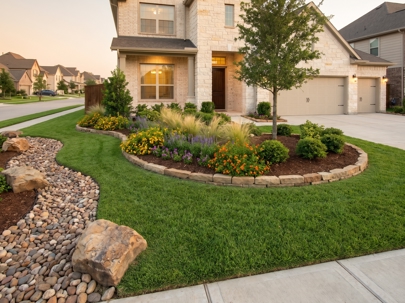
The narrow foundation bed included with many new homes is often the single biggest opportunity for improvement. Wider, deeper beds with layered plantings add curb appeal, soften the architecture, and create a sense of maturity that a row of identical shrubs cannot.
Moisture-tolerant subtropical and Gulf Coast planting palettes for high-humidity microclimates are built around plants that thrive in local conditions. Heat-tolerant perennials such as salvia, lantana, and Esperanza provide reliable color through long summers, while ornamental grasses add movement and texture. Seasonal color can be rotated twice a year, with cool-season annuals like pansies and snapdragons in fall and warm-season choices such as vinca, begonia, and pentas in late spring. Each bed is edged, excavated, and amended before planting, and every plant is matched to the light conditions in its spot and installed at the correct spacing and depth.
On heavy clay, a little elevation goes a long way. A low wall of 12 to 24 inches creates a raised planting zone where roots sit above slow-draining native soil, protecting plants that are prone to root rot in wet ground and adding instant architectural interest.
Upgrade Five: Borders That Define the Design
Clean lines are what make a landscape look intentional. Landscape border edging and natural stone border masonry separate beds cleanly from the lawn and hardscape, keep turf from creeping into planting areas, and give the whole yard a finished outline. Natural stone is especially effective for garden bed borders and decorative features, bringing a traditional or organic look, while concrete block offers a clean, modern profile. Borders and low walls should align with the style of the home so the landscape and architecture read as a single design.
Upgrade Six: Mulch That Protects Young Roots
New plantings need help getting established, especially through their first Texas summer. A fresh layer of mulch, applied after planting is complete, helps beds retain moisture, regulates soil temperature, and reduces weed pressure. Mulch application for root thermoregulation and moisture retention buffers young roots from extreme afternoon heat and the occasional winter cold snap, while giving beds a clean, finished appearance. It should surround plants rather than pile against stems or trunks, and it should be refreshed as it breaks down.
Upgrade Seven: Smarter Irrigation and Outdoor Living
Builder irrigation systems are often designed for simple coverage rather than efficiency. Upgrading to zones designed around the plants they serve, with rotary heads for open lawn, fixed spray for tighter beds, and drip irrigation for gardens, shrubs, and trees, delivers water where it is needed. Weather-responsive smart controllers adjust or pause cycles based on real-time rainfall data and forecasts, and many existing systems can be upgraded to a smart controller after evaluation. Irrigation installations in the area typically require a permit, and an experienced provider coordinates that process for the homeowner.
Once the planting and drainage foundation is in place, outdoor living features can complete the picture. Paver patios, outdoor kitchens, pergolas, and fire pits extend the home into the yard and create spaces for the lakeside evenings and family gatherings that draw so many people to Sienna in the first place.
Common New-Yard Mistakes Worth Avoiding
Enthusiasm for a new home can lead to a few well-meaning mistakes that create problems later. One of the most common is piling soil or mulch high against the foundation to build up a bed. Raising the ground against the slab can direct water toward the house instead of away from it and can hide the foundation edge, where moisture and pests are easier to spot. Beds near the home should preserve the slope away from the slab that grading established.
Another frequent misstep is planting shrubs and trees too close to the house, walkways, or each other. Small nursery plants look sparse at first, but many grow far larger within a few seasons. Spacing them for their mature size avoids crowding, improves airflow, and reduces the need for constant pruning. Overwatering is a third trap. New sod needs consistent moisture during establishment, but continuing to water daily once roots have formed keeps clay soil saturated, invites fungal disease, and encourages shallow roots. Finally, adding beds, borders, or patios across the path water naturally takes can block drainage that was working well. Reviewing how water moves across the yard before adding new features keeps every improvement working together.
Planning the Transformation in Phases
Not every upgrade has to happen at once. A well-designed landscape plan integrates turf, planted zones, hardscape, drainage, and irrigation into one vision, with clear phasing if the project will be completed in stages. The groundwork, meaning soil, grading, and drainage, typically comes first because it protects everything installed later. Beds, borders, and turf follow, and outdoor living features can be added as the household is ready. Working from a single plan ensures that each phase fits the next, instead of creating a patchwork of separate projects.
Why One Team Makes the Upgrade Seamless
Upgrading a new-construction yard touches soil science, drainage, turf selection, horticulture, irrigation, and hardscape. When separate landscapers handle each piece, the results can clash, and homeowners end up coordinating the details themselves. Heroes Lawn Care of Bellaire approaches every project as one connected system. Each design begins with an on-site consultation and an assessment of drainage, grade, soil quality, sun exposure, and existing plant health, and most residential designs are delivered within a week of that visit. The same team that plans the project installs it, guided by a Texas A&M-trained agronomist with 15 years of landscape design experience across the Houston area.
After the transformation, ongoing lawn care services keep the new landscape thriving, with fertilization, weed control, and disease control matched to the soil and turf that were just put in place. For families in Sienna, TX, that means one accountable team from the first site walk through every season that follows. Heroes Lawn Care of Bellaire is licensed by the Texas Department of Agriculture and the Texas Commission on Environmental Quality.
Conclusion: From Move-In Ready to Truly Finished
A builder package gives a new home a starting point, but it rarely delivers a landscape that lasts. Effective landscaping in Sienna, TX goes beyond that package by repairing compacted ground and remediating Brazos River clay, giving water a planned path through grading, swales, French drains, and catch basins, and then layering in the right turf for each part of the lot, deeper beds with Gulf Coast-suited plants, natural stone borders, protective mulch, and smarter irrigation. Planned together and built in the right order, those upgrades turn a basic lot into a yard that matches the home it surrounds.
With the expertise to design, install, and maintain every part of that transformation, Heroes Lawn Care of Bellaire helps Sienna homeowners move from move-in ready to truly finished. A professional site assessment is the first step toward a landscape that feels established long before its time.