
Before You Sign: The Questions That Reveal Whether a Landscaping Contractor in Bellaire, TX Can Handle Clay, Drainage, and City Permits | Heroes Lawn Care of Bellaire
Choosing someone to transform a yard usually starts the same way. A few names come from neighbors, a few more from an online search, and before long there are several proposals on the kitchen table. They all promise a beautiful result, and most include attractive drawings or photos of past projects. On paper, they can look almost identical.
The differences show up later. One project drains perfectly through its first tropical storm, while another floods the new beds. One irrigation system passes city requirements without a hitch, while another stalls over paperwork nobody mentioned. One patio stays level for years, while another starts to tilt toward the house after the first dry summer. The quality of the outcome was decided long before installation, in the planning and expertise of the team that was hired.
That is why the most important part of hiring a landscaping contractor in Bellaire, TX happens before any contract is signed. The right questions reveal whether a company understands the conditions that make this city such a demanding place to build a landscape, or whether it plans to apply the same approach it uses everywhere else. The questions below are designed to bring those differences into the open.
What Makes Bellaire a Demanding Place to Build a Landscape
Three local realities separate a well-prepared contractor from one that is guessing. The first is the soil. Houston black gumbo clay swells when wet and shrinks when dry, drains slowly, and compacts easily. It moves enough to shift poorly built surfaces and suffocate plants set into it without preparation.
The second is water. Bellaire sits close to Brays Bayou, receives intense rainfall, and has many lots shaped by decades of additions and renovations. Water that has no planned exit collects against foundations, drowns plantings, and lingers in lawns for days.
The third is regulation. Irrigation systems require permitting through the city, and outdoor watering is subject to local restrictions. A contractor who is unfamiliar with these requirements can leave a homeowner with delays, failed inspections, or a system that cannot be used as designed. Every question that follows connects back to at least one of these realities.
Question 1: “What Happens Before the Design Is Drawn?”
The answer to this question says more about a contractor than almost anything else. A company that jumps straight to a plant list or a rendering without studying the property is designing for a generic yard, not for this one.
Listening for a Real Site Assessment
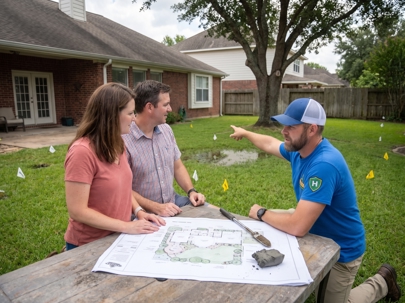
A strong answer describes a thorough walk of the property with the homeowner, followed by an assessment of drainage, grade, soil quality, sun exposure in each area of the yard, and the health of existing plants. On many Bellaire lots, mature oak canopies shape what will grow and where, so a good contractor explains how the design will work with that canopy rather than against it.
The assessment should also reveal how the household wants to use the space. A family with young children, a homeowner who entertains often, and someone who wants low-maintenance beds all need different layouts. If a contractor never asks how the yard will be used, the design will reflect the contractor’s preferences rather than the homeowner’s.
Who Designs It, and Who Builds It?
This follow-up question uncovers one of the most common causes of disappointing results. When one company designs a project and another installs it, details are lost between the drawing and the ground. A grade note is missed, a drain is moved, or a plant substitution changes the look of the whole bed.
A turnkey design-to-installation residential landscape project avoids that gap. The plan integrates turf, planted zones, hardscape, drainage, and irrigation into a single design, with clear phasing if the work will happen in stages. The homeowner reviews the plan and provides feedback, and installation does not begin until everyone is fully aligned. Then the same team that planned the project carries it out. That continuity is what keeps the finished yard faithful to the design.
Question 2: “Who Handles the City Permits?”
Many homeowners never think to ask this, and many contractors never volunteer the answer. Yet permitting is often the first place a project stalls.
City of Bellaire Irrigation Permitting and Watering Restriction Compliance
A residential irrigation installation in Bellaire typically requires a permit, which is managed through the city’s Development Services Department. Statewide, irrigation work must also meet the standards of Texas Administrative Code Chapter 344, and backflow prevention devices fall under the testing and certification requirements of the Texas Commission on Environmental Quality. A qualified contractor should be able to explain who prepares the documentation, who coordinates with the city, and who handles backflow testing, paperwork, and certification submission.
City of Bellaire irrigation permitting and watering restriction compliance also affects design. Bellaire enforces outdoor irrigation restrictions that limit when and how often homeowners can water, which means plant choices, turf selection, and irrigation zoning all need to account for those limits from the beginning. A contractor who designs a thirsty landscape without considering local watering rules is setting the homeowner up for a yard that cannot be kept healthy within the rules.
Question 3: “How Will the Grade Be Corrected?”
On clay soil, grade is the foundation of everything above it. Houston black gumbo clay re-grading for positive foundation runoff diversion reshapes the yard so water moves away from the house rather than toward it. Asking how this will be handled quickly separates experienced contractors from those who plan to lay sod over whatever slope already exists.
A complete answer covers several stages. The existing grade, soil, drainage patterns, and buried infrastructure, such as irrigation lines and older drainage systems, are evaluated first. Target elevations are then planned around drainage goals and the landscaping that will follow. Professional equipment cuts high spots, fills low areas, and contours the surface. Redistributed soil is compacted properly to prevent future settling, and a final inspection confirms that water flows in the intended direction. If a contractor cannot describe how fill soil will be compacted on clay, that is a warning sign, because loosely placed soil tends to sink unevenly and recreate the very low spots the work was meant to fix.
Question 4: “Where Will the Water Go?”
Grading moves water across the surface, but many Bellaire properties also need water carried underground. A contractor should be able to point to the exact spots where water collects today and explain where it will go after the project is complete.
High-Capacity French Drain Contracting and Connected Systems
High-capacity French drain contracting is one of the most effective solutions for yards where water lingers after rain. The details reveal how seriously a contractor takes the work. On clay soil, a properly built French drain uses commercial-grade woven geotextile fabric to keep fine clay particles from clogging the gravel, clean angular crushed stone around the pipe, and perforated pipe sloped so gravity carries water steadily to an outlet. That outlet must sit lower than the collection point and be placed to prevent backflow, whether it is a pop-up emitter, a daylight outlet, or a connection to an existing drainage system.
A capable contractor also explains how the French drain fits into a broader plan. Catch basins collect water from low areas, channel drains intercept runoff along patios and driveways, yard drains handle isolated wet spots, and downspout extensions keep roof water from dumping against the foundation. When these pieces are designed together, the yard handles storms as one system instead of several disconnected fixes.
The Questions That Reveal Long-Term Thinking
The first four questions focus on the groundwork that keeps a landscape stable and dry. The next set reveals whether a contractor is thinking about how the yard will perform years from now, not just how it will look on the day the crew leaves.
Question 5: “How Will the Clay Soil Be Prepared?”
Plants and turf set directly into compacted gumbo clay often struggle, stall, or develop root problems within a season. Deep-till soil structural remediation is the step that gives them a fighting chance. Existing vegetation is removed, the soil is tilled to the appropriate depth, and the surface is graded to eliminate low spots.
The follow-up question matters even more: what goes into the soil, and why? A thoughtful answer explains that amendments are chosen based on the site assessment, targeting compaction, pH imbalance, or nutrient shortages rather than applying the same product everywhere. Heroes Lawn Care of Bellaire uses proprietary soil amendment products developed in-house by an owner with two decades of research-and-development chemistry experience, an unusual level of expertise that allows soil preparation to be matched to local clay rather than borrowed from a generic formula.
Question 6: “What Will Hold the Beds and Slopes in Place?”
Retaining walls and raised planters do structural work, so the answer should go beyond appearance. Custom retaining walls and raised planters matching the home’s style should be engineered to hold soil and water pressure, not simply stacked to look attractive. Natural stone suits a traditional or organic look and works especially well for garden bed borders, concrete block delivers a clean, modern profile with maximum structural strength, and concrete retaining wall systems can be matched to a property’s specific structural needs.
Raised planters are especially valuable on clay. A low wall of 12 to 24 inches creates an elevated planting zone where roots sit above slow-draining native soil, which helps plants that dislike wet conditions thrive. A good contractor explains how the wall will drain, how it will tie into the rest of the landscape, and how its materials will complement the home’s architecture.
Question 7: “How Will the Irrigation Be Zoned?”
Irrigation is often treated as an afterthought, yet it decides how healthy the landscape stays and how efficiently water is used. Hydrozoned drip irrigation installation and smart controller setup is the standard a modern design should meet.
The key idea is that each zone is designed around the plants it serves. Rotary heads suit open lawn areas, fixed spray heads fit tighter beds, and drip irrigation delivers targeted root-zone watering to gardens, shrubs, ornamentals, and trees. Emitter spacing and output rates are chosen to match the plants in each zone, and drip and spray zones can run on a single controller and mainline.
Smart, weather-responsive controllers then adjust or pause watering cycles based on real-time rainfall data and forecasts, which helps the landscape stay healthy within local watering restrictions. Before handoff, sensors should be verified as correctly positioned and actively communicating with the controller. Homeowners with an existing system should also ask whether it can be upgraded to a smart controller rather than replaced entirely.
Question 8: “Can the Outdoor Living Spaces Be Planned Together?”
Many homeowners want more than plants and turf. Patios, outdoor kitchens, pergolas, fire pits, and low-maintenance play areas are all part of modern outdoor living. Outdoor living integration with paver hardscaping, turf conversion, and curated softscapes works best when every element is planned in the same design, so surfaces drain correctly, irrigation avoids hardscape, and plantings frame the spaces people use most.
Paver patios and walkways need properly compacted aggregate bases and edge restraints to stay level on clay. Turf conversion, replacing natural grass with artificial turf, has its own requirements: existing grass and organic material are removed, a compacted crushed aggregate base is installed and graded, and a weed barrier is placed without restricting drainage. Infill is chosen for the intended use, including pet-friendly options that drain quickly and resist odor. Artificial turf performs consistently in shade and under foot traffic, though a good contractor will also point out that turf in full sun can run hotter than natural grass. Curated softscapes then soften the hardscape with plants suited to Houston heat, humidity, and soil, such as salvia, lantana, Esperanza, and ornamental grasses.
Question 9: “What Happens After the Crew Leaves?”
A landscape is a living system, and the months after installation decide whether it settles in or struggles. A trustworthy contractor provides clear care guidance for new sod, plantings, and irrigation, and offers an ongoing maintenance option for homeowners who want continued support.
This is also the moment to confirm credentials. A contractor that applies fertilizers and pest control products should be licensed by the Texas Department of Agriculture, and one that installs irrigation systems should work within the Texas Commission on Environmental Quality framework. Asking for these details takes a few seconds and can prevent serious problems later.
Warning Signs Hidden in the Answers
Sometimes what a contractor does not say is just as revealing as what it does. A proposal that arrives before anyone has walked the property is a design for an imaginary yard. A plan with no mention of grade or drainage assumes Bellaire, TX clay will behave like sandy soil. An irrigation layout with a single type of head across lawn and beds ignores how differently those areas use water. Vague answers about permits, such as “that usually is not a problem,” often mean the homeowner will be the one discovering the requirements later.
Another warning sign is a long list of subcontractors. When grading, drainage, walls, irrigation, and planting are each handed to a different crew, the landscaping contractor becomes a coordinator rather than a builder, and accountability is split across several companies. If something goes wrong, each crew can point to another. Asking who will actually be on site for each stage of the project clears this up quickly.
How a Qualified Contractor Answers Every Question
Comparing landscapers becomes much easier when the answers are laid side by side. The best landscaping contractor for a home in Bellaire, TX is rarely the one with the glossiest drawing; it is the one whose answers are specific, local, and consistent. A qualified contractor will describe a real site assessment, a single integrated plan, and one team responsible from design through installation. It will explain how permits and watering restrictions shape the design, how grade and drainage will be corrected, how clay will be prepared, and how walls, irrigation, and outdoor living spaces will work together.
Heroes Lawn Care of Bellaire builds its landscaping work around exactly these answers. Projects begin with an on-site consultation and a full assessment of drainage, grade, soil, sun exposure, and existing plant health, and most residential designs are delivered within one week of that visit. The same crew that plans the project installs it, guided by a Texas A&M-trained agronomist with 15 years of landscape design experience across the Houston area. Irrigation permitting through the city and backflow paperwork are handled for the homeowner, and the company is licensed by the Texas Department of Agriculture and the Texas Commission on Environmental Quality.
Because Heroes Lawn Care of Bellaire also provides ongoing lawn care services, fertilization, weed control, and disease control, the finished landscape can be cared for by the same team that built it, with products formulated in-house for Gulf Coast conditions. For homeowners comparing options for Bellaire lawn care and landscaping, that continuity is often the deciding factor.
Conclusion: Ask First, Sign Second
A beautiful drawing is easy to produce. A landscape that drains, grows, and holds up on black gumbo clay is not. Before choosing a landscaping contractor in Bellaire, TX, homeowners should ask what happens before the design is drawn, who handles city permits, how the grade and drainage will be corrected, how clay soil will be prepared, what will hold the beds and slopes in place, how the irrigation will be zoned, how outdoor living spaces will be planned, and what support continues after installation.
The answers reveal which companies truly understand local soil, water, and regulations, and which are hoping the yard behaves like every other. Heroes Lawn Care of Bellaire is ready to answer every one of these questions in detail, on site, with a plan built for the property and a team that stays accountable from the first consultation to the final walkthrough.