
Caliche, Deer, and Flash Floods: What Florence, TX Landscaping Has to Solve Before the First Plant Goes In | Heroes Lawn Care of Cedar Park
The plant list is the fun part of any yard. Choosing a tree, picking a color palette, imagining a bed in bloom: that is what most homeowners picture when they think about landscaping. In Florence, TX, the plant list is also the part that comes last. Before anything goes into the ground, three problems have to be dealt with: a layer of hardened caliche that roots cannot penetrate, a deer population that treats most gardens as a buffet, and storms that dump a month of rain in an hour and send it across the property at speed.
Yards that skip those steps tend to repeat the same story. The new trees stall in their holes, the new shrubs are eaten to stubs, and the first heavy storm carves a gully across the lawn. Yards that solve them first tend to look better with less effort, year after year. Heroes Lawn Care of Cedar Park builds Florence properties in that order, and the sections below follow the same sequence: fix the ground, control the water, choose plants that survive the wildlife, and then connect the finished home perimeter to the prairie beyond.
The Three Problems Under Every Florence, TX Yard
Caliche Beneath a Thin Layer of Soil
Much of the land around Florence sits on limestone, and in many places the soil above it is only a few inches deep. Caliche, a layer of calcium carbonate cemented into a hard, chalky crust, often lies just below the surface. It behaves almost like weak concrete. Roots cannot push through it, water pools on top of it or drains through it unevenly, and shovels bounce off it. A hole dug for a tree can turn into a bathtub that drowns the roots after a rain.
Deer Everywhere
Deer are a fact of life across rural Williamson County. They browse at dawn and dusk, they are not shy about approaching a house, and in dry years they will eat plants they normally avoid. A garden planned without deer in mind is a garden planned for them.
Storms That Arrive All at Once
Central Texas rain does not come gently. A summer or spring storm can deliver several inches in a short window, and on open acreage, the water has room to build speed. Compacted ground, bare soil, and slopes turn that rainfall into runoff that cuts channels, undermines edges, and carries soil off the property.
Problem One: Fixing the Ground
Mechanical Rock Ripping and Caliche Subsoil Remediation With Enriched Organic Compost Blending
Caliche cannot be planted into. It has to be broken. Mechanical rock ripping and caliche subsoil remediation with enriched organic compost blending uses heavy equipment, such as a ripper tooth on a tractor or skid steer, to fracture the hardpan in planting areas. The crust is broken to a useful depth, and the rubble is mixed back into the soil above it along with finished compost.
The compost matters as much as the ripping. Caliche-influenced soil is alkaline, low in organic matter, and slow to hold moisture. Blending compost into the broken material improves its texture, feeds the microbial life that supports root growth, and gives plants a place to establish. The treated areas drain better, hold water longer in dry spells, and let roots wander instead of coiling in a hole. For trees, the treated zone is made wide, not just deep, so roots can spread in every direction.
Why the Ground Work Pays Off Later
This step is the least visible part of the project and the most consequential. Plants set into untreated caliche often survive for a season, then decline as their roots hit the wall. Plants set into remediated ground continue to improve through the following years. Extra effort spent choosing better plants cannot make up for a bad foundation.
Problem Two: Controlling the Water
Laser-Guided Slope Grading and Dry Rock Swale Construction for Flash-Storm Stormwater Redirection
Water follows gravity, and a yard that is graded casually sends it wherever the land happens to tilt. Laser-guided slope grading and dry rock swale construction for flash-storm stormwater redirection takes control of that process. Laser-guided equipment sets precise elevations across the property, creating gentle slopes that carry water away from the house, driveway, and planting areas toward safe discharge points.
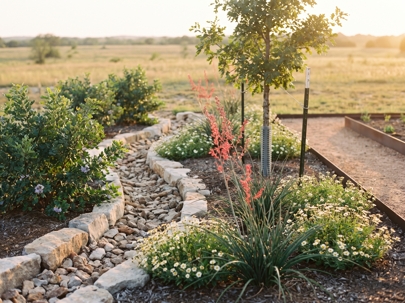
Dry rock swales are the workhorse of this approach. A swale is a shallow, shaped channel lined with stone, and it stays dry most of the time, filling only during storms. The stone slows the flow, prevents erosion, and lets water soak in along its path. Swales are sized to the area they drain, and their slopes are set to keep water moving without letting it gain destructive speed. On a Florence property, they often run along the contour of a slope or at the edge of a patio, where they look like a natural creek bed and function as a drainage system.
Reading the Land Before Shaping It
Heroes Lawn Care of Cedar Park starts every Florence project with a site walk that follows the water, marking where it enters the property, where it slows, and where it leaves. That map becomes the grading plan, and it keeps swales and slopes honest to what the land actually does during a storm.
Good grading begins with observation. Walking the property after a heavy rain shows where water actually travels, where it pools, and where it cuts. Those paths become the starting point for the design. A swale placed where the land already wants to carry water works with natural flow, while one forced across the slope fights it and tends to fail.
Problem Three: Plants That Survive the Wildlife
Deer-Resistant Hill Country Native Plant Selection Featuring Texas Mountain Laurel, Red Yucca, and Blackfoot Daisy
No plant is deer-proof, but many are deer-resistant. Deer-resistant Hill Country native plant selection featuring Texas mountain laurel, red yucca, and blackfoot daisy builds a planting around species that deer tend to avoid. Texas mountain laurel is an evergreen shrub with glossy, leathery leaves, purple spring blooms that smell of grape, and seeds that are toxic to browsers. Red yucca sends up tall coral flower stalks above a clump of stiff, spiky leaves that deer rarely touch. Blackfoot daisy forms a low mound of gray-green foliage covered with small white flowers nearly year-round, and it thrives in the thin, rocky, alkaline soil that challenges many other plants.
These natives share useful traits: tough foliage, strong scents or spines, and adaptation to local rainfall and soil. They need little supplemental water once established, and they tolerate heat that cooks many imported plants. Mixing them in groups creates a layered design with texture and seasonal color that looks deliberate. During drought, when deer become less choosy, placing the most vulnerable plants closer to the house and using temporary protection while new plants establish improves results.
Protecting What Deer Like
Layout can do some of the protecting. Placing fragrant, spiky, or fuzzy plants along the outer edge of a bed creates a deterrent border around more tempting plants inside it. Planting in drifts rather than single specimens also helps, since a large mass of resistant plants discourages casual browsing. Fencing a small courtyard garden or a vegetable bed with a tall, sturdy barrier handles the highest-value plantings.
Some plants worth growing are on the deer menu. Young trees are particularly at risk, since bucks rub their antlers on trunks in the fall and can strip the bark in a night. Protection is simple and effective when done early, as the next section explains.
Building the Framework of Shade
Specimen Shade Tree Planting (Bur Oak, Cedar Elm, Texas Red Oak) With Structural Staking and Trunk Deer-Guard Protection
Trees are the permanent architecture of a landscape, and in Florence they are also a defense against the Texas sun. Specimen shade tree planting (Bur Oak, Cedar Elm, Texas Red Oak) with structural staking and trunk deer-guard protection places strong native trees where they will shade the house, frame the view, and anchor the planting beds. Bur oak is a long-lived, massive tree that handles limestone and drought. Cedar elm is a tough, fast-establishing choice with small leaves and good fall color. Texas red oak offers a graceful canopy and brilliant autumn foliage.
Planting technique matters more than the species. The hole is wide and shallow, set in remediated ground, with the root flare at or slightly above the surrounding grade. Staking holds the tree steady in wind while its roots establish, and the ties are kept loose enough that the trunk can flex and build strength. A trunk guard, a rigid sleeve or a cage of wire, protects the bark from antler rubbing and browsing during the first years. Stakes and guards are adjusted as the tree grows and removed when they are no longer needed.
Bridging the House and the Prairie
Acreage Homestead Transition Landscaping Bridging Manicured Home Perimeters With Native Hill Country Prairie
Many Florence homes sit on large lots where the yard simply stops and open land begins. Acreage homestead transition landscaping bridging manicured home perimeters with native Hill Country prairie fills the space between them. The idea is to move gradually from the formality of beds and turf near the house to the looseness of native grasses and wildflowers farther out, so the property reads as one design instead of two.
Near the house, the planting is structured: defined beds, trimmed turf, and foundation plantings. Moving outward, the planting loosens into groupings of native shrubs and grasses, then into meadow that merges with the surrounding prairie. Paths, stone accents, and tree groupings guide the eye across the transition. The approach also supports fire safety, since clear, well-maintained zones near the home give way to lower-fuel, spaced plantings farther out.
Drought-Tolerant Tifway 419 Bermuda and Palisades Zoysia Certified Sod Installation and Establishment
Turf has a place near the house, where play, pets, and entertaining happen. Drought-tolerant Tifway 419 Bermuda and Palisades Zoysia certified sod installation and establishment offers two dependable choices. Tifway 419 Bermuda is a hybrid that grows densely, handles full sun and heavy wear, and recovers quickly from damage. Palisades Zoysia is a softer, finer grass that tolerates some shade, uses less water, and forms a thick, attractive carpet.
Certified sod is grown under quality controls to ensure variety purity, and it arrives uniform and free of weeds. Installation begins with prepared, graded soil, ideally improved with compost. The sod is laid in tight, staggered rows, rolled for firm contact, and watered immediately. Establishment takes several weeks, during which the sod needs consistent moisture until roots knit into the soil. Right-sizing the turf area keeps maintenance manageable and leaves more room for the native plantings that suit the property.
Details That Hold It Together
Heavy-Duty 14-Gauge Commercial Steel Landscape Bed Edging Installation for Clean Hardscape Separation
Edges define a landscape, and thin plastic edging tends to heave and fade. Heavy-duty 14-gauge commercial steel landscape bed edging installation for clean hardscape separation creates a crisp, durable line between turf, beds, and paths. Steel strips are driven into the ground and joined, forming a continuous barrier that holds mulch and soil in the bed and keeps turf from creeping in.
The profile stays low, with only a thin line of metal visible. Curves are formed smoothly, and stakes lock the edging into the ground. The finished edge looks tailored, resists roots and heat, and survives the freeze and thaw cycles that disturb weaker materials. Because it separates cleanly from paths and stone, it also keeps the maintenance of each area simple.
Compacted Decomposed Granite Pathway Integration Paired With Aromatic Double-Shredded Texas Cedar Mulch
Paths invite people through the yard, and their surfaces affect how the whole landscape feels. Compacted decomposed granite pathway integration paired with aromatic double-shredded Texas cedar mulch combines two natural materials. Decomposed granite is laid in thin layers, compacted firmly, and edged to hold it in place. It makes a smooth, warm-toned surface that drains well and blends with the local stone.
Cedar mulch fills the adjacent beds. Double-shredded, it knits together and stays put on slopes and during rain. It insulates roots, slows evaporation, and suppresses weeds, and its natural aroma is a pleasant bonus. Applied at a consistent depth and kept clear of trunks and stems, it protects the soil through the heat of summer and the occasional freeze.
Hand-Dressed Native Edwards Plateau Limestone Boulder Accents and Dry-Stack Garden Border Masonry
Stone belongs in a Florence landscape because the land is made of it. Hand-dressed native Edwards Plateau limestone boulder accents and dry-stack garden border masonry bring that character into the design. Boulders are set partway into the ground so they look like natural outcrops, and they anchor bed corners, mark path turns, and slow runoff. Dry-stacked borders, built without mortar, create low walls that frame beds and define planting levels.
Hand dressing, the shaping of the stone's face with hand tools, gives each piece a refined edge while keeping its natural character. Dry-stack construction allows water to drain through the wall, avoiding the pressure that can build behind mortared structures. The stone also supports the water-wise approach, since it covers ground that would otherwise need watering.
Watering What Is Planted
Water-Wise Subsurface Drip Irrigation Conversion With Pressure-Compensating Emitters for Native Ornamental Beds
Even drought-tolerant plants need help while they establish. Water-wise subsurface drip irrigation conversion with pressure-compensating emitters for native ornamental beds replaces overhead sprays with tubing that delivers water directly to the roots. Pressure-compensating emitters release the same amount of water along the entire line, even across slopes and long runs.
The tubing is buried or covered with mulch, which protects it and keeps water from evaporating. Beds receive slow, deep watering, which encourages deep roots, and weeds get less moisture. After the first year or two, many native plants can be weaned off supplemental water, with the system retained for dry periods and new additions. Separate zones for beds, trees, and turf let each be watered according to its needs.
Putting the Work in Order
A Practical Sequence
The order of work follows the logic of the problems. Survey and planning come first, including observation of water flow. Ground remediation and grading come next, along with swales and drainage. Irrigation lines go in before planting. Trees, shrubs, and beds follow, with stakes and guards on the trees. Turf is installed in the prepared areas. Edging, paths, and stone are set, and mulch finishes the beds. Heroes Lawn Care of Cedar Park schedules each phase so completed work is not disturbed by the next.
Seasonal Timing
Storm season shapes the calendar as well. Completing swales and slope work before the wettest months lets the stone settle and vegetation take hold along the banks, so the first big rain meets a finished system and not a construction site.
Timing matters in Florence, TX. Fall is the best season for planting trees and shrubs, since cool air and warm soil favor root growth. Spring suits warm-season sod, once soil temperatures rise. Summer is the time for maintaining and observing, and grading and swale work are best done in dry stretches when the ground can be shaped cleanly.
Keeping the Landscape Healthy
The First Two Years
New plantings need attention until they are established. Water consistently, check trunk guards and stakes, refresh mulch, and watch for erosion after storms. Small repairs early prevent larger ones later. A lawn care service familiar with the property can handle turf care and seasonal cleanup while respecting the new plantings and structures.
Long-Term Stewardship
After establishment, a native landscape asks for far less than a conventional one. Annual cutbacks of grasses, occasional pruning, mulch top-ups, and periodic checks of drainage features keep everything in order. The reward is a property that gets better with age, looks right in the setting, and handles drought, deer, and storms with little fuss.
Solving It First Pays Off
The most beautiful landscapes in Florence, TX are the ones that began with the least glamorous work. Broken caliche, shaped slopes, and stone-lined swales do not photograph well, but they determine whether the shade trees thrive, whether the beds survive the deer, and whether the first big storm leaves the yard intact.
For property owners across Florence, TX ready to build that way, Heroes Lawn Care of Cedar Park delivers landscaping that solves the ground, the water, and the wildlife first, and then plants with confidence. The best place to start is a walk across the property after a rain, to see where the water goes and where the ground fights back.