
December, January, February: The Month-by-Month Winter Yard Maintenance Plan for Houston, TX Homes | Heroes Lawn Care of Bellaire
Why Houston Yards Need a Winter Plan
Winter in Houston rarely looks like winter anywhere else. There may be a week of crisp mornings, then a stretch of shorts weather, then a sudden cold front that sends everyone scrambling to cover pipes. Rain can soak the ground for days at a time, and the lawn sits somewhere between green and gold, neither fully growing nor fully asleep. With so much variation, it is easy to assume the yard can simply be left alone until spring.
That assumption usually creates more work later. Mild winters allow weeds and fungal diseases to stay active, heavy rains test every drain on the property, and the occasional hard freeze can crack an unprepared irrigation system overnight. At the same time, several of the most important tasks of the year, such as pruning live oaks safely, can only be done during these months. A clear yard maintenance plan for Houston, TX homes turns winter into a productive season by assigning each job to the month when it matters most.
This guide breaks the season into three parts: December for preparing against cold and rain, January for protecting the property and preventing spring problems, and February for building the bridge to spring.
What Makes a Houston Winter Unique
Three characteristics shape every recommendation in this plan. The first is mildness. Freezes in the Houston area are usually brief, which means cool-season weeds, fungi, and even mosquitoes never fully shut down. The second is rain. Winter fronts often bring steady, soaking rainfall that saturates slow-draining gumbo clay and exposes every weak point in a property’s drainage. The third is unpredictability. Most winters pass with only a few light freezes, but severe events do happen, as many residents remember from the winter storm of February 2021. A good yard maintenance plan for Houston, TX prepares for the ordinary season while staying ready for the extraordinary one.
December: Prepare for Cold and Rain
December is about getting the property ready before the coldest weather and heaviest winter rains arrive. The tasks this month protect systems and plantings that take real time and effort to replace.
Irrigation System Winterization Inspections
An irrigation system left full of water is vulnerable to the first hard freeze. Winterization should happen as temperatures begin to drop rather than after a freeze is already in the forecast. The process starts with a detailed inspection to identify vulnerabilities in the system, followed by blowing out and draining water from the lines with air compressors so nothing remains inside to freeze and crack pipes or fittings. Removable parts such as hoses and faucets are disconnected and stored, and irrigation heads and nozzles are evaluated for alignment and function so the system is ready to perform in spring.
Because dormant and semi-dormant lawns need far less water, a winterized system rarely harms the landscape. During unusually dry stretches, beds and newly planted areas can be watered by hand.
Clearing Drains, Basins, and Swales Before Winter Storms
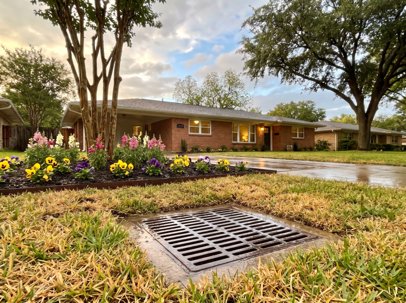
By December, leaves from oaks and other trees are falling steadily across Houston yards, and they collect wherever water is meant to flow. Subsurface French drain, catch basin, and surface swale clearing ahead of heavy winter rainstorms keeps those systems working. Catch basin grates should be inspected and cleared of debris at least twice a year, and early winter is one of the most important times to do it. French drain inlets and pop-up emitters should be checked to make sure they are not buried or blocked, and dry creek swales should be clear of debris that could slow or redirect water.
Inside a catch basin, sediment gradually settles into the sump. When that sediment reaches the outlet pipe, the basin loses capacity and needs cleaning, typically every two to five years depending on how much soil and debris the property sheds. A basin that has quietly filled with sediment may look fine from above but fail during the first heavy storm.
Refreshing Mulch Over Root Zones
A fresh layer of mulch is one of the simplest ways to prepare beds for winter. Insulating mulch topdressing moderates soil temperature, helping buffer root zones during sudden cold snaps, while also retaining moisture and reducing weed pressure. Mulch should be spread evenly around plants rather than piled against stems or trunks, and it should never bury the base of a tree. Refreshing thin or decomposed areas in December keeps beds protected through the coldest weeks of the year.
Caring for Cool-Season Color Beds
Pansies and snapdragons planted in fall bring color to Houston yards through the winter months, but they still need attention. Cool-season winter color bed maintenance includes weeding, refreshing mulch, and monitoring plant health so that problems such as poor drainage or disease are caught early. Beds that stay soggy after heavy rain may need adjustments before root problems develop. With consistent care, cool-season annuals continue blooming until warm-season plants such as vinca, begonia, and pentas take their place in late spring.
January: Protect, Prune, and Prevent
January is typically the coldest month in Houston, and it is also the last month for several time-sensitive tasks. The focus shifts to protecting trees and turf and preventing problems that would otherwise surface in spring.
The Final Weeks of the Oak Pruning Window
Oak wilt is a serious fungal disease in Texas that spreads through fresh pruning wounds during its high-risk period, which runs roughly from February through June. Dormant-season live oak and hardwood structural pruning timed within the safe oak wilt window must therefore be completed between late fall and January. Any pruning still needed on live oaks should be scheduled early in the month.
Winter pruning also gives crews a clear view of each tree’s structure. Removing dead limbs, thinning dense sections that create wind resistance, and correcting crossing or rubbing branches improve both the health and appearance of the tree before spring growth. Professional tree pruning and trimming in this service covers trees up to ten feet in height, and larger trees that need high-canopy work are best referred to a licensed arborist.
Winter Weed Suppression
While St. Augustine rests, cool-season weeds take advantage. Winter broadleaf and grassy weed suppression targeting Poa annua, henbit, and common chickweed keeps them from spreading through the lawn. Poa annua, also called annual bluegrass, forms light-green clumps that produce white seedheads in late winter and early spring. Henbit is a winter annual broadleaf with square stems and small purple flowers, and chickweed forms low mats in moist, shaded areas.
The fall pre-emergent barrier, typically applied from late August through mid-September, stops many of these weeds before they sprout. For those that slip through, targeted post-emergent treatments in January help stop them before they flower and drop seed for next year. Treating them now means a cleaner lawn when spring green-up begins.
Watching for Fungal Disease on Damp, Shaded Lawns
Cool, wet weather and shaded turf create conditions where fungal problems can persist. Cool-weather fungal monitoring for brown patch, caused by the Rhizoctonia fungus, across damp, shaded gumbo clay lawns helps catch outbreaks while they are still small. Circular or irregular patches with darker, smoky edges are a common warning sign. A fall preventive fungicide application provides protection for lawns that had disease activity earlier in the year, and continued observation through January allows a quick response if an outbreak appears.
Overwatering makes disease more likely. Irrigation that runs on summer schedules in January keeps clay saturated and turf wet for long periods, exactly the conditions fungi need.
Letting the Lawn Rest
January is not the month to feed the lawn. St. Augustine absorbs very little fertilizer while dormant, and nitrogen applied now mainly feeds winter weeds and encourages brown patch. Seasonal fertilization programs finish with a potassium-focused fall application and resume in early spring, when the grass can actually use the nutrients. A homeowner tip for January: thick layers of fallen leaves should not be allowed to mat on the lawn for weeks, since they block light and hold moisture against dormant turf.
February: Building the Bridge to Spring
February often brings the first hints of spring in Houston, with warm afternoons and buds forming on early plants. It is also a month of transitions, when the rules for several tasks change and preparations for the growing season begin.
The Oak Wilt Cutoff
As February begins, the oak wilt high-risk period starts. Live oaks should not be pruned from roughly February through June, because fresh wounds can allow the disease to spread. Any oak pruning that did not happen by the end of January should generally wait until late fall, unless a tree poses an immediate hazard. Planning ahead in December and January is what keeps this deadline from becoming a problem.
Late-Winter Crepe Myrtle Canopy Thinning
Crepe myrtles are among the most commonly mistreated ornamental trees in the Houston area. Severe topping, where every branch is cut back to the same height each year, weakens the tree and produces clusters of weak shoots. Late winter, while the trees are dormant and their structure is easy to see, is the time for a better approach. Corrective canopy thinning removes interior branches that cross, rub, or crowd the center of the tree, improving airflow and light while preserving its natural shape. Removing no more than about 25 percent of the canopy in a single session protects the tree from stress, and cleaning tools between trees helps prevent the spread of disease.
Timing the Spring Pre-Emergent
February sets up the year’s weed control. The spring pre-emergent barrier stops summer weeds such as crabgrass before they germinate, and in the Houston area it typically goes down from late February into early March. Timing is guided by soil temperature rather than a fixed date, since a warm winter can start germination earlier and a cool one can delay it. Getting this application right in February prevents months of weed problems later.
Checking Drainage and Irrigation Before Spring
Late winter is the time to review how the property handled the season’s rains. Low spots that held water, beds that stayed soggy, and areas where runoff reached the foundation all point to drainage improvements that can be made before spring planting and the next storm season. French drains, catch basins, yard drains, downspout extensions, and regrading are all easier to install while the lawn is still dormant.
A simple habit makes this review far more useful: taking a few photos of the yard during or just after each heavy winter rain. Pictures of standing water, overflowing gutters, or runoff crossing a walkway capture problems that disappear within hours once the sun returns. Shared during a drainage consultation, those images show exactly where water collects and how it moves, which leads to more precise solutions and fewer surprises when the spring storm season begins.
The irrigation system also needs attention before warm weather arrives. A system that was properly winterized should be ready to return to service, but heads, nozzles, and coverage should be checked as it comes back online so that spring watering is efficient and even.
Planning the Spring Program
February is the month to finalize plans for the growing season. Most lawns benefit from three to four fertilization applications across spring, summer, and fall, with the program typically beginning by early March as turf emerges from dormancy. A warm February weekend can make the lawn look ready early, but waiting for genuine green-up keeps the first application working for the grass rather than the weeds. Core aeration, which opens compacted clay so water and nutrients reach the roots, can be scheduled for later in the season when the lawn is actively growing.
For homeowners considering larger changes, February is also an ideal time for a landscape design consultation. Most residential designs can be delivered within about a week of the site visit, leaving time to review the plan and schedule installation before the spring rush.
How to Tell the Winter Plan Is Working
A successful winter rarely announces itself. Its results show up quietly as the season turns. Drains that were cleared in December carry January storms off the property without leaving puddles against the foundation. The irrigation system comes back online in late winter without cracked fittings or leaking heads. Live oaks pruned during the safe window head into spring with clean, well-structured canopies and no exposure to oak wilt.
The lawn tells the rest of the story. Turf that was not pushed with nitrogen during dormancy emerges evenly, with few winter weeds competing for space and no lingering brown patch rings. Pansy and snapdragon beds stay healthy through the cold months, and mulch keeps soil moist and weeds down until the spring color change. When February ends and the first warm days arrive, a property that followed a structured yard maintenance plan is ready to grow, while a neglected one is still catching up. Those differences are the clearest measure of a winter well spent.
Why One Team Makes Winter Maintenance Simple
A month-by-month winter plan involves irrigation, drainage, tree care, weed control, disease monitoring, bed maintenance, and spring planning. Coordinating separate specialists for each task is where important windows get missed. Searching for “best lawn service near me” often turns up companies that handle only one piece of the puzzle. Heroes Lawn Care of Bellaire brings these services together under one program, so every task happens in the right month.
The company provides irrigation winterization, drainage solutions, tree pruning for trees up to ten feet, weed and disease control, seasonal bed maintenance, and complete lawn care services. Roughly 90 percent of the fertilization, weed, insect, and fungal products Heroes Lawn Care of Bellaire applies were developed and registered in-house by an owner with two decades of research-and-development chemistry experience. Programs are guided by a Texas A&M-trained agronomist with 15 years of experience across the Houston area, and the company is licensed by the Texas Department of Agriculture and the Texas Commission on Environmental Quality.
For homeowners in Houston, TX, especially in the neighborhoods near Bellaire, that means a single team can handle the entire winter calendar, from the first December inspection to the final February preparations. Heroes Lawn Care of Bellaire makes sure the yard enters spring ready to grow.
Conclusion: Three Months, One Strong Start to Spring
Winter in Houston is short, mild, and unpredictable, which makes timing everything. Effective yard maintenance in Houston, TX follows the calendar. December prepares the property with irrigation winterization, drain and swale clearing, fresh mulch, and care for cool-season color beds. January protects and prevents, finishing live oak pruning within the safe window, suppressing winter weeds, monitoring for brown patch, and letting the dormant lawn rest. February builds the bridge to spring with the oak wilt cutoff, crepe myrtle thinning, spring pre-emergent timing, drainage and irrigation checks, and a finished plan for the growing season.
Handled month by month, those tasks keep the yard protected through the coldest weeks and ready to thrive as soon as warm weather returns. Heroes Lawn Care of Bellaire offers the expertise and the complete range of services to carry out the plan from start to finish.