
The Mosquito That Destroys Its Own Nursery: How In2Care Service Protects Bellaire, TX Yards From the Inside Out | Heroes Lawn Care of Bellaire
Every summer evening tells the same story across Bellaire. The grill is lit, the kids are out on the lawn, and within minutes everyone is slapping at ankles and retreating indoors. Many homeowners respond by spraying, burning citronella, or hanging traps, only to find the bites returning a few days later. The problem is not a lack of effort. It is that most mosquito treatments attack the insects that are already flying while ignoring the far larger population developing in water that nobody can see.
A different approach has been gaining ground in neighborhoods along Brays Bayou, and it works by flipping the mosquito's own instincts against it. In2Care service uses the female mosquito as the delivery system, sending her out to treat the hidden breeding spots that sprays and handheld treatments never reach. Instead of fighting each new wave of biters, the system targets the next generation before it ever takes flight. For families in Bellaire, TX, where heat, humidity, and heavy rainfall create near-perfect breeding conditions for much of the year, that shift from reaction to prevention changes everything about how the backyard can be used.
Understanding why this works requires a closer look at the mosquitoes themselves, where they breed, and the surprisingly elegant biology that turns a single station into a neighborhood-scale defense.
The Container Breeders Living Closest to Bellaire Families
Not all mosquitoes behave the same way. The species most responsible for daytime and early-evening bites around Houston homes belong to the Aedes genus, especially the Asian tiger mosquito and the yellow fever mosquito. Both are container breeders. Rather than laying eggs in large ponds or marshes, they seek out small pockets of water close to where people live: a forgotten bucket, a clogged gutter, the saucer under a potted plant. They rarely travel far from where they hatch, which means the mosquitoes biting in a backyard were very likely born within a few hundred feet of it.
That behavior is exactly what makes Aedes container-breeding mosquito biological suppression so effective when it is done right. Because these mosquitoes stay close to home and rely on small, scattered water sources, a treatment that follows them to those sources can collapse the local population far more efficiently than one that only targets adults in the air. It is also why area-wide truck spraying, which drifts through streets at night, often does little against a species that is most active in shaded yards during the day.
The Hidden Water No One Can Find
Walk any Bellaire property after a storm and the obvious puddles are easy to spot. The real problem lies in the places that never get noticed. These cryptic breeding sites include the low spot inside a gutter that never fully drains, corrugated downspout extensions that hold water in their ridges, tree holes in mature live oaks, the inside of a folded tarp, the hollow base of a patio umbrella stand, decorative pots, drain grates, and even bottle caps tossed in a flowerbed. A female mosquito needs only a tablespoon of standing water to lay a batch of eggs.
Bellaire's conditions multiply these sites. Dense clay soil drains slowly, lush landscaping creates shaded moisture pockets, and frequent Gulf Coast downpours refill containers almost as fast as homeowners can empty them. Even the most diligent dump-and-drain routine misses dozens of tiny reservoirs. That is the blind spot traditional treatments cannot solve, and it is the exact gap the In2Care approach was designed to close.
How the Station Turns a Mosquito Into the Treatment
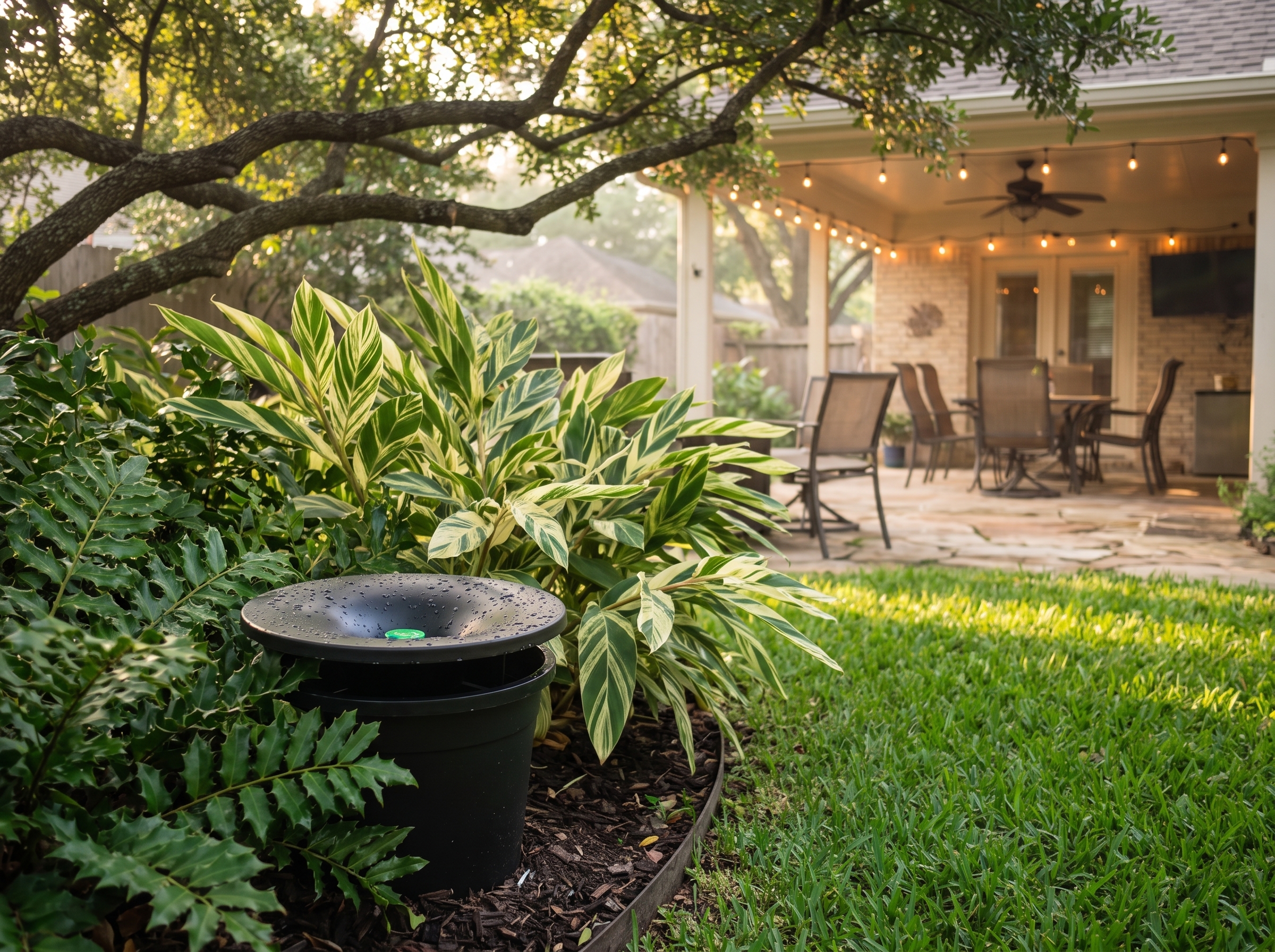
At first glance, an In2Care mosquito station looks like a simple dark container sitting quietly in a garden bed. Inside, it is a carefully engineered environment that mimics the perfect breeding site, then quietly arms every mosquito that visits.
Step One: The Irresistible Lure
The station holds water treated with an odor attractant designed to signal "ideal nursery" to egg-laying females. A floating platform covered with special gauze sits on the water surface, giving the mosquito a stable place to land while she inspects the site and begins laying eggs. To a female Aedes searching for somewhere to lay, the station looks and smells more appealing than almost anything else in the yard.
Step Two: The Pickup — Beauveria Bassiana and IGR Action
The gauze is coated with two active ingredients in a fine powder that clings to the mosquito's legs and body on contact. The first is pyriproxyfen, an insect growth regulator, or IGR. It does not kill adults; instead, it prevents mosquito larvae from developing into biting adults. The second is Beauveria bassiana, a naturally occurring fungus found in soils around the world. Beauveria bassiana fungus and insect growth regulator (IGR) action work on two different targets at once: the IGR stops the next generation, while the fungus infects the visiting adult.
Once the fungal spores attach, they begin penetrating the mosquito's outer skin. Over the following days, the infection reduces her activity and feeding, interferes with her ability to develop and transmit viruses, and eventually kills her. During that window, however, she remains active enough to do one more very important job.
Step Three: Carrying the Treatment to Hidden Water
Female Aedes mosquitoes practice what scientists call skip oviposition. Rather than laying all their eggs in one place, they spread them across several water sources to improve the odds that some survive. That survival strategy becomes the system's greatest strength. Each time a contaminated female lands on a new water source to lay more eggs, tiny amounts of the growth regulator transfer from her body into the water.
This process, known as autodissemination, accomplishes something no technician can do on foot. Larvicide transfer to cryptic standing water breeding sites happens automatically, carried by the very insect that knows where those sites are. The clogged gutter, the forgotten tarp, and the tree hole twenty feet up a live oak all receive a dose of the growth regulator, and any larvae developing there, including those laid by other mosquitoes, fail to reach adulthood.
Step Four: Two Generations Stopped by One Station
Inside the station itself, eggs laid by visiting females hatch into larvae that never survive to emerge as adults. The living larvae even release scents that attract more females to the station, creating a self-reinforcing cycle. The outcome is a two-front attack: adults that visit the station are weakened and eliminated by the fungus, while their offspring, both inside the station and at every hidden site they visit, are stopped before they can bite. Over successive weeks, the local mosquito population steadily collapses from within.
What In2Care Service Looks Like in a Bellaire Yard
The biology is impressive, but results depend on how the system is deployed and maintained. A well-run program treats each property as a unique map of shade, moisture, and family activity, then keeps every station working at full strength throughout the season.
Strategic Station Placement and Concealment
Autodissemination mosquito trap placement and maintenance begins with a careful walk of the property. Mosquitoes rest and lay eggs in cool, sheltered places, so stations perform best out of direct sunlight and protected from wind, typically in dense foliage near areas where the family gathers in the late afternoon and evening. Each station covers roughly 4,300 square feet, so a typical Bellaire lot may need one or more stations depending on its size, layout, and how much landscaping surrounds the outdoor living areas.
Placement also considers appearance. Shaded landscape bed and patio perimeter trap concealment keeps stations working without becoming an eyesore. A station tucked behind a row of shrubs, nestled among ferns under a live oak, or set at the back edge of a planting bed near the patio remains nearly invisible to guests while sitting exactly where mosquitoes travel. Bases are typically set slightly into the ground so stations cannot tip over in storms or be knocked around by pets, and the units require no electricity, chemicals sprayed into the air, or noisy equipment.
Monthly Servicing in a Subtropical Gulf Coast Climate
A mosquito station is only as effective as its last service visit. Monthly bio-active sachet refill and water replenishment keeps the lure attractive and the active ingredients fresh. During each visit, the technician replaces the refill sachet, which contains the treated gauze, the bio-active ingredients, and the attractant tablets, refreshes the water, and inspects the station for damage, debris, or shifting.
Subtropical Gulf Coast yard mosquito station servicing also has to account for local weather. Heavy rain can dilute or overflow water, extreme heat accelerates evaporation, and falling leaves from oaks can clog openings. Monthly visits are an opportunity to adjust placements as the landscape grows, relocate stations that are not receiving visits, and point out new standing-water problems that homeowners can easily fix. In Bellaire, TX, where mosquito activity can begin early in spring and extend well into fall, consistent servicing through the full season is what turns early results into lasting control.
A Non-Spray Option Built for Families, Pets, and Pollinators
Many homeowners hesitate to schedule mosquito treatments because of concerns about children playing on the lawn, dogs rolling in the grass, or bees visiting the garden. A non-spray green mosquito vector control system addresses those concerns directly. Nothing is fogged across the yard, and nothing drifts onto vegetable gardens, swimming pools, or neighboring properties.
The active ingredients are used in tiny quantities and stay contained within the station until a mosquito carries a trace amount away. Beauveria bassiana is specific to insects and does not infect people or domestic animals, and pyriproxyfen has very low toxicity to mammals; the same type of growth regulator appears in some common pet flea-control products. Because the station is designed specifically to attract egg-laying mosquitoes, butterflies, bees, and other beneficial insects are not readily drawn inside. For households looking for eco-friendly pet- and pollinator-safe mosquito abatement, the system offers a level of precision that broadcast treatments simply cannot match. Many families also choose it alongside regular lawn care, knowing their yard is being protected without adding another spray to the routine.
Managing West Nile and Dengue Risk at Home
Mosquito control is about more than comfort. Health officials in the Houston area monitor mosquitoes closely each year because local species can carry serious diseases. West Nile virus is detected in area mosquito samples during most warm seasons, and dengue fever, spread mainly by the yellow fever mosquito, has appeared in Texas in recent years. Other viruses carried by Aedes mosquitoes, such as Zika and chikungunya, remain a concern for travelers returning home.
West Nile and Dengue fever residential vector management works best when several layers combine. The station's strongest effect is on Aedes species, which are the primary carriers of dengue and are also capable of transmitting West Nile virus. The fungus adds another layer of protection by interfering with virus development inside infected mosquitoes. Pairing stations with simple habits, such as emptying containers weekly, keeping gutters clear, and correcting areas where water pools after rain, reduces breeding opportunities for every species, including the Culex mosquitoes most associated with West Nile. Homeowners should still follow public health guidance, use repellent during peak activity, and consult a doctor if mosquito-borne illness is suspected.
What to Expect Through the Season
Because the system targets the next generation rather than only the adults already flying, results build over time instead of appearing overnight. In the first few weeks after installation, stations begin attracting egg-laying females and the growth regulator starts spreading to nearby water sources. As each breeding cycle is interrupted, fewer new adults emerge, and homeowners typically notice a gradual but steady drop in biting pressure during late-afternoon and evening hours.
Timing matters in a climate where mosquitoes can stay active most of the year. Installing stations in early spring, before populations explode with warming temperatures and seasonal rains, gives the system a head start. Stations installed mid-season still help, but they begin by working against a population that has already multiplied. For that reason, Heroes Lawn Care of Bellaire recommends planning service before the first warm stretch of the year and maintaining it continuously through the fall, when mild temperatures and lingering moisture can keep mosquitoes biting longer than many residents expect.
Simple Habits That Multiply the Results
Homeowners can strengthen the program between visits with a few easy routines. Tipping out plant saucers, pet bowls, and toys once a week removes the most obvious water. Keeping gutters clean and downspout extensions straight prevents hidden pools along the roofline. Covering or storing tarps, recycling bins, and wheelbarrows upside down eliminates surprise reservoirs after a storm. Refreshing birdbath water every few days keeps it from becoming a nursery, and trimming dense, overgrown shrubs near patios reduces the cool resting spots adult mosquitoes seek during the hottest part of the day.
None of these habits replaces the station, because no routine can reach every hidden site. Together, though, they shrink the number of places mosquitoes can breed, which means each station spends its energy on the sites that truly matter. It is the same principle that guides a healthy lawn: steady, consistent care produces far better results than an occasional emergency fix.
Why Local Expertise Makes the System Work
Mosquito stations are only one part of a healthy outdoor environment. Many lawn care pest control programs rely on monthly barrier spraying alone, which knocks down adults for a short time but leaves the hidden breeding sites untouched. Effective Bellaire pest control looks at the whole property: where water collects, how landscape beds are shaded, which drainage issues create recurring puddles, and when local weather patterns will drive the next population surge.
Heroes Lawn Care of Bellaire brings that full-property perspective to every In2Care service plan. The company's ownership includes two decades of research-and-development chemistry in lawn and insect products, and its landscape work is guided by a Texas A&M-trained agronomist with 15 years of experience designing outdoor spaces across the Houston area. That combination means station placement is planned with the same care as the landscaping around it, and drainage or standing-water problems spotted during a mosquito visit can be addressed by the same team that maintains the lawn.
For families who want to reclaim their evenings outdoors, Heroes Lawn Care of Bellaire also offers the convenience of a single provider for lawn care services, landscaping, fertilization, and mosquito control. Licensed by the Texas Department of Agriculture and the Texas Commission on Environmental Quality, its technicians understand both the biology of the pests and the regulations that govern how they are managed in Bellaire, TX.
Conclusion: Letting the Mosquito Do the Work
Traditional mosquito control asks people to find and treat every drop of standing water on a property, an impossible task in a humid, rain-soaked climate. In2Care service changes the equation by recruiting the mosquito herself. Drawn to a carefully engineered station, the female picks up a growth regulator and a natural fungus, carries the growth regulator to the hidden breeding sites she alone can find, and stops the next generation in its tracks while the fungus quietly removes her from the population.
In a city like Bellaire, TX, with its mature trees, shaded beds, slow-draining clay, and frequent rain, that inside-out approach offers lasting relief without fogging the yard. Strategic placement, careful concealment, and consistent monthly servicing are what turn the science into results. Heroes Lawn Care of Bellaire combines all three with deep local knowledge of lawns, landscapes, and drainage, giving families a safer, quieter, and more effective way to take back their backyards this season and every season after.